State birds
What is the Wisconsin state bird?
The Wisconsin state bird is the American Robin. Wisconsin schoolchildren chose it in 1926–27, giving it twice as many votes as any other bird, and the Legislature made it law in 1949, in Chapter 218 of that year's laws, approved on June 4.
Updated
How did Wisconsin's schoolchildren choose the robin?
In the 1926–27 school year the state Federation of Women's Clubs sponsored bird studies in Wisconsin's public schools, and the children voted. They “chose the familiar robin (Turdus migratorius) 2-to-1 over the nearest competitor,” say the state's Wisconsin For Kids pages, and the Wisconsin Blue Book says the robin “received twice as many votes as those given any other bird.”
The state's pages add that the robin earned the title “partly because it is one of the five most abundant summer residents found in Wisconsin.”
When did the robin become Wisconsin's state bird by law?
In 1949, about 22 years after the vote. Assembly Bill 126 became Chapter 218 of the Laws of 1949, an act “relating to the Wisconsin state tree, flower and bird,” approved on June 4, 1949 (Laws of Wisconsin 1949). One short act named all three: the sugar maple, the wood violet and the robin.
The tree was the contested one: the Blue Book notes that the sugar maple won “in spite of efforts by white pine advocates.” Today Wisconsin Statutes § 1.10(3)(f) reads: “The robin (turdus migratorius) is the state bird.”
Is the robin really the first sign of spring?
Not quite, and Wisconsin says so. “We commonly think of it as the first sign of spring,” the state's pages admit, though it “arrives after the killdeers, Canada geese, and red-winged blackbirds.” All three are on our painting pages: the Killdeer, the Canada Goose and the Red-winged Blackbird.
The robin has a place in Wisconsin's official state ballad, “Oh Wisconsin, Land of My Dreams,” as a sign of spring; the ballad is set out in the same section of the statutes as the state bird.
Some robins never leave. In southeastern Wisconsin a few stay “all year long,” wintering in flocks deep in the woods and eating berries, Aubrey Fulsaas of Schlitz Audubon Nature Center told WUWM in 2025. The National Audubon Society's guide says some robins winter as far north as Canada, gathering where they find berry-bearing trees.
Where do robins nest in Wisconsin?
Almost everywhere. The Wisconsin Breeding Bird Atlas data on the University of Wisconsin–Green Bay's site record robins as possible to confirmed breeders in 1,084 of the atlas's 1,132 survey blocks, about 96 percent, with nest building from April 3 to July 15.
Does Wisconsin have a second official bird?
Yes: the mourning dove, Wisconsin's official symbol of peace since 1971. Chapter 129 of the Laws of 1971 added it to the state symbols and took it off the list of game birds, the Blue Book records, and a growing dove population led to its “reinstatement as a game bird in 2001.” Audubon's doves are on our Mourning Dove painting page.
Why is an American robin in a book about European birds?
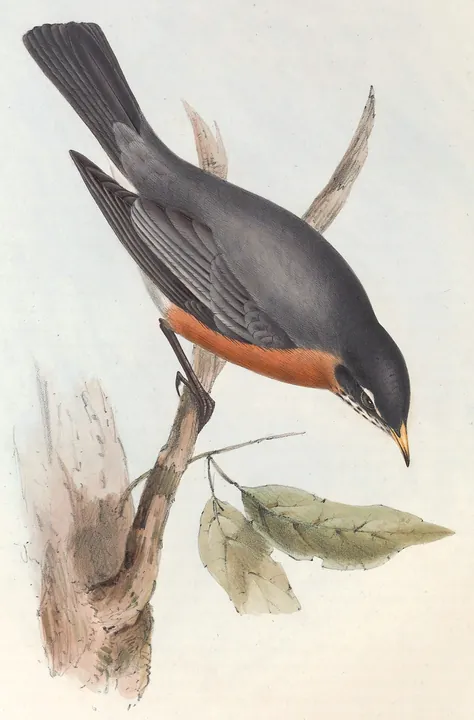
Because a few had strayed across the Atlantic. John Gould put it in The Birds of Europe as the “Migratory Ouzel,” Merula migratoria, noting that “M. Temminck states that it has been killed in Germany” and that one had been seen near Vienna (Gould's text). Of the plate he wrote: “We have figured an adult of the natural size.”
Wild robins can live a long time. The oldest in the federal banding records, a male banded in California in January 1962, was found dead there in May 1975, at least 13 years and 11 months old (USGS Bird Banding Laboratory; see the oldest wild birds). More robin paintings, among them Audubon's plate 131, are on our American Robin painting page.
Which other states have the robin?
Connecticut, which adopted it in 1943, and Michigan, where a resolution of the Legislature made the “robin redbreast” the state bird in 1931 (Michigan Manual).
The robin nearly won a fourth state. In Tennessee's statewide vote of 1933 it came second, 15,073 votes to the mockingbird's 15,553 (The Migrant, March 1933); the story is on our Tennessee state bird page.
Questions about the Wisconsin state bird
When did the robin become Wisconsin's state bird?
Schoolchildren chose it in 1926–27, and the Legislature made it official in 1949, in Chapter 218 of the Laws of 1949.
Do robins stay in Wisconsin in winter?
Some do. In southeastern Wisconsin a few robins stay all year, wintering in flocks in the woods and eating berries.
What is Wisconsin's state symbol of peace?
The mourning dove, since 1971.
Why is the robin Wisconsin's state bird?
Wisconsin's schoolchildren voted for it, two to one, and the state calls it one of the five most abundant summer birds in Wisconsin.
Birdfolio prints a birder’s life list as a book, each species beside a classic painting. Look inside a Birdfolio.
Orders open on November 1.