State birds
What is the Hawaii state bird?
The Hawaii state bird is the nēnē, or Hawaiian Goose. The territorial legislature named it on May 7, 1957, two years before statehood, by House Concurrent Resolution 52, and since 1988 the choice has been written into Hawaii Revised Statutes Section 5-17.
Updated
When did the nēnē become Hawaii's state bird?
In 1957, while Hawaii was still a territory. The Department of Land and Natural Resources says the nēnē was “officially designated Hawai'i's state bird on May 7, 1957,” and the Legislative Reference Bureau's 1978 study names the measure: House Concurrent Resolution 52 of the 29th Territorial Legislature, which made it the bird of the Territory.
The statutes caught up in 1988. Hawaii Revised Statutes § 5-17 names the nene, “also known as the Hawaiian goose,” as the official bird, and spells its scientific name Branta sandwicensis, with a w. Scientists and the US Fish and Wildlife Service spell it sandvicensis.
Why did Hawaii choose the nēnē?
For its looks, and to save it. The 1978 study says it was chosen because it is “neat, beautiful, indigenous to Hawaii and one of the rarest species” of birds in the world. And the DLNR's teacher's guide to the nēnē says wildlife experts “sought this designation in order to secure federal funds to help save it.”
How close did the nēnē come to extinction?
Close. In the 1950s fewer than 30 nēnē were left in the wild, according to the DLNR's history of nēnē management, all of them on Hawaiʻi Island, says the US Fish and Wildlife Service.
Captive breeding brought it back. A program that began in 1949 ran until 2011, and between 1960 and 2008 “some 2,800 captive-bred nene were released” at more than 20 sites (federal rule of 2019). In the 1950s, the DLNR history notes, nēnē were being bred on Hawaiʻi Island and at Slimbridge, in England.
When the nēnē was listed as endangered in 1967 there were fewer than 300. By 2017 the DLNR counted 3,252: 1,482 on Kauaʻi, 1,104 on Hawaiʻi Island, 627 on Maui, 37 on Molokaʻi and 2 on Oʻahu. On January 21, 2020, the federal government moved the nēnē from endangered to threatened.
Kauaʻi now has the most. Its nēnē increased dramatically as sugar cane farming ended in the 2000s, the DLNR history says, and the 2022 statewide survey estimated 3,862 birds, 2,430 of them on Kauaʻi.
Where can you see a nēnē in Hawaii?
On Maui, try Haleakalā National Park. The National Park Service suggests looking near the backcountry cabins, at Kalahaku Overlook and along the park roads, where drivers need to watch out for them. Nēnē were gone from Maui until a troop of Boy Scouts helped reintroduce them in 1962.
On Hawaiʻi Island, Hawaiʻi Volcanoes National Park has “right around 250 birds” (National Park Service). Nēnē also use pastures, farm fields and golf courses, which has its risks: the 2019 federal rule lists “vehicle collisions, and golf ball strikes” among the dangers they face.
They nest through the winter rainy season, and “in October the parents begin the nesting cycle again,” the DLNR guide says. Hawaii marks Nēnē Awareness Day on September 26, a day Governor Linda Lingle designated in 2003, according to the DLNR.
How is the nēnē different from other geese?
It is made for lava. According to the DLNR guide, nēnē descend from Canada Geese that settled in the islands about half a million years ago, and their feet changed to suit rough ground: “The foot has reduced webbing, long flexible toes, large nails and protective pads.” Their ancestor is on our Canada Goose painting page.
Its name is its voice. On the ground, the National Park Service says, nēnē make a low “nay-nay” call, the sound they are named for.
Some live long lives. The oldest Hawaiian Goose in the federal banding records was at least 24 years old: banded in March 1999, it was found in March 2023 after striking a moving aircraft (USGS Bird Banding Laboratory; see our list of the oldest wild birds).
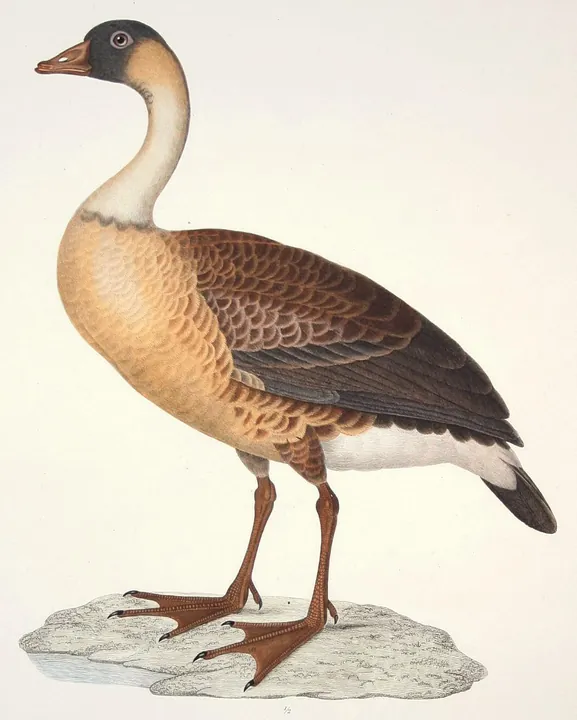
Who painted the nēnē on this page?
An artist who signed the plate “Prévost del.,” meaning Prévost drew it. It is plate 10 of the birds in the zoology atlas of the voyage of the French corvette La Bonite, by Eydoux and Souleyet (1841–52), and the plate calls the bird “Oie de Hawaï.” The records of the atlas don't settle the artist's first name, so our credit gives the name he signed.
Does any other state have the nēnē?
No. The nēnē lives only in Hawaii, so no other state could choose it, and it is the only goose among the state birds. Hawaii shares a piece of history with Alaska, whose Willow Ptarmigan was also named before statehood.
Questions about the Hawaii state bird
Is the nēnē the same as the Hawaiian Goose?
Yes. Nēnē is its Hawaiian name, and Hawaii's law names the nene, “also known as the Hawaiian goose.”
When did the nēnē become Hawaii's state bird?
On May 7, 1957, by House Concurrent Resolution 52 of the territorial legislature. A 1988 law, Hawaii Revised Statutes § 5-17, put it in the statutes.
How many nēnē are there?
The 2022 statewide survey estimated 3,862, most of them on Kauaʻi, up from fewer than 30 wild birds in the 1950s.
Where is the best place to see a nēnē?
Haleakalā National Park on Maui and Hawaiʻi Volcanoes National Park on Hawaiʻi Island both have nēnē, and Kauaʻi has the most. Drive slowly where they live.
Birdfolio prints a birder’s life list as a book, each species beside a classic painting. Look inside a Birdfolio.
Orders open on November 1.