State birds
What is the Pennsylvania state bird?
The Pennsylvania state bird is the Ruffed Grouse. Act 234 of June 22, 1931, adopted it as the “State game bird of Pennsylvania,” and today the Game Commission and the governor's office both call it the state bird. Grouse live in the state's young, brushy woods all year.
Updated
Is the Ruffed Grouse a state bird or a game bird?
Both, depending on who is talking. The 1931 law, Act 234, was passed “To select and adopt the ruffed grouse as the State game bird of Pennsylvania,” and its first section says the grouse “is hereby selected, designated and adopted as the State game bird of Pennsylvania.” It took effect “from and after its passage.”
Yet the heading printed above the act reads “RUFFED GROUSE ADOPTED AS STATE BIRD,” and that is how Pennsylvania speaks of it today. The Pennsylvania Game Commission calls the grouse “Pennsylvania's official state bird since 1931,” and the governor's office says it was “Designated the state bird on June 22, 1931.”
The act gives no reason; it has no preamble. The governor's office does record a piece of history: the grouse “was a vital source of food supply for early settlers in Pennsylvania.” By 1943 bird people elsewhere counted it as one: that January, North Carolina's bird club listed the Ruffed Grouse among the states' birds (The Chat, 1943).
How did West Nile virus hit Pennsylvania's state bird?
Hard. In a 2015 Game Commission trial with chicks hatched from wild eggs, “80% of the inoculated grouse died or had significant lesions” (Game Commission research summary). The virus had been “detected statewide by late summer 2002,” and the commission has shown it to be “a contributing factor in grouse declines,” its 2018 survey report says.
So the state went hunting for mosquitoes in grouse woods. In 2017 the Game Commission trapped them at “8 grouse habitat sites” on State Game Land 176, the Scotia Barrens, “for 12 weeks from mid-June through mid-September,” and widened the work to 9 game lands in 2018 and 18 in 2019 (annual job report, 2020). The main carrier in the woods turned out to be the mosquito Culex restuans.
Hunters gave something up too. Sightings of grouse broods in July 2016 were “the lowest in 35 years of monitoring,” and in April 2017 the Board of Commissioners approved the “emergency closure of the Late Season,” the hunt after Christmas; 72 percent of 220 written comments supported it. In the 2017–18 season hunters flushed 0.88 grouse an hour, “the lowest since record-keeping began.”
Where can you find a Ruffed Grouse in Pennsylvania?
In young woods, all year. “Grouse are found throughout Pennsylvania in suitable habitat and are year-round residents,” the Game Commission says; look where wooded country has “brushy conditions and young forests less than 20 years old.” Its 2018 survey report called the Northwest and Northcentral regions “the core of the grouse range.”
Listen in spring, when males drum in the mating season, “March and April.” Late summer is harder: adults molt “from July into September” and “may be hard to find.”
Grouse country has shrunk. “In the early 1900s,” the Game Commission's Wildlife Note says, Pennsylvania had “excellent grouse habitat in brushy, recently-logged forest areas.” Since then the forests have grown older and a large deer herd has thinned the undergrowth, and the survey report says long-term declines are “clearly linked” to the loss of about 40 percent of young-forest acreage.
How does a grouse survive a Pennsylvania winter?
It dives into the snow. On winter nights a grouse may spend the night in “a ‘snow roost’,” the Wildlife Note says, “sometimes flying directly into a soft snowbank at dusk.”
Its feet change for the season: in winter the toes grow a comb-like fringe that gives them “snowshoe-like properties.” And it eats from the bushes and trees: “Buds form the basis of the grouse's winter diet,” the Game Commission says.
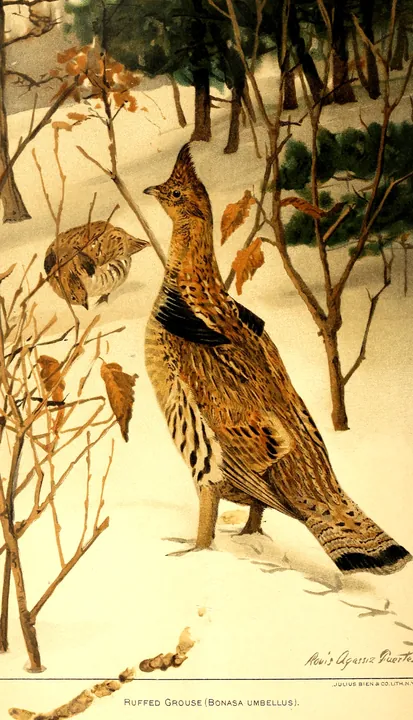
Our painting is a winter scene: one grouse on the snow beside its tracks and, behind it, a second up in a bare shrub.
Who painted the grouse on this page?
Louis Agassiz Fuertes, for the frontispiece of a federal report. It is Plate I of Sylvester D. Judd's The Grouse and Wild Turkeys of the United States, and Their Economic Value, Biological Survey Bulletin No. 24, whose letter of transmittal is dated July 15, 1905 (the bulletin on the Internet Archive). Fuertes signed it, and it is lettered with his name for the bird, “Ruffed Grouse,” and its Latin name, Bonasa umbellus; Julius Bien & Co. of New York printed it.
Judd's text has a line fit for a state bird: the grouse is “a bird of the woods, imparting the spirit of the wilderness to every sylvan retreat.” He noted that it was called the partridge in New England and usually the pheasant in the Southern States, and Pennsylvania's governor's office still says it is “Also known as a partridge.”
More of Fuertes's work is in our guide to Louis Agassiz Fuertes. Judd's bulletin covers wild turkeys as well; Audubon's are on our Wild Turkey painting page.
Does any other state have the Ruffed Grouse?
No. Pennsylvania is the only state with the Ruffed Grouse as its state bird. Three of its neighbors chose songbirds: New York the Eastern Bluebird, Ohio the Northern Cardinal and New Jersey the American Goldfinch.
The grouse did get one notable vote elsewhere. In Michigan's 1929 state bird election, Governor Fred Green reportedly voted for the Ruffed Grouse, Michigan Public reports; the robin won there instead (Michigan state bird).
Questions about the Pennsylvania state bird
When did the Ruffed Grouse become Pennsylvania's state bird?
On June 22, 1931, when Act 234 adopted it as the state game bird. The Game Commission calls it Pennsylvania's official state bird since 1931.
Is Pennsylvania's state bird a game bird?
Yes. The 1931 law names the Ruffed Grouse the “State game bird of Pennsylvania,” and the state's agencies call it the state bird.
How long do Ruffed Grouse live?
Not long, as a rule: “relatively few live to be two years of age,” the Game Commission says.
When do Ruffed Grouse drum?
In the mating season, March and April, according to the Pennsylvania Game Commission.
Birdfolio prints a birder’s life list as a book, each species beside a classic painting. Look inside a Birdfolio.
Orders open on November 1.