State birds
What is the North Carolina state bird?
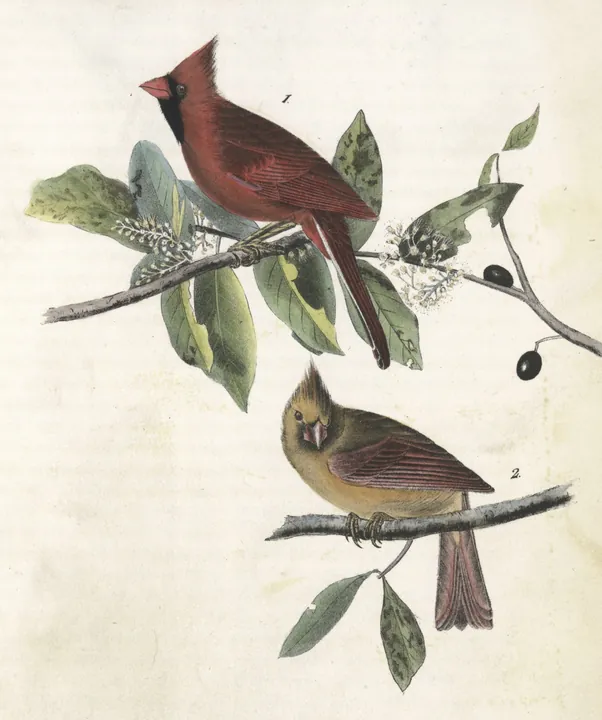
The North Carolina state bird is the Northern Cardinal. An act ratified on March 8, 1943, after a statewide vote run by the North Carolina Bird Club, declared the cardinal “the official State Bird of North Carolina,” and the law today is General Statutes Section 145-2.
Updated
Was the cardinal North Carolina's first state bird?
No. For one week in 1933, North Carolina's state bird was the Carolina Chickadee. Resolution No. 51 of the General Assembly named it after a “State-wide contest conducted by the newspapers,” sponsored by the State Federation of Women's Clubs, which chose the chickadee as “most beneficial to agriculture.” It was ratified on May 8, 1933 (Public Laws and Resolutions, 1933).
Seven days later it was gone. Chapter 521 of the same year's laws, ratified on May 15, 1933, repealed the resolution, and it gives no reason. North Carolina then went ten years without a state bird.
How did North Carolina vote for the cardinal?
Through its bird club. “Early in 1942” the North Carolina Bird Club began a campaign for a state bird, Roxie Collie Simpson wrote in the club's journal, The Chat, in January 1943, and schoolchildren were asked to send in their choices. The club's test was a bird that stays all year, lives statewide and is “pleasing to eye and ear.”
Club members also hoped the winner “would not be one chosen by any other state,” and two unclaimed candidates were in the running: the Red-headed Woodpecker and the Mourning Dove.
Local polls went every which way. In western North Carolina an Asheville Citizen-Times poll drew “758 ballots” for “21 different birds.” The Bob-white led with 233, the Scarlet Tanager had 153, and the cardinal got just 94. The Henderson Bird Club “unanimously chose the Carolina Wren,” the Greensboro Garden Club picked the Pine Warbler, the Raleigh Woman's Club the Bluebird, and a group from Farmville the cardinal.
The statewide count, reported by the club's president, H. H. Brimley, in March 1943, came to 23,244 votes: cardinal 5,000, dove 3,395, Red-headed Woodpecker 2,756, Bobwhite 2,455, Bluebird 2,348, Scarlet Tanager 2,156 and Robin 1,027. The club had hoped for a bird of its own and got one that Kentucky, Illinois, Indiana and Ohio had already chosen (Kentucky, Illinois, Indiana, Ohio). “Many of us had other preferences,” Brimley admitted.
What does North Carolina's state bird law say?
It opens with a claim. Chapter 595 of the 1943 session laws, “An Act for the Adoption of a State Bird,” says North Carolina and Connecticut were “the only states in the Union that have not adopted an official state bird” (Session Laws of North Carolina, 1943). That is what the act said, yet New York had no state bird law either until 1970 (New York State Library), as our New York state bird page tells. Connecticut adopted the robin that same year (CT.gov).
The preamble says bird clubs, garden clubs, “many of the schools” and individuals wanted a state bird, that the bird club had “canvassed the State for votes,” and that the cardinal “received a decidedly larger number of votes than any other species.” The act took effect when it was ratified, on March 8, 1943.
Its words live on in General Statutes § 145-2: “The cardinal is hereby declared to be the official State bird of North Carolina.” The State Library's encyclopedia, NCpedia, cites the same 1943 law, chapter 595.
What is a winter redbird?
North Carolina's cardinal. The Secretary of State's North Carolina Manual says the cardinal is “Also known as the winter redbird,” and Brimley's message of March 1943 called it “our ‘Winter Redbird’” and “one of our most conspicuous birds in both town and country.”
Brimley heard it in the capital: “One can hear his song almost to the center of the business activities of Raleigh.” Out in the country, he noticed, cardinals were quick to cross dips in the highway “bordered with bushes on both sides.”
More than a century earlier, Audubon put the bird's appeal simply: “Go where it may, it is always welcome” (Audubon's Ornithological Biography, 1834). Our Northern Cardinal painting page has more of his cardinals.
Where can you see cardinals in North Carolina?
Across the whole state, in every season. The Manual calls the cardinal “a year-round resident of North Carolina” and one of “the most common birds” of “our state's gardens, meadows and woodlands.” On the coast, the Wildlife Resources Commission sends birders to maritime forests, “among live oaks and holly trees,” and in the Piedmont it says “Urban parks and backyards” draw Northern Cardinals.
In the mountains they thin out with height. The Carolina Bird Club's Birds of North Carolina calls them common up to about 3,000 feet and rare much higher, and notes winter flocks of 20 or more. Its highest count: “1,001, Chapel Hill spring count, 12 May 2002.”
North Carolina's cardinals lay small clutches. “Cardinals in North Carolina typically set three eggs each spring,” the Manual says, while those further north “tend to set four.”
Which other states share North Carolina's cardinal?
Six: Illinois, Indiana, Kentucky, Ohio, Virginia and West Virginia. Illinois, like North Carolina, let the public choose, in its case schoolchildren; Virginia, in 1950, was the last of the seven (Virginia Legislative Information System).
Why seven states ended up with one bird is the subject of our guide to the cardinal state bird. Some of North Carolina's runners-up found homes elsewhere: the bluebird is the state bird of New York and Missouri, and the robin of Connecticut, Michigan and Wisconsin.
Questions about the North Carolina state bird
When did the cardinal become North Carolina's state bird?
In 1943. The act was ratified on March 8, 1943, and is now General Statutes § 145-2.
What was North Carolina's state bird before the cardinal?
The Carolina Chickadee, for one week: a resolution ratified on May 8, 1933, named it, and an act ratified on May 15 repealed it.
How many votes did the cardinal get?
5,000 of the 23,244 votes in the North Carolina Bird Club's 1943 count. The dove came second with 3,395.
Do cardinals stay in North Carolina in winter?
Yes. The cardinal lives across the state all year, and in winter it sometimes gathers in flocks of 20 or more.
Birdfolio prints a birder’s life list as a book, each species beside a classic painting. Look inside a Birdfolio.
Orders open on November 1.