State birds
What is the Alaska state bird?
The Alaska state bird is the Willow Ptarmigan, chosen before Alaska was a state. After a schoolchildren's contest, the Territorial Legislature made it the official bird in its first law of 1955, approved on February 4, and the law today still names the “Alaska Willow Ptarmigan.”
Updated
How did Alaska choose the Willow Ptarmigan?
With a school contest, before statehood. The 1955 law tells the story itself: Territorial Sportsmen, Inc. sponsored the selection, the Alaska Sportsmen's Council supported it, and in a contest run by the Territorial Department of Education and the Education Section of the Alaska Native Service, “the Willow Ptarmigan received by far the greatest number of votes” (Session Laws of Alaska 1955, chapter 1).
The Territorial Legislature made it law. “An Act to name an official bird for the Territory of Alaska” was chapter 1 of the 1955 session laws, the first law printed that year, approved on February 4, 1955. The Alaska Department of Fish and Game puts it simply: “Alaska school children chose the willow ptarmigan as a symbol of the Great Land.”
Statehood came almost four years later, when President Eisenhower issued his proclamation in January 1959 (National Archives), and the ptarmigan, as Fish and Game says, “became the official state bird when Alaska was made the 49th state.” Today's law, Alaska Statutes 44.09.060, still names the “Alaska Willow Ptarmigan (Lagopus lagopus alascensis Swarth),” the bird's Alaska subspecies.
Where can you find Willow Ptarmigan in Alaska?
Wherever there is tundra and willow. Fish and Game's species profile says Willow Ptarmigan have “the widest range in Alaska of any upland game bird,” on alpine and arctic tundra throughout the state. They favor willow-lined waterways on the western and northern coastal plains, and subalpine country elsewhere.
They avoid the broad forested valleys of the Interior, the thick woods of Southeast Alaska and the Aleutians west of Unimak Island. Some move with the seasons: hens from the north slope of the Brooks Range travel up to 100 miles south in late fall, and the movement back north starts in February and peaks in April.
In spring, Fish and Game says, they travel to their breeding grounds “in flocks of several thousand.” Their numbers can swing “between superabundance and virtual absence in just a few years,” in the profile's words.
How does a Willow Ptarmigan get through an Alaska winter?
By turning white and living on willow. Fish and Game describes a bird “changing its plumage from light brown in summer to snow white in winter,” and in winter “buds, twigs, and catkins of willows provide four-fifths or more of their food.” The name fits.
In spring the males put on “a beautiful cape of chestnut-red feathers,” and they stay to help: unlike other North American grouse and ptarmigan, “male willow ptarmigan usually help to care for their chicks.”
Was an Alaska town almost named Ptarmigan?
So one story goes. The gold-rush town of Chicken got its post office in 1903, and “there are several stories about how the town got its name,” says its National Register nomination. In one, the miners wanted to call the place Ptarmigan but “could not spell the word”; in another, the gold came in nuggets the size of corn kernels, or “chicken feed.”
Juneau has a ptarmigan name too. Its Chicken Ridge got that name “because of the numerous ptarmigan,” according to the National Register nomination for the Chicken Ridge Historic District.
Who made the painting on this page?
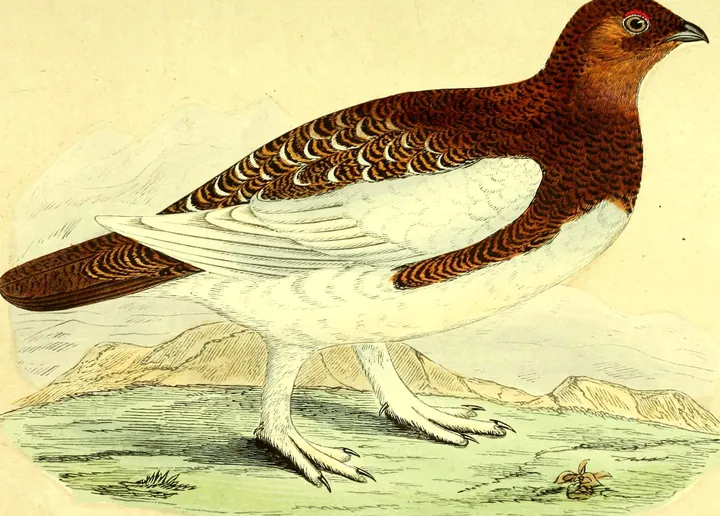
The plate comes from an English book, C. R. Bree's A History of the Birds of Europe, Not Observed in the British Isles, issued in parts from 1859 to 1863; this one is in volume 3 (1862), labeled “Willow Grouse,” and unsigned. The book was printed by Benjamin Fawcett of Driffield, and in his preface Bree thanks “the spirited enterprise of my artist, Mr. Fawcett” (Bree, vol. 1), so our credit names Fawcett.
Benjamin Fawcett, born in Bridlington in 1808, started his business in Driffield in 1831 and became one of the leading woodblock color printers in 19th-century England, according to the Hull History Centre. Volume 3 ends with his imprint: “B. Fawcett, Engraver and Printer, East Lodge, Driffield.”
Bree's text has its own stories. He held that the Willow Grouse was a different species from Britain's Red Grouse, three years after Darwin's On the Origin of Species: “I for one, however, refuse to submit to a dogma of this kind.” From a correspondent in Sweden he heard that a male guarding his sitting mate “has even been seen to drive away a fox.”
Does any other state have the Willow Ptarmigan?
No. Alaska is the only state with the Willow Ptarmigan as its state bird. Its closest match in history is Hawaii, whose nēnē was also named while the islands were still a territory, in 1957.
Questions about the Alaska state bird
When did the Willow Ptarmigan become Alaska's state bird?
On February 4, 1955, when the Territorial Legislature's first law of that year was approved, almost four years before Alaska became a state in January 1959.
Is the Willow Ptarmigan white all year?
No. It is light brown in summer and snow white in winter, Alaska's Department of Fish and Game says, and spring males wear a chestnut-red cape.
Do male Willow Ptarmigan help raise the chicks?
Usually, yes, unlike the males of other North American grouse and ptarmigan.
Who chose Alaska's state bird?
Alaska schoolchildren, in a contest run by the Territorial Department of Education and the Alaska Native Service's education section. The Territorial Legislature made their choice law.
Birdfolio prints a birder’s life list as a book, each species beside a classic painting. Look inside a Birdfolio.
Orders open on November 1.