State birds
What is the West Virginia state bird?
The West Virginia state bird is the Northern Cardinal. House Concurrent Resolution No. 12, adopted on March 7, 1949, put the choice of a state bird and a state tree to a vote of schoolchildren, students and civic groups that April, and the cardinal won by more than 11,000 votes, the West Virginia State Museum says.
Updated
Why did West Virginia need a state bird in 1949?
Because it was almost the last state without one. The resolution the Legislature adopted on March 7, 1949, says so in its preamble: “West Virginia is one of only three states without an officially designated state bird” (Acts of the Legislature, 1949).
It gave more reasons: interest in birds and wildlife was growing “among school children, civic organizations, bird study groups” and many other citizens, and those children and citizens “should have the privilege” of helping to choose.
The same resolution, House Concurrent Resolution No. 12, also set out to name a state tree, which West Virginia didn't have either.
Who voted for West Virginia's state bird?
Almost anyone in a classroom or a club. The resolution opened the vote to pupils in the public and private elementary and high schools, students at West Virginia University and every other college in the state, and the garden clubs, civic organizations, sportsmen's associations and bird study groups.
The vote was set for April 1949. The State Superintendent of Free Schools was to run it in every county and compile the returns, and a committee of the superintendent, the clerks of the House and Senate and the chairmen of both education committees was to declare “the bird receiving the most votes” the state bird.
The cardinal won “by more than 11,000 votes,” says the West Virginia State Museum, and the same vote made the sugar maple the state tree.
The Legislature's own symbols page tells it more briefly and calls the bird's measure House Resolution 12 (West Virginia Legislature); the 1949 Acts print it as one concurrent resolution, for the bird and the tree together.
What did West Virginians call the cardinal?
“Red bird.” The cardinal was “once known to most West Virginians as simply ‘red bird,’” writes Kathleen Carothers Leo in e-WV, the West Virginia Humanities Council's encyclopedia of the state (e-WV).
She lists why it was chosen: the male's brilliant red and crest, the female's softer colors, its presence all over the state, its cheery song, and its habit of living near houses and visiting feeders. Those are the encyclopedia's reasons; the 1949 resolution doesn't name the cardinal at all.
Her article adds a count worth knowing: cardinals eat 51 species of insects, 33 kinds of wild fruits and 39 different weed seeds.
West Virginia's choices often began with its schoolchildren, e-WV notes: the great rhododendron, the state's first official species, was named in 1903 after a vote of schoolchildren and a recommendation by Governor White.
Where and when can you see a Northern Cardinal in West Virginia?
Almost anywhere. e-WV says cardinals live statewide, near houses and at feeders, and build their nests close to the ground, in shrubs or small trees.
The West Virginia Division of Natural Resources calls winter one of the best times to go birdwatching, with the leaves off the trees, and puts the cardinal on its checklist for that season. At Ohio River Islands National Wildlife Refuge, the U.S. Fish and Wildlife Service counts cardinals among the core group of resident birds that stay for the winter.
To bring one closer, the encyclopedia suggests offering black oil sunflower or safflower seed.
How to tell a male cardinal from a female
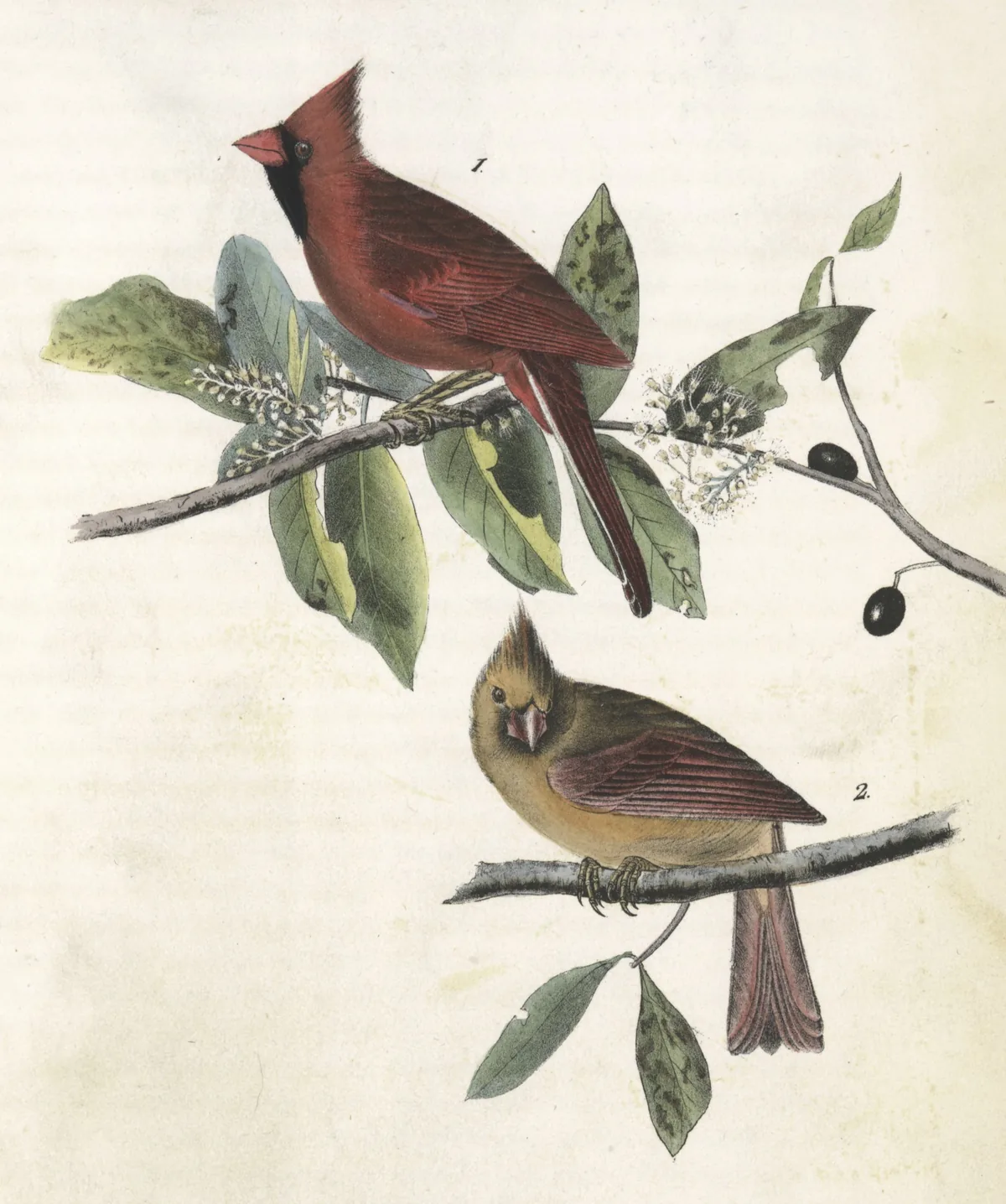
Only the males have the rich scarlet feathers and the black mask, the West Virginia State Museum points out; females and young birds are duller, with only tinges of red. Both share a crest on the head and a short, cone-shaped bill. A cardinal is 8.75 inches long, with a 12-inch wingspan, the Tennessee Wildlife Resources Agency says, and its song is a series of clear, repeated phrases, usually of two notes.
Which other states have the cardinal as their state bird?
Six: Illinois, Indiana, Kentucky, North Carolina, Ohio and Virginia. West Virginia, in 1949, was the sixth of the seven to choose it; Virginia followed in 1950. The whole story of the seven is in our guide to the cardinal state bird.
For more classic portraits of the bird, see our Northern Cardinal paintings.
Questions about the West Virginia state bird
When did the cardinal become West Virginia's state bird?
In 1949. House Concurrent Resolution No. 12, adopted March 7, 1949, set up a statewide vote that April, and the cardinal won it.
How was West Virginia's state bird chosen?
By a vote of schoolchildren, college students and clubs across the state in April 1949. The State Museum says the cardinal won by more than 11,000 votes.
Do cardinals stay in West Virginia in winter?
Yes. The U.S. Fish and Wildlife Service counts them among the resident birds that stay through the winter at the Ohio River Islands refuge.
What is West Virginia's state bird and flower?
The cardinal is the state bird, and the rhododendron is the state flower, adopted on January 29, 1903, after a vote of public school pupils.
What is West Virginia's state animal?
The black bear. Students, teachers and sportsmen chose it in a poll in 1954 and 1955, and the Legislature adopted it in 1973.
Birdfolio prints a birder’s life list as a book, each species beside a classic painting. Look inside a Birdfolio.