Classic bird paintings
Mourning Dove painting: Audubon's plate and other classic portraits
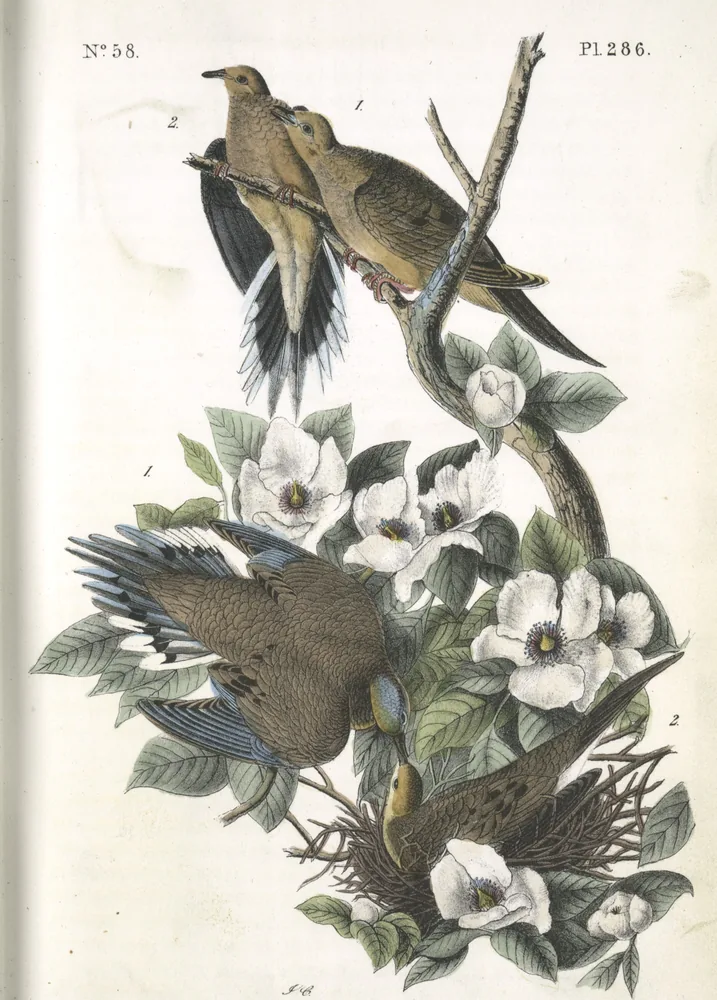
John James Audubon painted the Mourning Dove as plate 17 of The Birds of America (1827–38), under the name Carolina Pigeon, or Turtle Dove. A free high-resolution scan is on Audubon.org. Shown here is plate 286 of his smaller octavo edition (1840–44), where it is the Carolina Turtle Dove.
Updated
About this painting
The picture here is plate 286 of the octavo edition, published from 1840 to 1844 in a book-size format, where the bird is the Carolina Turtle Dove. It keeps the two pairs and the flowering stuartia of the big plate. The “two turtle doves” of the Christmas carol are another species, the European Turtle Dove: see the birds of the Twelve Days of Christmas, one by one.
Audubon’s Mourning Dove: plate 17, “Carolina Pigeon, or Turtle Dove”
In the lower pair, the female sits on her eggs and takes food from her mate's bill. Above, a courting female has walked out to the tip of the branch, wings and tail already opening, ready to fly off and test her suitor. Audubon introduced them as “two as gentle pairs of Turtles as ever cooed their loves in the green woods.”
In spring, he wrote, the male rises as if to climb high, then sails down in a wide circle, wings and tail spread, to land near the sitting female. He found it nesting in every part of the country he visited: in Louisiana from early April, raising two broods, but in Connecticut seldom before the middle of May, with one. He thought it more a gleaner than a reaper of the farmer's fields, picking up grain left after the harvest, and noticed that its feathers come out at the slightest touch.
His friend John Bachman once put a male Mourning Dove in a cage with a female European Turtle Dove. The two paired and laid eggs, but the cage fell, the eggs broke, and the American bird escaped.
Story: Audubon, Ornithological Biography, vol. 1 (1831), pp. 91–95; vol. 5 (1839), p. 555. See plate 17 free at Audubon.org.
More classic portraits, free to see
- John James Audubon, The Birds of America, octavo edition (1840–44), plate 286: “Carolina Turtle Dove” (the painting shown above). Free scan (New York Public Library Digital Collections)
- Louis Agassiz Fuertes, for Elon H. Eaton’s Birds of New York (1910–14), plate 42: “Mourning Dove”, with the Passenger Pigeon. Free scan (Internet Archive)
About the Mourning Dove
- A Mourning Dove fills its crop with seeds quickly, then digests them while it rests. (Source: National Audubon Society)
Doves that visit your yard can be counted in just two days: Project FeederWatch asks for two days in a row, as often as once a week or only once between November 1 and April 30. How to pick your FeederWatch count days.
Are Mourning Doves in Texas all year?
Yes. Mourning Doves are in Texas in every season, and nesting has been reported in every month, most of it from March to September, the Texas Breeding Bird Atlas says. Winter brings more: Texas and Mexico are major winter homes for doves from the central states and provinces, from the Appalachians to the western Great Plains.
It is very widespread here. Atlas volunteers found it in more map blocks than the House Sparrow, and one Breeding Bird Survey route in Shackelford County averaged 231 Mourning Doves a year, the highest of any route in the United States and Canada. Building the nest is teamwork of an odd kind: the male brings small twigs and stands on the female's back to hand them over, while she shapes a bowl with her body. The flimsy platform usually holds two white eggs.
Source: Texas Breeding Bird Atlas, Mourning Dove (Tweit, 2007).
What other doves live in Texas?
Several, and two of them have spread a long way. The White-winged Dove, with red legs, blue eye rings and broad white wing stripes, once spent the summer mainly in the forests along the lower Rio Grande. As those were cleared for farms after 1920 it moved north, and by 2005 it had been found nesting in most Texas counties; about 1.3 million lived in San Antonio year-round in 2001, the Texas Breeding Bird Atlas says.
The Inca Dove, first collected at Laredo in 1866, had reached Austin by 1889 and lives mostly around houses. One Austin nest sat where guy wires crossed a trolley wire that rose at least two feet every 15 minutes as the cars passed, and it still fledged two young. The sparrow-sized Common Ground Dove nests mainly in South Texas, often in prickly pear, and the White-tipped Dove of the far south is best known by its call, like someone blowing across the mouth of a bottle.
Sources: Texas Breeding Bird Atlas, White-winged Dove (Tweit, 2007); Texas Breeding Bird Atlas, Inca Dove (Casto, updated 2007); Texas Breeding Bird Atlas, Common Ground Dove (Tweit, 2007); Texas Breeding Bird Atlas, White-tipped Dove (Tweit, 2007).
What are the white doves released at weddings?
Often an albino form of the Ringed Turtle-Dove, apparently a cage bird for thousands of years and one of the most popular in the world, the Texas Breeding Bird Atlas says.
Released birds are usually poorly equipped for the wild. The House Sparrows and European Starlings that took hold in North America were wild birds when they were brought over, the atlas explains, while doves raised in cages usually lack what wild parents teach their young about surviving. Atlas volunteers found only a few nesting records in Texas, one of them near Houston. In the United States the birds that do last usually live in subdivisions with plenty of bird feeders, and in Florida many such colonies of escaped cage birds have proved short-lived.
Source: Texas Breeding Bird Atlas, Ringed Turtle-Dove (Tweit, 2006).
How long does a Mourning Dove live?
A Mourning Dove's average lifespan is just longer than a year, says the Indiana Department of Natural Resources. The Chesapeake Bay Program gives an average of one to two years, though some doves live well over 10. The first year is the hardest: for every 100 doves hatched in a summer, only 20 to 30 live to breed the next, Pennsylvania's Game Commission says. The oldest known wild Mourning Dove was at least 30 years and 4 months old (USGS Bird Banding Laboratory): it was banded in Georgia in 1968 and found in Florida in 1998.
Hunting is part of the story: an average of 20 million Mourning Doves are hunted in the US each year, the Chesapeake Bay Program says. To keep their numbers steady, Indiana's fact sheet adds, a pair needs two to five nestings a year.
Sources: Indiana Department of Natural Resources; Chesapeake Bay Program; Pennsylvania Game Commission; USGS Bird Banding Laboratory. A banding record is the minimum age of one bird when it was found again, not a typical lifespan. How long do wild birds live?
How can you tell if a plate 17 print is an original?
By its size: an original plate 17 is a hand-colored sheet about 26 by 38 inches; the Mourning Dove’s octavo version, plate 286, is book-size, from 1840–44. Many prints sold today are reproductions: how to tell an original from a reproduction. For all 435 plates at a fraction of an original’s price, see which edition of The Birds of America to buy.
In a Birdfolio hardcover, this painting sits beside the date and place you first saw a Mourning Dove. See your own list as a book, free.