State birds
What is the Georgia state bird?
The Georgia state bird is the Brown Thrasher. Georgia schoolchildren first chose it in 1928, and the General Assembly made it official on March 20, 1970, after a 35-year campaign by The Garden Club of Georgia, says the state's Department of Natural Resources.
Updated
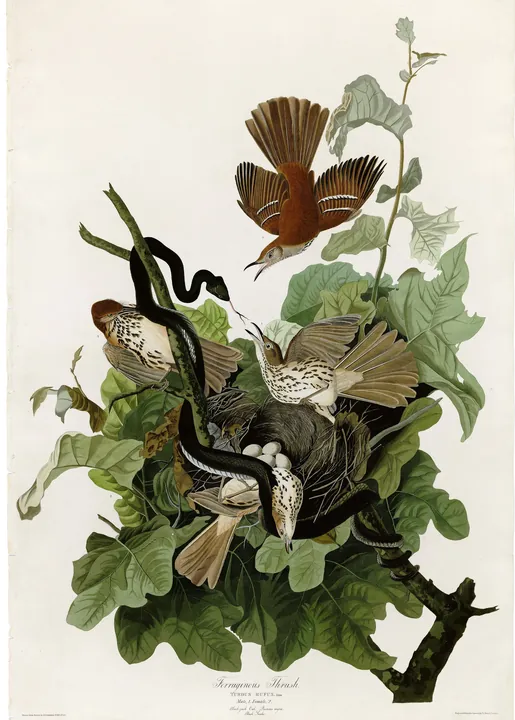
Why is the brown thrasher Georgia's state bird?
Because Georgia's schoolchildren picked it, back in 1928. “In truth, the brown thrasher was originally selected by school children in 1928,” writes Terry W. Johnson, a former nongame program manager, for the Georgia Department of Natural Resources.
How it got on the ballot is told by Birds Georgia, the Atlanta bird club's successor, in its centennial history. Asked to pick the state bird in 1928, the Atlanta Bird Club was “unable to agree” and named three candidates: the Purple Martin, the Red-headed Woodpecker and the Brown Thrasher. The Atlanta Federation of Clubs put the three to a vote of schoolchildren, and the thrasher won.
People have questioned the choice ever since, Johnson admits, when Georgia has far more colorful birds, such as the cardinal, the scarlet tanager and the bluebird. His answer is the song.
Why did it take until 1970 to make it official?
Because of a tree. In 1935, with schoolchildren and bird lovers behind it, the House “unanimously passed a motion” to make the brown thrasher the state bird and the pine the state tree, the department's own magazine, Outdoors in Georgia, recounted in August 1976 (Outdoors in Georgia, 1976).
Four days later the Senate passed its own resolution for the thrasher but left out the pine. The legislature went home “polarized between the pine tree and the live oak,” and no act was passed.
Governor Eugene Talmadge stepped in. On April 6, 1935, he proclaimed the brown thrasher the state bird and the pine the state tree, saying that schoolchildren and garden clubs had “indicated by their votes” what they wanted. The magazine adds a curious detail: the proclamation is “not recorded in the Executive Minutes,” and it quoted the words from the front page of that day's Atlanta Journal.
The next General Assembly overruled the governor on the tree, making the live oak official on February 25, 1937. The bird had to wait. On March 20, 1970, after a 35-year campaign by The Garden Club of Georgia, the General Assembly made the thrasher official at last.
The bobwhite quail became the state game bird in 1970 too, the Department of Natural Resources says; an unofficial copy of Georgia's code puts both birds on page 418 of that year's laws. The thrasher's champions had seen off rivals before, the 1976 magazine says, “even over such fine candidates as the bobwhite quail.”
How many songs does a brown thrasher know?
More than a thousand. “More than 1,100 song types have been attributed to this species,” Johnson writes for the Department of Natural Resources, and they include snatches of its neighbors' songs.
To tell it from a mockingbird, count the repeats: the thrasher usually sings each phrase twice, the mockingbird three times.
Older Georgians heard words in it. Country people across the South called it the “planting bird,” the 1976 magazine says, and heard it telling the farmer to “drop it, drop it, drop it, cover it, cover it, cover it.”
Audubon heard a musician. In 1834 he wrote that the bird “scarcely possesses the faculty of imitation” but can sing for hours without a slip, and that young thrashers start practicing in autumn, “repeating passages with as much zeal as ever did Paganini” (Audubon's text, vol. 2).
Was Atlanta's hockey team named after the brown thrasher?
Yes. When the National Hockey League gave Atlanta a new team in 1997, it was called the Thrashers, “named for the brown thrasher, Georgia's state bird,” according to Today in Georgia History, a program of the Georgia Historical Society and Georgia Public Broadcasting.
The story did not end well. The Thrashers sold 12,000 season tickets for their first season, reached the playoffs once in 11 seasons and never won a playoff game, and after years of losses they left for Canada in 2011, the same program recounts.
Is the brown thrasher related to the mockingbird?
Yes. AviList, today's world list of birds, puts the Brown Thrasher, Toxostoma rufum, in the family of mockingbirds and thrashers. So Georgia's bird is a relative of the Northern Mockingbird, the state bird of its neighbors Florida and Tennessee.
Its scientific story starts in the colonial South. Linnaeus named it Turdus rufus in 1758, based on the fox-colored thrush in Mark Catesby's Natural History of Carolina, the AOU Check-list of 1983 records; it has since been moved to the genus Toxostoma.
Audubon thought it the strongest bird of its kind in the country: neither the mockingbird nor the robin could stand up to it, he wrote, and it would chase a cat or a dog, tease a raccoon or a fox, and follow hawks to defy them.
His friend Bachman, who raised many thrashers, had one so tame that whenever he took up a spade or a hoe it would “follow at my heels,” picking up every insect and worm he turned over.
Where can you see brown thrashers in Georgia?
Anywhere in the state with thick shrubs. The thrasher ranges “from Rising Fawn in northwest Georgia to St. Marys on the Georgia coast,” Johnson writes; the 1976 magazine found it from the thickets of Brasstown Bald, at 4,768 feet, to the base of the Tybee light.
Winter is a good time to look. Thrashers are “more plentiful here in winter,” the magazine said, because birds that nest as far north as southern Manitoba and northern Maine come south to join Georgia's own.
Nesting starts early. Around Atlanta, eggs may be laid as early as April 5, the peak comes in early May, and most pairs nest again around late July; the male takes his turn sitting on the eggs, the magazine noted.
To bring one into a yard, Johnson suggests dense, thorny shrubs, fallen leaves left beneath them, a brush pile and a birdbath on the ground no more than 1½ inches deep. Thrashers have become regular visitors to feeders too, especially for suet laced with peanut butter, and for mealworms.
The oldest Brown Thrasher in the federal banding records was banded in Florida on October 4, 1967, at an age the Banding Lab codes as unknown (age codes), and was found dead there on May 6, 1978, at least 10 years and 7 months old (USGS Bird Banding Laboratory; more on our page of the oldest wild birds).
Does any other state have the brown thrasher?
No. The Brown Thrasher is Georgia's alone among the 50 state birds in our table. Its neighbors chose the mockingbird (Florida and Tennessee), the yellowhammer (Alabama), the Carolina Wren (South Carolina) and the cardinal (North Carolina).
Questions about the Georgia state bird
When did the brown thrasher become Georgia's state bird?
Officially on March 20, 1970, when the General Assembly designated it. Schoolchildren had chosen it in 1928, and Governor Eugene Talmadge proclaimed it on April 6, 1935.
Why did Georgia choose the brown thrasher?
Georgia schoolchildren chose it in 1928 from three birds the Atlanta Bird Club put forward, and The Garden Club of Georgia campaigned for it until the 1970 law.
What is Georgia's state game bird?
The bobwhite quail, also since 1970, says the Georgia Department of Natural Resources.
How many songs can a brown thrasher sing?
More than 1,100 song types have been attributed to it, says the Georgia Department of Natural Resources.
What is Georgia's state bird and flower?
The brown thrasher is the state bird, and the Cherokee rose is the state floral emblem. It was named in 1916 with the support of the Georgia Federation of Women's Clubs, the Secretary of State says.
What is Georgia's state animal?
Georgia has a state mammal, the white-tailed deer, and a state marine mammal, the right whale. House Bill 70, passed by the General Assembly in 2015, named the deer; the whale has held its title since 1985.
Birdfolio prints a birder’s life list as a book, each species beside a classic painting. Look inside a Birdfolio.