Classic bird paintings
Killdeer painting: Audubon's plate and other classic portraits
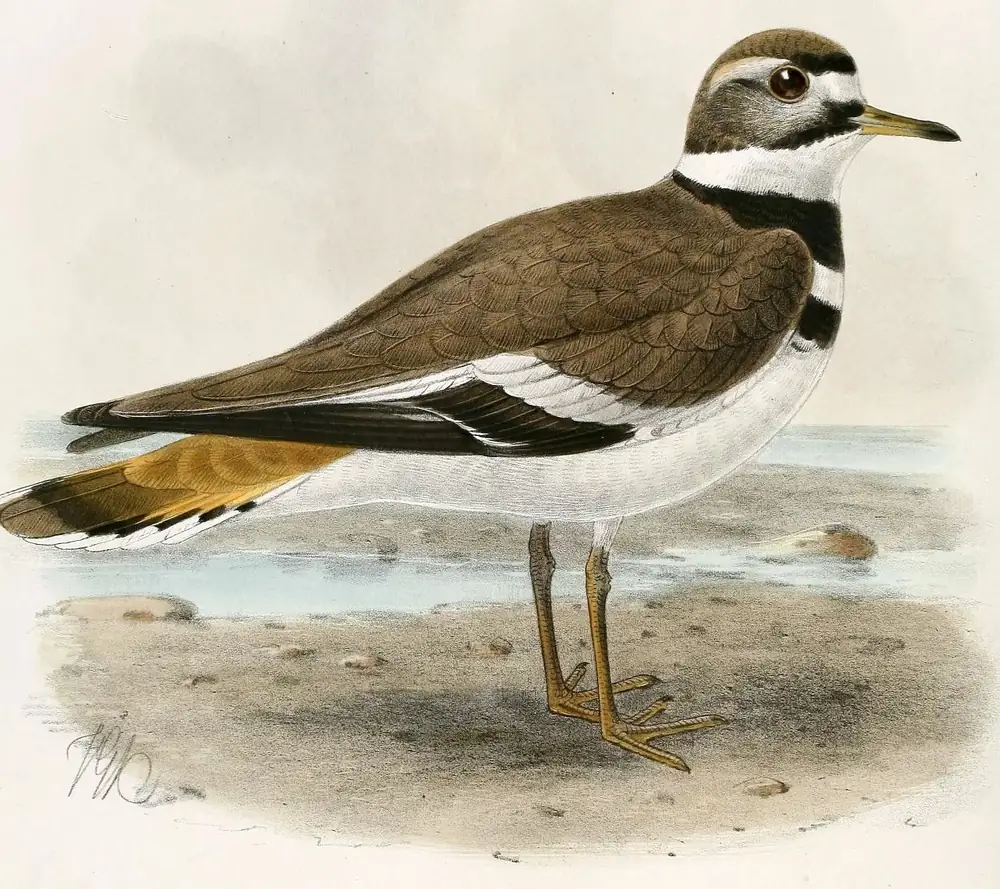
John James Audubon painted the Killdeer as plate 225 of The Birds of America (1827–38), a male and a female in summer plumage, under the name Kildeer Plover. A free high-resolution scan is on Audubon.org. The Killdeer shown here is J. G. Keulemans's plate from the supplement (1895–96) to H. E. Dresser's A History of the Birds of Europe.
Updated
The story of this painting
On January 11, 1885, walking home past the Long Pool on Tresco, in the Isles of Scilly, F. Jenkinson saw a bird settle on the grass and heard “a gentle half note” he was sure belonged to no bird he had seen before. It stayed about for days, and on January 14 he shot it. The name Killdeer Plover came to him at once, and a small book on American birds confirmed it: a plump female, not an exhausted straggler.
That bird, and a doubtful one from near Christchurch in 1857, earned the Killdeer its place in H. E. Dresser's A History of the Birds of Europe, as a rare straggler to England, recorded nowhere else in the Palearctic region. Dresser knew it well from Texas, where he found it at almost every pool and, when he was stalking some rarer bird, “a perfect nuisance,” its loud cry putting every bird nearby on alert.
Its name, he noted, quoting Richardson, came from its loud, shrill cry, supposed to sound like killdeer. The plate, number 708, appeared in the supplement, volume 9 (1895–96); its lettering says J. G. Keulemans drew it on the stone.
Story: Dresser, A History of the Birds of Europe, vol. 9 (1895–96), plate 708; vol. 9 (1895–96), pp. 345–348.
Audubon’s Killdeer: plate 225, “Kildeer Plover”
Wandering over a prairie west of the Mississippi on a moonlit night, Audubon told his reader, you will hear the Killdeer before you see it: it circles you, its clear notes asking why you are there, and follows you until some light turns it away.
People called it noisy and restless. He disagreed: watched from cover, killdeers go about their business silently for hours, and in winter they were unusually quiet. Kildee, from its call, was the better name, and to “run like a Kildee” meant to move as fast as possible. While he lived in Pennsylvania, his tenant the miller's son caught newly hatched birds for fish bait. One morning Audubon met him coming from Perkiomen Creek with a hatful of young killdeers, sent him back to return them, and never felt happier than when he saw the chicks run off and hide under the stones.
Plate 225 shows a male and a female in summer. The chapter's heading misprints it as CCXV, 215, while the description below gives CCXXV; H. E. Dresser's book later cites the same wrong number.
Story: Audubon, Ornithological Biography, vol. 3 (1835), pp. 191–195; Dresser, A History of the Birds of Europe, vol. 9 (1895–96), pp. 345–348. See plate 225 free at Audubon.org.
More classic portraits, free to see
- John James Audubon, The Birds of America, octavo edition (1840–44), plate 317: “Kildeer Plover”. Free scan (New York Public Library Digital Collections)
- Louis Agassiz Fuertes, for Elon H. Eaton’s Birds of New York (1910–14), plate 39: “Killdeer Plover”, with American Golden-Plover, Black-bellied Plover and Semipalmated Plover. Free scan (Internet Archive)
About the Killdeer
- Killdeer feed with short runs and pauses, picking food from the ground. (Source: National Audubon Society)
- The Killdeer's call sounds like its name. (Source: National Audubon Society)
How long does a Killdeer live?
Killdeer have no typical lifespan in the agency guides we checked. As a ground nester it is easy prey: Hinterland Who's Who, from Environment and Climate Change Canada, says rats and foxes take the eggs, and cats, dogs, foxes and hawks the young. The oldest known wild Killdeer was at least 10 years and 10 months old (USGS Bird Banding Laboratory): it was banded in Kansas in 1963 and found there again in 1974.
Sources: Hinterland Who's Who; USGS Bird Banding Laboratory. A banding record is the minimum age of one bird when it was found again, not a typical lifespan. How long do wild birds live?
How can you tell if a plate 225 print is an original?
By its size: an original plate 225 is a hand-colored sheet about 26 by 38 inches; the Killdeer’s octavo version, plate 317, is book-size, from 1840–44. Many prints sold today are reproductions: how to tell an original from a reproduction. Plate 225 and the other 434 also come bound in one modern book: which Birds of America book to buy.
In a Birdfolio hardcover, this painting sits beside the date and place you first saw a Killdeer. See your own list as a book, free.