State birds
What is the Arizona state bird?
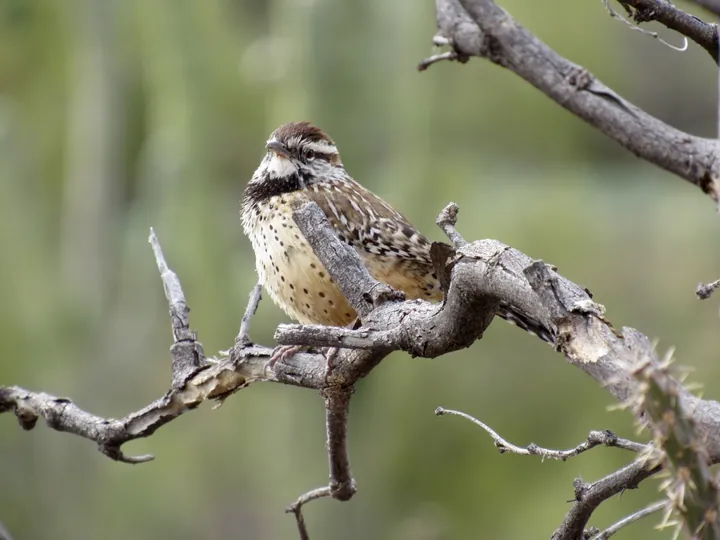
The Arizona state bird is the Cactus Wren. Arizona State Parks says it was designated in 1931, and the law, Arizona Revised Statutes § 41-854, names “The cactus wren, otherwise known as Coues’ cactus wren,” with an old scientific name, heleodytes brunneicapillus couesi (Sharpe).
Updated
Why does Arizona's law call it Coues' cactus wren?
Because that was the bird's official name in 1931. The American Ornithologists' Union's Check-list of North American Birds of that year lists the “Northern Cactus Wren” as Heleodytes brunneicapillus couesi (Sharpe), the same name Arizona's law uses (AOU Check-list, 1931; A.R.S. § 41-854).
The name has a twist: it rests on a bird from Texas. The Check-list gives its type locality, the place the first described specimen came from, as Laredo, Texas, and R. Bowdler Sharpe's 1881 description, in the British Museum's catalog of its birds, lists a skin collected at Laredo on February 28, 1867 (Sharpe, 1881).
Sharpe gave the cactus wrens of the United States the new name Campylorhynchus couesi because he believed the older name described a different bird. “It is strange that Lafresnaye's name should have been so long used for this species,” he wrote, pointing to doubts raised by “Professor Baird and Dr. Coues.”
Later ornithologists went back to the older name. The AOU's 1983 Check-list calls the species Campylorhynchus brunneicapillus, named by Lafresnaye in 1835 from a bird said to come from California, which the Check-list calls an error for the coast of southern Sonora, in Mexico (AOU Check-list, 1983). AviList uses the same name today. Arizona's law kept the 1931 one.
Who was Coues?
Elliott Coues was an army doctor and one of the first to list the birds of Arizona. His List of the Birds of Fort Whipple, Arizona, published in 1866 and signed “Assistant Surgeon U. S. Army,” took in every other species then known to live in the Territory as well (Coues, 1866).
The cactus wren is on his list, with an honest note: “Common in the southern and western portion of the Territory. Not observed at Whipple.” So the bird that later carried his name was one he had not seen at his own fort.
When did the cactus wren become Arizona's state bird?
In 1931. “The cactus wren was designated as Arizona's state bird in 1931,” says Arizona State Parks, which adds its own explanation, that the bird symbolizes “the rugged beauty and resilience of the desert environment.”
The statute, section 41-854, gives no year (Arizona Legislature), and we could not open the 1931 act or the legislative journal behind it, so this page names no bill, no day and no sponsor. Some newspaper stories name them; we have not been able to check those against the record.
Arizona's neighbors were choosing birds at the same time. Colorado adopted the Lark Bunting in 1931, and California the California Quail the same year.
Where do cactus wrens build their nests?
In the spiniest plants they can find. Cactus wrens build “large, football-shaped nests,” Arizona State Parks says, mostly in cholla, saguaro, mesquite and palo verde, out of grasses, twigs and feathers.
The National Audubon Society's guide describes the shape exactly: a football lying on its side, with the entrance at one end and a narrow tube leading to the nest chamber. Both birds build it, usually less than 10 feet off the ground.
They build more than one. A pair may make several nests and use some only for roosting, the parks department says, and the guide adds that the male may build extra “dummy” nests while the female sits on the eggs. After the breeding season, cactus wrens may sleep in their nests at night.
They can be rough neighbors: adults sometimes puncture the eggs of other birds nesting nearby, the guide says.
Is the cactus wren the largest wren in the United States?
Yes. At about 7 to 9 inches long it is “the largest wren in the United States,” says Arizona State Parks.
It belongs to a tropical group of big, sociable wrens, with eight species in Mexico, and it is “very different from our other temperate-zone wrens,” the Audubon guide says. Pairs may mate for life and stay together all year on one territory.
Listen for it before you see it. Its main call is “a harsh, raspy ‘cha-cha-cha’ sound,” in the parks department's words.
Where can you see cactus wrens in Arizona?
In the desert, and often in town. Arizona State Parks recommends Catalina State Park, at the foot of the Santa Catalina Mountains; Lost Dutchman State Park, among the saguaros and cholla of the Sonoran Desert; Picacho Peak State Park; and Alamo Lake State Park, where desert meets streamside habitat.
The Audubon guide says the bird is most numerous where cholla cactus is common, but it also lives in mesquite brush and in towns. Look for pairs or family groups strutting on the ground or hopping through the brush, often spreading their wings and tails as they call to each other.
It is a permanent resident, so any month will do. The oldest Cactus Wren in the federal banding records was a male banded in California on July 15, 2006, already past his first calendar year (age codes); his color marker was seen on the free bird there on July 17, 2013, when he was at least 8 years and 1 month old (USGS Bird Banding Laboratory; see the oldest wild birds).
Why is the Arizona state bird shown in a photograph?
Because Audubon never painted it. The Cactus Wren is not on any of the 435 plates of his Birds of America (all of Audubon's plates) or the 500 plates of its smaller octavo edition, and his five volumes of bird biographies have no account of it.
So this page shows a photograph by CK2AZ, shared under a Creative Commons license that asks for credit, which is why the credit names the license.
Does any other state have the cactus wren?
No. Arizona is the only state with the Cactus Wren. Its neighbors chose the California Quail (California), the Mountain Bluebird (Nevada), the California Gull (Utah), the Greater Roadrunner (New Mexico) and the Lark Bunting (Colorado).
Questions about the Arizona state bird
When did the cactus wren become Arizona's state bird?
In 1931, according to Arizona State Parks. The law is Arizona Revised Statutes § 41-854.
Why is the cactus wren Arizona's state bird?
No record we could read gives the Legislature's reason. Arizona State Parks says the bird symbolizes the rugged beauty and resilience of the desert.
Is the cactus wren the largest wren in the United States?
Yes. Arizona State Parks puts it at about 7 to 9 inches long, the largest wren in the country.
Where do cactus wrens nest?
In cholla, saguaro, mesquite and palo verde, in large football-shaped nests. A pair builds several and roosts in some of them.
What is Arizona's state bird and flower?
The cactus wren is the state bird, and the saguaro's blossom is the state flower. Arizona's law names “the pure white waxy flower” of the giant cactus, the saguaro.
What is Arizona's state animal?
Arizona names a state mammal: the ringtail. The same law, Arizona Revised Statutes § 41-859, also names a state reptile, fish and amphibian.
Birdfolio prints a birder’s life list as a book, each species beside a classic painting. Look inside a Birdfolio.