State birds
What is the Maryland state bird?
The Maryland state bird is the Baltimore Oriole. Chapter 54 of the Acts of 1947, approved on February 26, 1947, noted that Maryland had “no official State Bird” and chose the oriole, whose black and orange it tied to Lord Baltimore's coat of arms. The law is now General Provisions § 7-301.
Updated
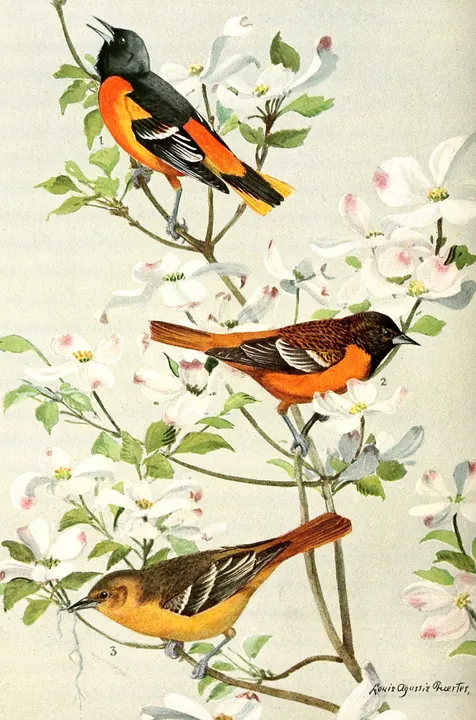
Did the Baltimore Oriole lose its name?
For a while, and the timing was awkward for Baltimore. By 1983 the American Ornithologists' Union, which keeps the standard list of North American bird names, listed Icterus galbula only as the “NORTHERN ORIOLE,” noting that the eastern birds had often been treated as a species of their own (AOU Check-list, 1983). That same year the Baltimore Orioles won the World Series (Maryland Manual).
So, as MLB.com put it in 2021, for a stretch “the baseball Orioles were the only Baltimore Orioles, at least technically.”
The merger didn't last. The bird is the Baltimore Oriole once more in today's world list of birds, AviList, and in Maryland's law, which kept the name all along.
What did a king want with Maryland's birds?
A hundred mockingbirds, to begin with. In 1698 a letter from Whitehall, dated “the 5th of February 1697/8,” told Maryland's Council of “his Majestys pleasure to have one hundred Mocking Birds Sent for his Volary at Loo.” A volary is an aviary. The king was William III, and Loo, we take it, was his palace of Het Loo in the Netherlands.
The Council added birds of its own. It ordered the sheriffs to have “the Poorer sort of Inhabitants” catch “Blew Birds, Baltemore Birds, Black Birds Wth Red Wings” and other curiosities, the governor “assuring them that he will see them paid for them” (Proceedings of the Council, p. 455 and p. 456).
So the oriole already had its Maryland name in 1698. Where that name came from was another matter.
Is the Baltimore Oriole named after Lord Baltimore?
That is the story, and it was already a story in 1731. Mark Catesby, on whose “Baltimore-Bird” Linnaeus based his 1758 name for the species, wrote: “It is said to have its name from the Lord Baltimore's coat of arms” (Catesby, vol. 1, on the Internet Archive).
Catesby gave the arms in heraldry's language, “topaz and diamond”: gold and black. The Calvert “colors of gold and black” still appear on Maryland's flag, the Maryland Manual says; the Calverts were the Lords Baltimore. The 1947 law spoke of black and orange, and the Manual's own bird page settles on “black and golden orange” (Maryland Manual, state bird).
Catesby knew the bird from just two colonies: he had seen this gold-colored bird, he wrote, only in Virginia and Maryland.
How did the oriole become the Maryland state bird?
By an act that began by admitting Maryland had none. Chapter 54 of 1947, Senate Bill 180, opened with a preamble noting that the state “at the present time has no official State Bird.” It praised the oriole as “a bird of great beauty” with “a sentimental attachment to the history and traditions of Maryland” (Laws of Maryland 1947).
The act was approved on February 26, 1947, and took effect on June 1. Today the law, General Provisions § 7-301, needs only one sentence: “The Baltimore Oriole (Icterus galbula) is the State bird.”
Maryland had protected the bird long before it honored it. Chapter 154 of the Laws of 1882, approved March 30, 1882, made it illegal to “shoot or in any manner catch, kill or have in possession” a Baltimore Oriole, or to disturb its nest or eggs, on pain of a fine of 10 to 20 dollars for each bird (Laws of Maryland 1882, p. 207 and p. 208).
The act also gave people a reason to report a killer: “one-half of all fines imposed shall go to the informer.”
Where did the baseball Orioles get their name?
Nobody can say for sure. Baltimore's ballclubs have been called the Orioles since 1882: “A team called the Baltimore Orioles played in the American Association from 1882 to 1891,” the Maryland Manual records. Why that first club chose the name, the records we found don't say.
One Orioles club became famous somewhere else. The American League's Orioles of 1901 “relocated to New York City following the 1902 season” and “later would become the New York Yankees,” the Manual says. The Yankees keep their distance: “The New York Yankees don't recognize the Baltimore Orioles in their official team records,” Gordon J. Gattie writes for the Society for American Baseball Research (SABR).
Today's Orioles came from St. Louis. Formerly the St. Louis Browns, they made their debut at Memorial Stadium on April 15, 1954, and have won the World Series three times, in 1966, 1970 and 1983. The bird has a tune of its own as well: Hoagy Carmichael wrote the song “Baltimore Oriole” in the late 1930s, the Manual notes.
When can you see Baltimore Orioles in Maryland?
From spring into fall. “Baltimore Orioles rarely winter in Maryland,” says the state's Department of Natural Resources. They come back “in March through April” and nest across the state in large trees in open country, “along country roads, in towns, or edges of woods near streams.” The eggs, four to six of them, are laid in May and June.
You can help with the nest. Orioles will use “short pieces of colored yarn (no longer than four inches),” the DNR says.
There are fewer of them than there were. The Manual says the oriole's numbers have fallen since 1966, and faster after 1980, as Dutch elm disease, pesticides and the loss of breeding and tropical wintering grounds took their toll; the DNR says the decline “may approach a rate of 2% annually.”
The oldest Baltimore Oriole in the federal banding records was a male banded in Minnesota on July 28, 1996, and caught there in 2007, the record says, “by or due to: hawks, owls, or other raptors.” It was at least 12 years old (USGS Bird Banding Laboratory; more on our page of the oldest wild birds).
Does any other state have the Baltimore Oriole?
No. Of the 50 state birds in our table, the Baltimore Oriole is Maryland's alone. Its neighbors chose other birds: Pennsylvania the Ruffed Grouse, Virginia and West Virginia the cardinal, and Delaware a breed of farm chicken, the Blue Hen.
Audubon's own orioles, and his account of how a pair builds its hanging nest, are on our Baltimore Oriole painting page.
Questions about the Maryland state bird
When did the Baltimore Oriole become Maryland's state bird?
In 1947. Chapter 54 of that year's laws (Senate Bill 180) was approved on February 26 and took effect on June 1, 1947.
Why is it called the Baltimore Oriole?
Its colors were said to match Lord Baltimore's coat of arms; Mark Catesby was already writing “It is said” about that in 1731. Maryland's 1947 law gives the same reason.
Was the Baltimore Oriole ever called the Northern Oriole?
Yes. By 1983 the American Ornithologists' Union listed it only as the Northern Oriole. It is the Baltimore Oriole again today.
Do Baltimore Orioles stay in Maryland in winter?
Rarely. Maryland's DNR says they return in March and April and nest across the state.
What is Maryland's state bird and flower?
The Baltimore Oriole is the state bird, and the Black-Eyed Susan is the state flower. The General Assembly named it Maryland's “Floral Emblem” in 1918, the Maryland State Archives says.
What is Maryland's state animal?
Maryland has none. Its official symbols, as the Maryland State Archives lists them, include a state dog, a state cat and a state horse, but no state animal.
Birdfolio prints a birder’s life list as a book, each species beside a classic painting. Look inside a Birdfolio.
Orders open on November 1.