In short: The Northern Cardinal is the state bird of seven states: Illinois, Indiana, Kentucky, North Carolina, Ohio, Virginia and West Virginia, more than any other bird. Kentucky chose it first, by a resolution approved on February 17, 1926, and Virginia last, in 1950. What the states' own records say about the bird is simple: cardinals stay all year, the male is bright red, and it sings.
The seven cardinal states, in order
| State | Year | How it was chosen |
|---|---|---|
| Kentucky | 1926 | A resolution approved February 17, 1926. The law today calls it "the native redbird, commonly known as the Kentucky cardinal." |
| Illinois | 1929 | A vote of Illinois schoolchildren. The other candidates were the bluebird, meadowlark, bobwhite and oriole. |
| Indiana | 1933 | An act of 1933 naming the "Red Bird or Cardinal" |
| Ohio | 1933 | Named in 1933, says the Ohio Department of Natural Resources |
| North Carolina | 1943 | A statewide vote run by the North Carolina Bird Club, then Session Laws 1943, chapter 595 |
| West Virginia | 1949 | House Resolution 12, March 7, 1949, which let public school pupils and civic organizations name the bird |
| Virginia | 1950 | Chosen by the General Assembly, as Cardinal News reports; the Code of Virginia's history for the law begins in 1950 |
The National Audubon Society's field guide puts the count the same way: the cardinal is "the official state bird of no fewer than seven eastern states."
Why did so many states choose the cardinal?
No national rule picked it. Each state chose its own bird, and the reasons in the record overlap:
- It stays all year. The Audubon field guide calls the cardinal a "permanent resident throughout its range." Illinois's state booklet says "Cardinals live in Illinois all year," and Indiana's Historical Bureau says the same of Indiana.
- It's bright, and it sings. The measure Virginia passed in 1950, as Cardinal News quotes it, says "the Cardinal by reason of its bright plumage and cheerful song is worthy of selection." Illinois's booklet adds that "both the male and female sing." John James Audubon, in his Ornithological Biography, lists Red Bird and Virginia Nightingale among its names.
- It passed the tests of the day. When Tennessee's ornithologists ran their state bird campaign in 1933, they judged candidates on "state-wide distribution, beauty and distinctiveness of marking and song," on economic value, and on "permanent and nesting residence" (The Migrant, March 1933). A widespread, year-round, bright red songbird covers most of that list.
- The timing. All seven chose between 1926 and 1950, when many states picked their birds through school votes and campaigns by women's clubs and bird clubs. Cardinal News reports that Katherine B. Tippetts, conservation chair of the General Federation of Women's Clubs in the 1920s, campaigned for every state legislature to name a state bird. Illinois, North Carolina and West Virginia let the public choose.
Which state chose the cardinal first?
Kentucky. The Kentucky Legislature's own history page says: "In a resolution, approved February 17, 1926, the cardinal became the official Kentucky state bird." That is three years before Illinois, the next of the seven. Kentucky's statute, KRS 2.080, still calls it "the native redbird."
The states that went another way
Tennessee, 1933. Tennessee held a statewide vote, and the cardinal came third. The Migrant printed the final count in March 1933: mockingbird 15,553, robin 15,073, cardinal 13,969, bobwhite 10,460 and bluebird 9,125, out of 72,931 votes. The mockingbird is also the Texas state bird.
North Carolina, the other way round. In 1933, at the suggestion of the North Carolina Federation of Women's Clubs, the General Assembly named the Carolina Chickadee the state bird by Resolution 51, then repealed it a week later (Session Law 1933-521). The chickadee's nickname was the tomtit, and, as NCpedia puts it, "legislators balked at the idea that North Carolina might become known as the 'Tomtit State.'" Ten years later North Carolina tried again with a statewide vote. More than 23,000 votes were cast; the cardinal won with a plurality of 5,000, and the dove came second with 3,395.
Colorado, 1931, wanted the opposite of a shared bird. According to the Denver Public Library's history of the choice, its lawmakers were won over by the fact that no other state had claimed the Lark Bunting. That story is on our page about the Colorado state bird.
Where can you see a cardinal?
In any of the seven states, in any month, since cardinals don't migrate. They are regulars at feeders: the Audubon field guide says feeders stocked with sunflower seeds may have helped the cardinal spread north.
The oldest known wild cardinal was a female, banded in Pennsylvania on March 16, 1956, and caught again there on March 17, 1971: at least 15 years and 9 months old, by the USGS Bird Banding Laboratory's records. That is a record from bird banding, not a typical lifespan.
Audubon's cardinal
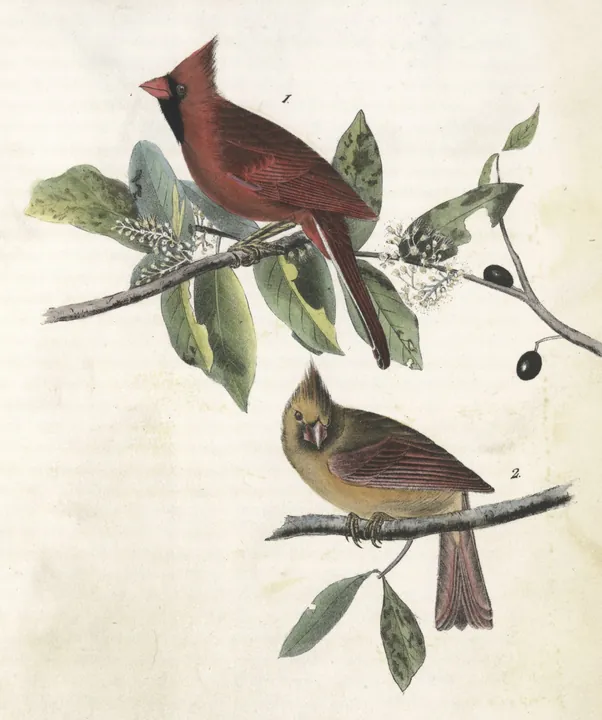
The painting above is Audubon's "Common Cardinal Grosbeak," plate 203 of the octavo edition of The Birds of America, a male and a female on wild almond. In his big Havell edition the cardinal is plate 159, "Cardinal Grosbeak". Kentucky's legislative history page illustrates its state bird with an Audubon print too. More classic portraits of the bird are on our Northern Cardinal painting page.
Birdfolio prints a birder's life list as a book, each species beside a classic painting.
Every state's bird
The cardinal's seven states, and every other state's bird with its year and official source, are in our table of state birds of all 50 states. These states have a page of their own: Texas, Colorado, Oregon, Nebraska, Montana and Maine.
Questions people ask
How many states have the cardinal as their state bird?
Seven: Illinois, Indiana, Kentucky, North Carolina, Ohio, Virginia and West Virginia.
Which state chose the cardinal first?
Kentucky, by a resolution approved on February 17, 1926.
Which state chose it last?
Virginia, in 1950.
Is the cardinal the most common state bird?
Yes. Seven states chose it. The Western Meadowlark is next, with six states, then the Northern Mockingbird, with five.
Why isn't the cardinal Tennessee's state bird?
It came third in Tennessee's 1933 vote, behind the mockingbird and the robin.