State birds
What is the Virginia state bird?
The Virginia state bird is the Northern Cardinal. The General Assembly chose it in 1950 with House Joint Resolution 9, but the bird was left out of the Code of Virginia's list of state emblems until a 2016 law added it to Section 1-510.
Updated
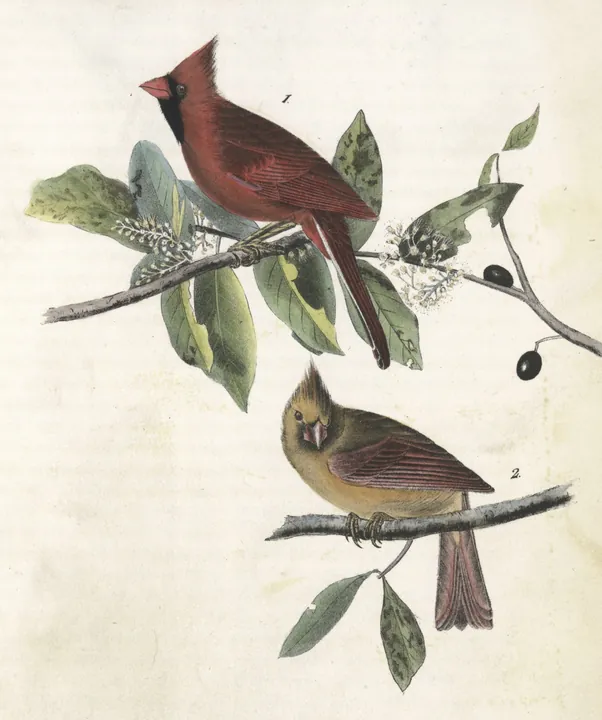
When did the cardinal become Virginia's state bird?
In 1950, when the General Assembly adopted House Joint Resolution 9, as the Virginia Legislative Information System records in the history of a 2016 bill. The resolution's preamble, as Cardinal News quotes it, noted that Virginia “has not selected any official bird, which action has been taken by many other States.”
It gave its reason in a single line: “the Cardinal by reason of its bright plumage and cheerful song is worthy of selection.” Virginia was the last of the seven cardinal states; Kentucky was the first, in 1926.
Why was the cardinal missing from Virginia's law books?
By oversight. Virginia lists its official emblems in Code of Virginia § 1-510, and until 2016 neither the cardinal nor the state tree was on the list. That year H.B. 335 added “the Northern Cardinal as the state bird and the American Dogwood as the state tree,” both “adopted as HJ 9 (1950) and HJ 6 (1956), respectively,” which “had been inadvertently omitted.”
The House passed it 98 to 0, and the governor approved it on March 7, 2016, as chapter 278 of that year's Acts, in force from July 1, 2016. A Senate bill about the state rock, S.B. 352, made the same correction and became chapter 675 (2016 Session Highlights).
Where can you see cardinals in Virginia?
In almost any backyard, in any month. The Virginia Department of Wildlife Resources suggests beginners start with two “very vocal, common backyard birds,” the Northern Cardinal and the Carolina Wren. Cardinals don't migrate: the National Audubon Society's guide calls the species a “permanent resident throughout its range.”
If you feed them, the department has one Virginia tip: because of bears, “it is best to put out feeders only from November–March.”
Cardinals can live a long time. The oldest in the federal banding records was a female banded in Pennsylvania in March 1956 and found again there in March 1971, at least 15 years and 9 months old (USGS Bird Banding Laboratory; see our list of the oldest wild birds).
What did Audubon call the cardinal?
The Cardinal Grosbeak, and he knew its nicknames. In the octavo Birds of America he wrote that the bird “is known by the names of Red-bird, Virginia Nightingale, Cardinal-bird,” and ranked it first of its family “in richness of plumage, elegance of motion, and strength of song” (Audubon's text, vol. 3).
He noticed that the female sings too: while she sits on the eggs the male sings to her, “and at times she also assists.” And he saw what a cage does to its color: “The purity of its colouring is soon lost when it is kept in confinement.”
The painting on this page is his octavo plate 203; his larger Havell edition has the cardinal on plate 159. More of his cardinals are on our Northern Cardinal painting page.
Which other states have the cardinal as their state bird?
Six others: Illinois, Indiana, Kentucky, North Carolina, Ohio and West Virginia, which makes the Northern Cardinal the state bird of seven states, more than any other bird. Several let the public choose: Illinois schoolchildren voted, and North Carolina held a statewide vote before its 1943 law.
Why so many states settled on one bird is the subject of our guide: why is the cardinal the state bird of 7 states?
Questions about the Virginia state bird
When did the cardinal become Virginia's state bird?
In 1950, by House Joint Resolution 9 of the General Assembly.
Is the cardinal in the Code of Virginia?
Yes, since 2016. A 2016 law added it to Section 1-510, noting it had been “inadvertently omitted.”
Do cardinals stay in Virginia in winter?
Yes. Cardinals don't migrate, so Virginians can see them all year, often at feeders.
Why is the cardinal the state bird of so many states?
Seven states chose it between 1926 and 1950, Virginia last. It stays all year and the red male is easy to recognize; our cardinal guide has the full story.
Birdfolio prints a birder’s life list as a book, each species beside a classic painting. Look inside a Birdfolio.
Orders open on November 1.