State birds
What is the New Hampshire state bird?
The New Hampshire state bird is the Purple Finch. The 1957 Legislature chose it over the New Hampshire hen, Governor Lane Dwinell signed the bill on April 25, 1957, and the law, RSA 3:10, says “The purple finch is hereby designated as the official state bird of New Hampshire.”
Updated
Why did the purple finch beat the New Hampshire hen?
Because it had better friends. In 1957 Rep. Robert S. Monahan of Hanover, then a Dartmouth College forester, filed a purple finch bill on February 12, Lincoln's birthday, and later testified that it had the backing of the Audubon Society of New Hampshire, the New Hampshire Federation of Garden Clubs and the State Federation of Women's Clubs, the New Hampshire Almanac says.
The hen had a champion too. Rep. Doris M. Spollett of Hampstead, a veteran legislator, mail carrier and breeder of prize goats, sponsored the New Hampshire hen once again; she had lost her first bid for it eight years earlier, while she served in the Senate.
Monahan wanted speed, urging quick action “before some other state beats us to it.” The House Committee on Recreation, Resources and Development heard his bill on March 27, the House passed it, the Senate agreed, and Governor Lane Dwinell of Lebanon signed it on April 25. The hen bill, as the almanac tells it, was left in a pigeonhole.
The almanac, compiled by the New Hampshire State Library, sums it up: “The pert little purple finch toppled the one-time sturdy New Hampshire hen.” The law's own record agrees on the day: RSA 3:10 took effect on April 25, 1957 (RSA 3:10).
Did the New Hampshire hen ever get a title?
Sixty-one years later, a farm bird did. Since 2018 the New Hampshire Red has been “the official state poultry of New Hampshire,” under RSA 3:29, in the same chapter of the law as the purple finch (RSA chapter 3).
A year later New Hampshire added a state raptor: RSA 3:30, in force since June 14, 2019, names “The red-tailed hawk, Buteo jamaicensis.” Classic paintings of it are on our Red-tailed Hawk page.
Neither one replaced the purple finch, which remains “the official state bird of New Hampshire.”
Did Audubon eat purple finches?
He said so. In the first volume of his Ornithological Biography (1831), Audubon described purple finches wintering in Louisiana, flocks of six to twenty that husked buds at the tips of branches, where “they hang like so many Titmice” (Audubon's text, vol. 1).
Some farmers called them destructive, accusing them of stripping the blossoms from fruit trees, but Audubon “never observed this in Louisiana.” Then he added, plainly, “I have eaten many of them,” and judged the meat as good as any small bird's, except the Rice Bunting.
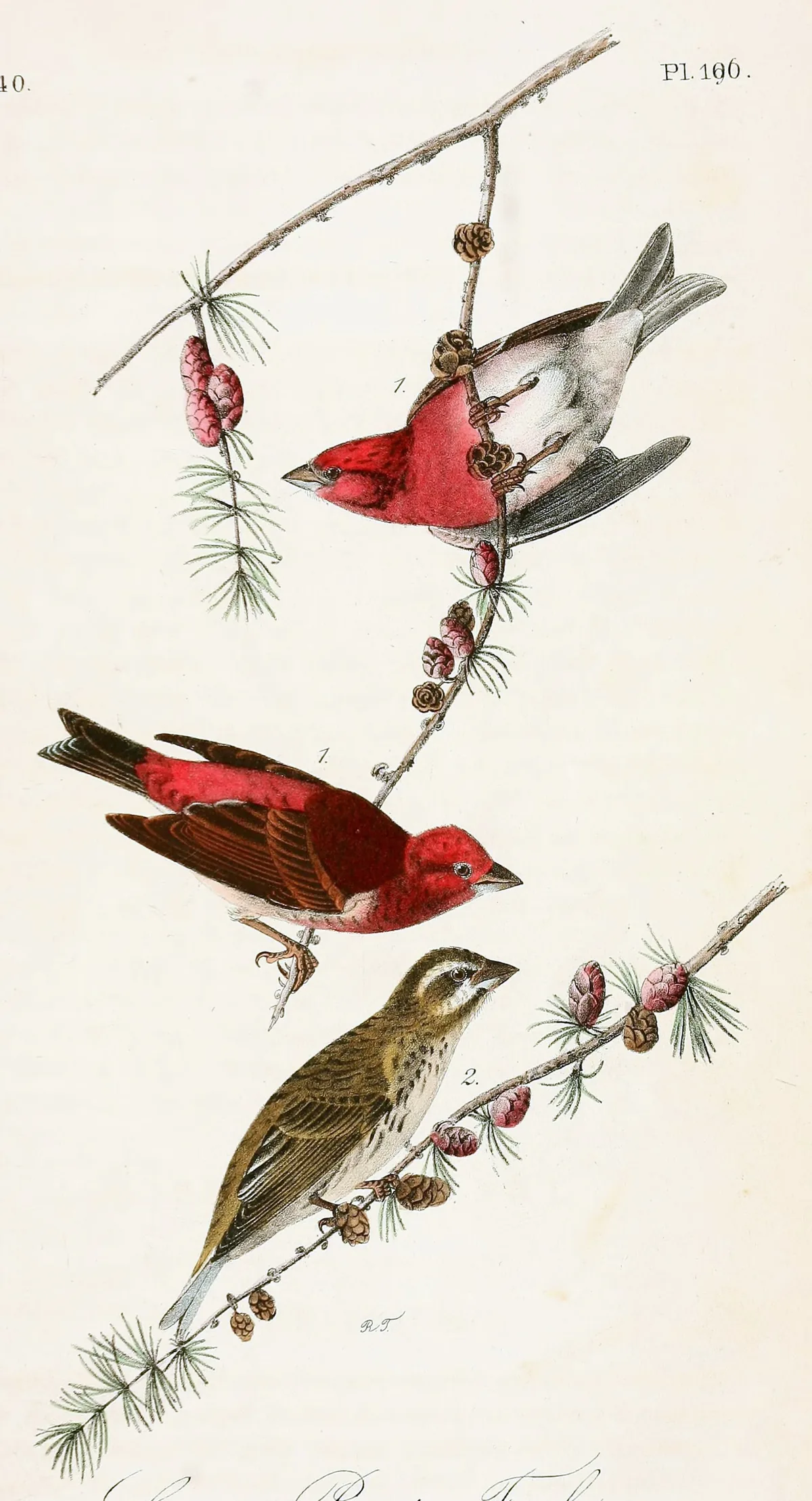
The purple finch was among his first pictures in print: it is plate 4 of the big Havell edition of The Birds of America. The painting on this page is his later octavo version, which he titled “Crested Purple Finch.”
Is the purple finch really purple?
Not quite. The National Audubon Society's guide puts it plainly: “Not really purple, more of an old-rose color.” The female is brown and streaked, as in the painting.
The guide also says purple finches have grown scarcer at feeders in the Northeast, where competition with House Sparrows and then House Finches “may have driven them back into the woods.”
Where can you see a Purple Finch in New Hampshire?
In the woods first, and at feeders when they come. The Audubon guide says the purple finch breeds mostly in coniferous and mixed woods, and in migration and winter turns up in many kinds of wooded and half-open country, suburbs included.
For a trip, Audubon magazine names the Purple Finch among the birds to look for around the Connecticut Lakes.
Small birds can live long lives. The oldest Purple Finch in the federal banding records was banded in North Carolina on March 14, 1960, already past its first year (age codes), and caught and released there on February 4, 1972: at least 12 years and 8 months old (USGS Bird Banding Laboratory; see the oldest wild birds).
How to tell a Purple Finch from a House Finch
The Oklahoma Department of Wildlife Conservation describes a bird the size of a sparrow, with a notched tail, about 4.7 to 6.3 inches long. On the male, the breast, throat and head are raspberry red; the female has a clear white eyebrow and a white mustache. The look-alike is the House Finch, and Tennessee's watchable wildlife guide gives the difference: the House Finch is slimmer, and its tail is not notched.
Does any other state have the purple finch?
No. New Hampshire is the only state with the Purple Finch. Its neighbors chose Maine and Massachusetts the chickadee, and Vermont the Hermit Thrush.
Its look-alike, the House Finch, has a page of classic paintings of its own: see our House Finch paintings.
Questions about the New Hampshire state bird
When did the purple finch become New Hampshire's state bird?
In 1957. Governor Lane Dwinell signed the bill on April 25, 1957, and it is now RSA 3:10.
Why is the purple finch the state bird of New Hampshire?
Because the 1957 Legislature preferred it to the New Hampshire hen. Its bill had the backing of the state's Audubon Society, garden clubs and women's clubs, the New Hampshire Almanac says.
Is a purple finch the same as a house finch?
No. They are two different species; the House Finch is slimmer, and its tail is not notched.
What is New Hampshire's state bird and flower?
The purple finch is the state bird, and the purple lilac is the state flower, by a 1919 law. The pink lady's slipper has been the state wildflower since 1991.
What is New Hampshire's state animal?
The white-tailed deer, by a 1983 law. RSA 3:12 names “The white tail deer.”
Birdfolio prints a birder’s life list as a book, each species beside a classic painting. Look inside a Birdfolio.