State birds
What is the Washington state bird?
The Washington state bird is the American Goldfinch, which the law still calls the willow goldfinch. Senate Bill 318 made it official in 1951, approved on March 19, and the law today, RCW 1.20.040, reads: “The willow goldfinch is hereby designated as the official bird of the state of Washington.”
Updated
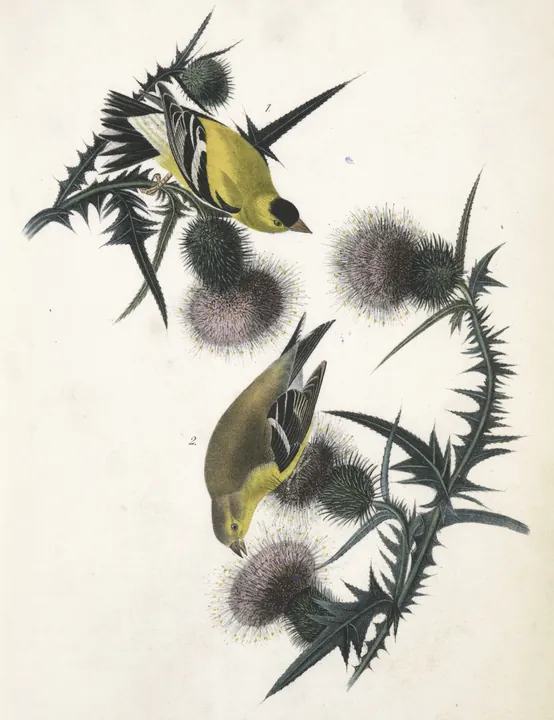
Why did it take Washington 23 years to choose a state bird?
Because it chose twice. In 1928, the Washington State Legislature recounts, lawmakers let schoolchildren pick the state bird, and “the meadowlark won hands-down.” But the meadowlark was already the bird of other states. In 1931 the Washington Federation of Women's Clubs held a vote of its own, and “the goldfinch won handily over the tanager, song sparrow, junco and pileated woodpecker.”
“Washington now had two unofficial state birds,” the Washington State Library writes in its history of the fight, which it sums up as “23 years of bickering and grandstanding.” In 1943 the Senate passed Senate Bill 134, naming the goldfinch the state bird and the rhododendron the state flower, but the House never acted on it.
Garden clubs finished the job. In 1951 Emma Otis, bird chairman of the Capital District of Garden Clubs, moved that the clubs back “the Willow Goldfinch as the official bird of the State of Washington” (State Library, Volume 2). Senator Carlton Sears of Thurston County introduced Senate Bill 318 on February 15, 1951; it passed the Senate on March 1 and the House on March 6, and was approved on March 19 (Session Laws of 1951, chapter 249). According to the Legislature, schoolchildren voted again in 1951.
What is a willow goldfinch?
The goldfinch of the Pacific Coast, and the name was coined in California. In 1897 the ornithologist Joseph Grinnell described it in The Auk as a new subspecies, Spinus tristis salicamans, and gave it the English name Willow Goldfinch. His type specimen came from Pasadena, collected on December 21, 1895, and he called the bird “a characteristic inhabitant of the willow copses which border the marshes.”
Birders today count it as part of one species, the American Goldfinch. Washington has more than one form of it: Seattle Audubon's BirdWeb notes that “the Cascades divide the two subspecies found in Washington.” The law keeps the western bird's old name.
When can you see goldfinches in Washington?
From spring to fall, in almost any weedy corner of the lowlands. BirdWeb calls the goldfinch “common from mid-April to mid-October in appropriate habitat throughout Washington's lowlands.” Look along brushy field edges, especially where thistle grows, and at backyard feeders.
Winter thins them out. Many of the state's breeding goldfinches leave, and more of those that stay are east of the Cascades, especially along the Columbia and Snake Rivers, BirdWeb says. The males change color for the season: the National Audubon Society's guide says they turn dull brown in winter, and calls the goldfinch a late nester, with most nesting in July and August.
They were not always common west of the mountains. In western Washington, BirdWeb says, goldfinches were formerly rare, and they spread as logging, farms and suburbs opened the forest into weedy second growth.
A goldfinch can live for more than a decade. The oldest one in the federal banding records was banded in Maryland in February 2004 and caught again there in May 2013, at least 10 years and 11 months old (USGS Bird Banding Laboratory; more records on our page of the oldest wild birds).
What is the difference between a goldfinch and a mugwump?
It was asked on the Senate floor in 1943. As the State Library tells it, quoting the Seattle Times of February 9, 1943, Senator Barney Jackson asked, “What is the difference between a goldfinch and a mugwump?” Senator Paul G. Thomas answered that “a mugwump is something that just sits on a fence.” The goldfinch bill then sat in the House for eight more years.
Emma Otis's notes from 1951 have a line of their own about the bird: “Responsibility seems to rest lightly upon the shoulders of the goldfinch.”
The goldfinch has had a challenger since. Senate Bill 5820 of 2011 proposed “designating the great blue heron as the official bird of the state of Washington.” It went to committee and no further, and the law still names the willow goldfinch. Audubon painted the heron too: see our Great Blue Heron painting page.
Did Audubon know Washington's goldfinch?
He knew it reached the Northwest. In the text beside plate 181 of the octavo Birds of America he wrote: “This interesting species is found on the shores of the Columbia river” (Audubon's text, vol. 3).
He also described a caged goldfinch trained to haul up its own water in a tiny bucket, a bird that “would draw water for its drink from a glass.” More of his goldfinches, and portraits by other painters, are on our American Goldfinch painting page.
Which other states have the American Goldfinch?
Two: Iowa, which adopted it in 1933, and New Jersey. Both states call it the eastern goldfinch, so the three states use two old names, eastern and willow, for one species.
The meadowlark, the children's choice of 1928, is today the state bird of six states, among them Oregon and Montana.
Questions about the Washington state bird
Is the willow goldfinch the same as the American Goldfinch?
Yes. The willow goldfinch is the Pacific Coast form of the American Goldfinch, named by Joseph Grinnell in 1897; Washington's law keeps that name.
When did the goldfinch become Washington's state bird?
In 1951. Senate Bill 318 was approved on March 19, 1951, and is now RCW 1.20.040.
Do goldfinches stay in Washington in winter?
Some do, mostly east of the Cascades along the Columbia and Snake Rivers, but many of the state's breeding goldfinches leave, Seattle Audubon's BirdWeb says.
Why isn't the meadowlark Washington's state bird?
Schoolchildren picked it in 1928, but other states already had it, and in 1931 the Washington Federation of Women's Clubs voted for the goldfinch instead.
Birdfolio prints a birder’s life list as a book, each species beside a classic painting. Look inside a Birdfolio.
Orders open on November 1.