State birds
What is the Louisiana state bird?
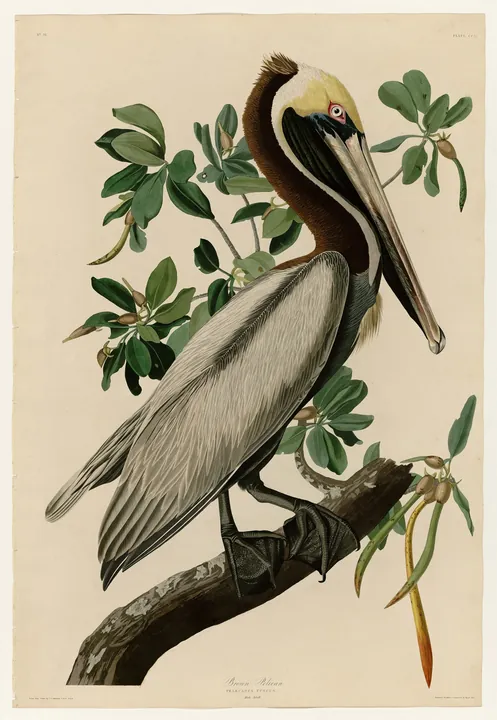
The Louisiana state bird is the Brown Pelican. Louisiana Revised Statutes 49:159 makes it the official bird “After July 27, 1966,” the pelican “as it presently appears on the seal of the state of Louisiana”; the section was first enacted in 1958 and amended in 1966.
Updated
Why does the pelican on Louisiana's flag have blood on it?
Because a 2006 law requires it. Louisiana's flag and seal show a pelican “tearing its breast to feed its young,” and since Act No. 92 of 2006 both designs “shall include an appropriate display of three drops of blood” (R.S. 49:153, the state flag; R.S. 49:151, the state seal).
The flag law describes the banner “now in general use”: a solid blue field with the pelican and its young in white, over a white ribbon bearing the state motto in blue, “Union, Justice and Confidence.” The 2006 act told state agencies not to throw away flags or stationery with the old seal, but to bring in the new design.
Real pelicans live on fish. The Brown Pelican's diet “is almost entirely fish,” such as menhaden, says the National Audubon Society's guide.
When did the Brown Pelican become Louisiana's state bird?
In 1966, by the law now in force. Section 49:159 names the Brown Pelican as it appears on the seal and directs its use on the seal, on “other insignia of the state and on all official documents” (R.S. 49:159).
The section itself is older. Its history line cites Acts 1958, No. 486, amended by Acts 1966, No. 457. We could not find the text of either act, so we can't say what the 1958 version said; July 27, 1966, is the date the law in force gives.
That date hides a twist. When the 1966 law named it the official bird, Louisiana had no brown pelicans at all: they had vanished by 1963, and the first birds of a long restocking arrived only in 1968.
Did brown pelicans disappear from Louisiana?
Yes. Before 1920 Louisiana had an estimated 50,000 to 85,000 brown pelicans, and “By 1963, the brown pelican had completely disappeared from Louisiana,” the U.S. Fish and Wildlife Service wrote in 2009, when it took the species off the endangered list (Federal Register, Nov. 17, 2009).
A pesticide was the likely cause. The Service named endrin “the probable cause” of the decline: first used in the Mississippi River Basin in 1952, it washed off sugarcane fields in heavy rains, and an estimated six million menhaden, a pelican food fish, were found dead between 1960 and 1963.
DDT did harm too. Its breakdown product, DDE, hurt brown pelicans' nesting success in Louisiana and Texas and killed some Louisiana birds outright, the Service found.
How did brown pelicans come back to Louisiana?
From Florida, as chicks. Between 1968 and 1980, “1,276 nestling brown pelicans were transplanted from colonies in Florida to coastal Louisiana,” the Service records.
The poison was still there. More than 300 of the 465 birds released in Louisiana since 1968 died in April and May 1975, and chemists at Louisiana State University found seven pesticides in the brain tissue of five dead birds they tested.
Then the colonies took hold. Louisiana's wildlife surveys counted a peak of 16,501 successful nests, producing 39,021 young, in 2004. On December 17, 2009, the brown pelican came off the federal endangered list “due to recovery,” and it remains protected as a migratory bird.
How do brown pelicans keep their eggs warm?
With their feet, a South Carolina law explains. Its 2024 act making the eastern brown pelican the state seabird says that, unlike most birds, pelicans “incubate their eggs with the skin of their feet,” standing on the eggs and holding them under the webbing (South Carolina Code § 1-1-612).
That is why thin shells were a disaster: the same act's preamble says DDT left eggs with shells that broke during incubation. South Carolina keeps the Carolina Wren as its state bird; the pelican is its state seabird.
Where can you see brown pelicans in Louisiana?
Along the coast, wherever there is something to stand on. The Fish and Wildlife Service lists pelican roosts as “pilings, jetties, sandbars, and mangrove islets,” and in most places the birds use their nesting grounds as roosts all year.
Watch them fish. Brown Pelicans dive headfirst “from as high as 60 ft above water,” then tilt the bill down to drain the pouch before swallowing, the Audubon guide says.
Leave the nesting islands alone. Raccoon Island, one of Louisiana's largest colonies, belongs to the Isles Dernieres Barrier Islands Refuge, where the state's Department of Wildlife and Fisheries restricts public access, and North and Breton Islands, in Breton National Wildlife Refuge, are closed to visitors in the nesting season.
In winter Audubon found them on Louisiana's lakes: “they are seen on Lake Borgne and over Lake Pontchartrain,” he wrote, though never on the Mississippi above the tides. “They are very sensible to cold,” he added (Audubon's text, vol. 3), and the Service notes that hard freezes can kill them, though such freezes in Louisiana are infrequent.
Pelicans can live a long time. The oldest in the federal banding records was banded in South Carolina on June 17, 1972, before it could fly, at the age the Banding Lab calls “Local” (Banding Lab age codes). Caught in Florida on April 5, 2000, because of a parasite infestation, it was released alive, at least 27 years and 10 months old (USGS Bird Banding Laboratory; more on our page of the oldest wild birds).
More of Audubon's pelicans, among them the young bird of plate 421, are on our Brown Pelican painting page.
Does any other state have the Brown Pelican?
No. Of the 50 state birds in our table, the Brown Pelican belongs to Louisiana alone. Its neighbors all chose the mockingbird: Texas, Arkansas and Mississippi.
Questions about the Louisiana state bird
Why is the pelican Louisiana's state bird?
Louisiana's law ties the bird to the state seal: the official bird is the Brown Pelican “as it presently appears on the seal.” The seal and the flag show a pelican feeding its young.
When did Louisiana adopt the pelican as its state bird?
The law in force makes it the official bird after July 27, 1966. The section was first enacted in 1958 and amended in 1966.
Is the brown pelican still endangered?
No. The U.S. Fish and Wildlife Service took it off the federal endangered list on December 17, 2009, because it had recovered. It is still protected as a migratory bird.
Why are there drops of blood on the Louisiana flag?
A 2006 law requires the pelican on the flag and the seal, shown tearing its breast to feed its young, to include three drops of blood.
What is Louisiana's state bird and flower?
The Brown Pelican is the state bird, and the magnolia is the state flower, chosen by the Legislature in 1900, says the Louisiana House of Representatives. Since 1990 Louisiana has also had a state wildflower, the Louisiana iris.
What is Louisiana's state animal?
Louisiana names a state mammal: the black bear, made the official state mammal by a 1992 act (Louisiana Revised Statutes 49:161.1).
Birdfolio prints a birder’s life list as a book, each species beside a classic painting. Look inside a Birdfolio.
Orders open on November 1.