State birds
What is the Massachusetts state bird?
The Massachusetts state bird is the Black-capped Chickadee. Chapter 121 of the Acts of 1941, approved on March 21, 1941, made it the state bird in the same act that named the American elm the state tree, and the law still says “The chickadee (Penthestes atricapillus) shall be the bird or bird emblem of the commonwealth.”
Updated
When did the chickadee become the state bird of Massachusetts?
On March 21, 1941. That day Chapter 121 of the Acts of 1941 was approved, an act “designating the chickadee as the state bird and the American elm as the state tree” (Acts of 1941, Chapter 121).
It is a short law. It added two sections to Chapter 2 of the General Laws: section 8, “The American elm (Ulmus americana) shall be the tree or tree emblem of the commonwealth,” and section 9, in the same words, for the chickadee.
So the bird and the tree share a birthday, as the Secretary of the Commonwealth notes: both were adopted on March 21, 1941. Section 9 still reads as it did then (General Laws, Chapter 2, Section 9).
The elm has had a harder time since. The American elm, the Secretary's page says, “has been severely afflicted by Elm Disease.”
Why does the Massachusetts law say Penthestes atricapillus?
Because that was the chickadee's scientific name when the law was written. The American Ornithologists' Union's 1931 Check-list called the Black-capped Chickadee Penthestes atricapillus atricapillus (AOU Check-list, 1931).
Names kept moving after that. By 1983 the same Check-list had put it in Parus, as Parus atricapillus (AOU Check-list, 1983), and today's world list, AviList, calls it Poecile atricapillus. The bird never changed; the law's genus is simply two names out of date.
Maine's law goes the other way and gives no scientific name at all, only “the chickadee.”
The Secretary of the Commonwealth lists some folk names as well: the chickadee “is also known as the titmouse, tomtit, and the dickybird.”
Are chickadees as gentle as they look?
Not always, according to Audubon. In the fourth volume of his Ornithological Biography (1838) he called the chickadee “courageous and at times exceedingly tyrannical,” and wrote that it “will attack young birds, break their skulls, and feed upon their flesh,” which he had seen more than once (Audubon's text, vol. 4).
It eats almost anything, he added: insects and their eggs, berries, grapes, acorns, pine seeds, sunflower seeds, pokeberries, pears and “flesh of all kinds.” His verdict: “it may be truly called omnivorous.”
He also passed on a Boston naturalist's find. Dr. Brewer of Boston once found in a single chickadee hole a nest of skunk hair and moss large enough, he said, “to weigh two or more ounces.”
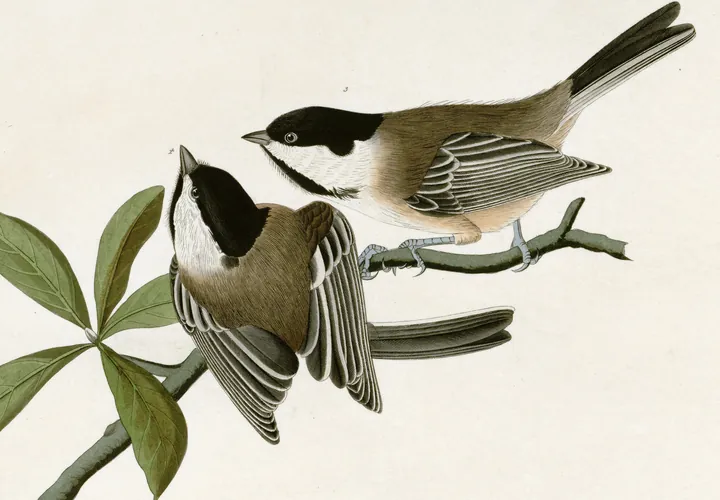
The picture on this page shows a gentler side: two chickadees from plate 353, which Audubon titled “Black-capt Titmouse.” More of his chickadee stories are on our Black-capped Chickadee painting page.
Does the State Library of Massachusetts collect chickadees?
In its way, yes. The library's Special Collections Department began gathering chickadee objects and pictures before a 2012 exhibition, “Amazing Birds: The Wild Side of Massachusetts,” and friends and family kept donating more, it wrote in 2016 (State Library blog, 2016).
One prize came out of a Cracker Jack box: a miniature booklet from the 1940s, 2¾ by 2⅛ inches, titled Chickadee, by John H. Eggers, with a copyright date of 1941, the year of the law.
An older piece is a bird card of 1922, one of a set of 30 issued by Church and Dwight Co. and illustrated by the English botanical artist Mary Emily Eaton. Its scientific name for the chickadee, the library points out, is wrong (State Library blog, 2014).
From January 13 to February 10, 2026, the library put Audubon's plate 353 on display for the nation's 250th birthday. At first, its preservation librarian admitted, “we couldn't find this bird in Birds of America,” because Audubon called it a titmouse (State Library blog, 2026).
Where can you see chickadees in Massachusetts?
Almost anywhere, in any month. The State Library calls them “hearty non-migratory birds” that can be seen “throughout the year (and in all corners of the Commonwealth).”
In winter they travel in little flocks, often with nuthatches, creepers and kinglets, says the National Audubon Society's guide. At a feeder a chickadee may take one sunflower seed at a time and fly off to stuff it into a crack in the bark.
Some autumns bring more than usual: the guide says the species occasionally stages “invasions,” with large numbers flying south, mostly in the northeastern states and southeastern Canada.
For nesting, the Secretary's page says, the chickadee uses a stump, a tree or a fence post close to the ground. Listen for its name in the call: “Chick-adee-dee-dee.”
Chickadees can live a long time for so small a bird. The oldest in the federal banding records was banded in New York in its first year, on November 19, 2009 (age codes), and caught and released there on March 24, 2021, at least 11 years and 9 months old (USGS Bird Banding Laboratory; see our page of the oldest wild birds).
What is the Massachusetts state game bird?
The wild turkey. Chapter 2, Section 36, of the General Laws makes it “the game bird and game bird emblem of the commonwealth” (General Laws, Chapter 2, Section 36), and the Secretary of the Commonwealth dates the choice to December 23, 1991.
Audubon painted that bird too, as our Wild Turkey painting page shows.
Which other state has the chickadee as its state bird?
One: Maine, which chose the chickadee in 1927, fourteen years before Massachusetts. Maine's law never says which chickadee, and a 2019 bill to settle it did not pass.
The rest of New England chose other birds: Connecticut the American Robin, New Hampshire the Purple Finch, Vermont the Hermit Thrush and Rhode Island a farm chicken, the Rhode Island Red.
Questions about the Massachusetts state bird
When did the chickadee become the Massachusetts state bird?
On March 21, 1941, when Chapter 121 of the Acts of 1941 was approved.
What is the Massachusetts state tree?
The American elm. The same 1941 act that named the chickadee made the elm the state tree.
Is the Massachusetts state bird the Black-capped Chickadee?
Yes. The law says the chickadee, Penthestes atricapillus, an old scientific name of the Black-capped Chickadee.
Do chickadees stay in Massachusetts in winter?
Yes. They do not migrate, and the State Library says they can be seen all year in every corner of the state.
What is Massachusetts's state bird and flower?
The chickadee is the state bird, and the mayflower is the state flower, adopted on May 1, 1918. The mayflower is also called the ground laurel or trailing arbutus, the Secretary of the Commonwealth says.
What is Massachusetts's state animal?
Massachusetts has no single state animal. It names a state horse (the Morgan), a state dog (the Boston Terrier), a state cat (the tabby) and a state marine mammal (the right whale).
Birdfolio prints a birder’s life list as a book, each species beside a classic painting. Look inside a Birdfolio.