State birds
What is the North Dakota state bird?
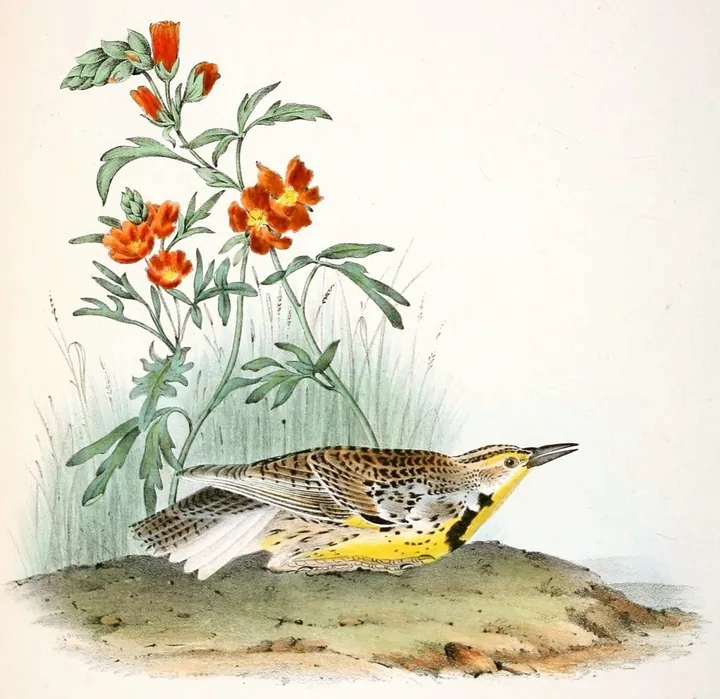
The North Dakota state bird is the Western Meadowlark. A short act approved on March 10, 1947, named it together with the state tree, the American elm, and today North Dakota Century Code 54-02-06 says “the meadowlark, sturnella neglecta, is the official bird” of the state.
Updated
What did Theodore Roosevelt say about the meadowlark?
He praised its song, once he got used to it. Ranching on the Little Missouri in the Dakota Badlands, Roosevelt wrote in Hunting Trips of a Ranchman (1885): “One of our sweetest, loudest songsters is the meadow-lark” (the book on the Internet Archive).
The trouble was the look-alike: the western bird looks so much like the meadowlark of the East, which, Roosevelt thought, “utters nothing but a harsh, disagreeable chatter.” Out west, he wrote, “the plains air seems to give it a voice.”
Two lines tied to the state bird were about other birds, North Dakota Game and Fish points out. In the same paragraph Roosevelt wrote, “I have heard the prince of them all, the Missouri skylark,” and his Missouri skylark is the Sprague's Pipit, not the meadowlark. The bird he praised as good eating was the long-billed curlew.
How did North Dakota choose its state bird?
In one act with its state tree. House Bill 270 of 1947, “An Act To name the North Dakota state tree and the North Dakota state bird,” has two sections: the first makes the American elm the official tree, and the second says “The Meadowlark, Sturnella Neglecta, shall be the official bird of the state of North Dakota.” Nine representatives sponsored it, and it was approved on March 10, 1947, as chapter 329 of the session laws (Laws of North Dakota 1947).
Today the law is North Dakota Century Code 54-02-06, which still calls the bird “the meadowlark, sturnella neglecta.” The State Historical Society of North Dakota teaches it to fourth graders in one line: “In 1947, the Western Meadowlark became the state bird of North Dakota.”
The act gives no reason for the choice. A 2008 textbook from the North Dakota Center for Distance Education, on Game and Fish's website, explains it this way: “Because North Dakota is well-known for its prairie, the western meadowlark was chosen” (Habitats of North Dakota: Prairie). That is a teacher's explanation, written decades later, not the Legislature's.
How did Audubon meet the Western Meadowlark?
On the Missouri in 1843. Audubon traveled up the river to the mouth of the Yellowstone, “in what is now North Dakota,” while working on his book of North American mammals, and his party noticed that the meadowlarks there sang differently, North Dakota Game and Fish writes. The state's 2008 textbook says he “spent a few months at Fort Union in western North Dakota.”
The first specimens were collected on May 24, 1843, Game and Fish says, in what is now South Dakota. Audubon's journal for that day records that the party “shot four Meadow-larks” (Audubon and His Journals).
In the octavo Birds of America (vol. 7, 1844) he named the bird Sturnella neglecta, and was frank about one thing: its flesh “is indifferent eating” (Audubon's text). Why he called it neglecta is on our Montana state bird page.
Where do North Dakota's meadowlarks go in winter?
South, and researchers are tracking them to find out where. In May 2024, scientists from the Smithsonian, North Dakota Game and Fish and the University of North Dakota fitted six male meadowlarks with tiny GPS backpacks, North Dakota Outdoors reported. They lured each one into a mist net with a meadowlark decoy and a recorded song.
Andy Boyce of the Smithsonian put the method bluntly: “When male meadowlarks are on the breeding grounds, they're enraged and they're dumb.” One tagged male was back “singing and responding” 45 minutes after its release.
The first results came from four birds tagged in 2022. Three of them gave a full year of data: two spent the winter in southern Nebraska and one in central Kansas. Three birds are not a whole population, but they were enough for Boyce to say North Dakota “needs to be communicating with states like Kansas and New Mexico.”
When can you see a meadowlark in North Dakota?
From March to early November. The Game and Fish species page says the Western Meadowlark “occurs in North Dakota primarily from March to early November” and is rare in other months. The males come back first, “around mid-March,” with the females a few weeks behind (North Dakota Outdoors, 2021), and nesting peaks from mid-April to late July.
Look in pasture and prairie. It is most common in grazed native grassland, and also uses tame grass, Conservation Reserve Program (CRP) land, hayland and field edges, singing from fence posts, large rocks and shrubs. The species page names the Badlands, the Drift Prairie, the Missouri Coteau and the Missouri Slope as its main regions.
Game and Fish's 2021 advice is simple: drive country roads past pastures and watch the fence posts. Watch from the road, and ask before you walk onto private land.
Is North Dakota's state bird declining?
Yes. Game and Fish's species page says the Western Meadowlark is down “42% since 1970,” and its Meadowlark Initiative says the bird “is declining 1.3% per year in North Dakota,” where “72% of the native prairie has been converted to other uses.”
So the state bird has a job. The initiative calls it “the ambassador” for keeping native grassland and working ranches. In 2021 the USDA chose its grant proposal, one of 85 projects nationwide, which asked for 10 million dollars from the Natural Resources Conservation Service, alongside more than 12 million from partners (North Dakota Outdoors, 2021).
Does North Dakota share its state bird?
With five states: Kansas, Montana, Nebraska, Oregon and Wyoming, as the State Historical Society's lesson lists them. North Dakota came last of the six: Wyoming adopted the meadowlark in 1927, and Kansas in 1937, ten years before North Dakota's act.
Two of its neighbors chose other birds: South Dakota the Ring-necked Pheasant, in 1943, and Minnesota the Common Loon.
Questions about the North Dakota state bird
When did the Western Meadowlark become North Dakota's state bird?
On March 10, 1947, when the act naming the state tree and the state bird was approved. It is now North Dakota Century Code 54-02-06.
Did Theodore Roosevelt call the meadowlark the prince of them all?
No. In Hunting Trips of a Ranchman (1885) that title went to the “Missouri skylark,” the Sprague's Pipit, as North Dakota Game and Fish notes. He called the meadowlark “one of our sweetest, loudest songsters.”
When do meadowlarks come back to North Dakota?
In March. Game and Fish says the males arrive around mid-March and the females a few weeks later, and most are gone by early November.
What is North Dakota's state tree?
The American elm, named in the same 1947 act as the state bird.
Birdfolio prints a birder’s life list as a book, each species beside a classic painting. Look inside a Birdfolio.
Orders open on November 1.