State birds
What is the Vermont state bird?
The Vermont state bird is the Hermit Thrush. Vermont State Parks says the 1941 Legislature debated the choice hard before it took effect on June 1, 1941, and the law, Title 1, section 497 of the Vermont Statutes, says simply: “The State Bird shall be the hermit thrush.”
Updated
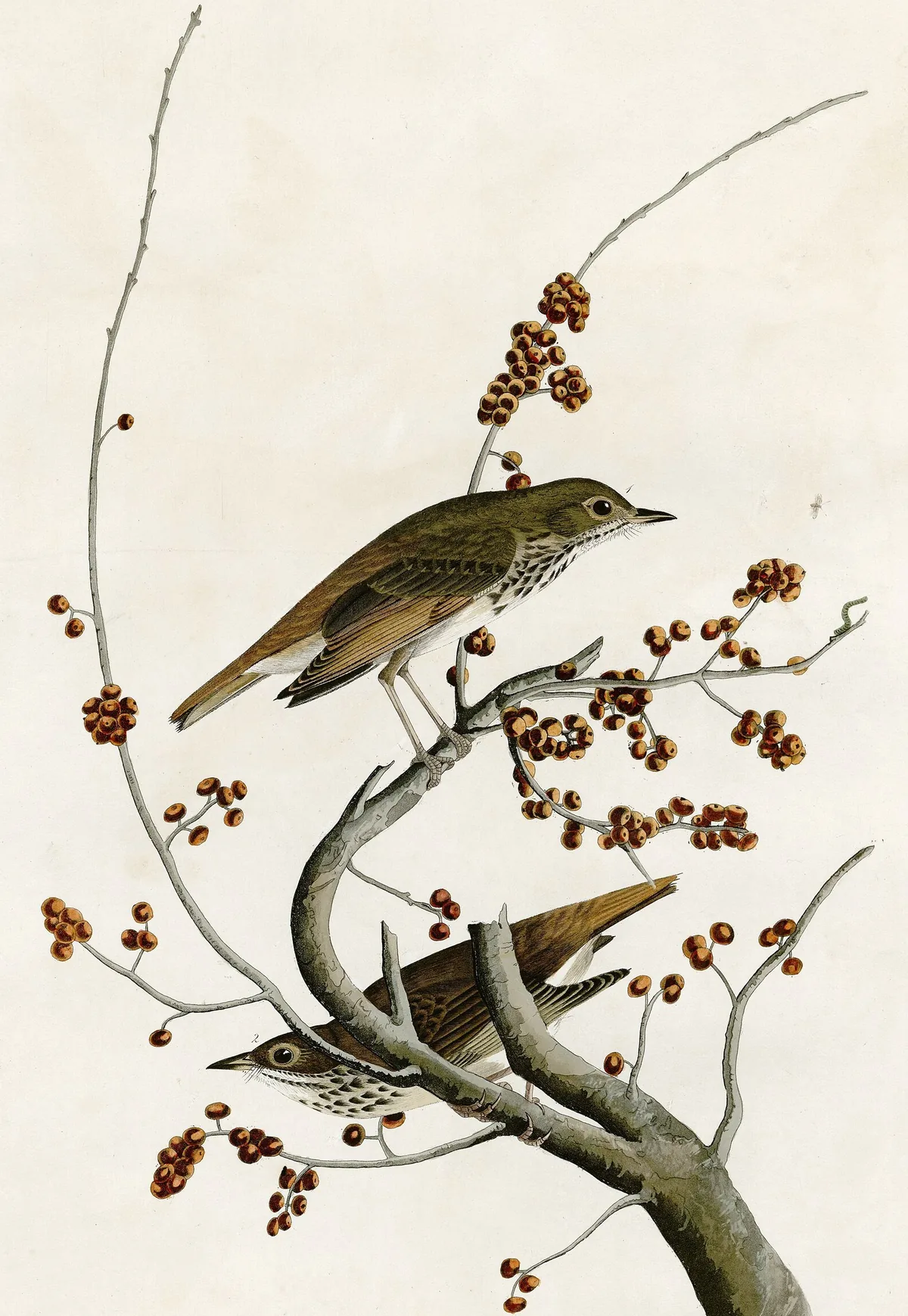
Why did Vermont argue over the hermit thrush?
Because it leaves every fall. According to Vermont State Parks, the hermit thrush “was heavily debated by the 1941 Vermont legislature,” and the main question was its migration: should a state honor a bird that summers in Vermont and spends the winter in the southern United States?
The thrush won anyway, and it became the state bird on June 1, 1941, the parks department says. Some legislators had wanted the crow or the blue jay instead, the Vermont Historical Society notes.
The law itself is one short line, with no date attached: “The State Bird shall be the hermit thrush” (Vermont Statutes, Title 1, § 497). The state flower's section, right after it, is just as brief: “The State Flower shall be the red clover.”
Did Audubon really say the hermit thrush has no song?
He did. In 1831, in the first volume of his Ornithological Biography, Audubon wrote, “The Hermit Thrush has no song,” only “a soft plaintive note” that seldom carried more than twenty-five or thirty yards (Audubon's text, vol. 1).
Vermonters hear it differently. Vermont Fish & Wildlife calls its flute-like song “one of the most beautiful of any North American bird,” and says it has earned the nickname American nightingale.
Audubon met his hermit thrushes in the South, in the canebrakes along the Mississippi, and saved his praise for a cousin: in the same account he calls the Wood Thrush his great favorite. The Wood Thrush is now the official bird of the District of Columbia.
Where and when can you see a Hermit Thrush in Vermont?
From April to mid-October. Vermont Fish & Wildlife says the hermit thrush leaves the state in mid-October, winters south of Pennsylvania and is “one of the first woodland birds to return in the spring,” arriving in April. It rarely tries to spend the winter here, though one sometimes turns up at a feeder.
Almost any forest will do. Vermont State Parks says the song can be heard in the morning and the evening in most Vermont woodlands, and suggests listening at mealtimes in Maidstone State Park, Molly Stark State Park or Woodford. At Marsh-Billings-Rockefeller National Historical Park, the Park Service lists it among the songbirds heard during the summer.
For nesting it likes forest interiors with openings close by, such as ponds or meadows, the department says, and its nesting season runs from mid-May to mid-August. Vermont State Parks adds that the nest sits on the ground at the base of a tree.
It can live a decade or more. The oldest Hermit Thrush in the federal banding records was banded in Maryland on March 9, 1999, in its second year of life (age codes), and caught and released there on April 12, 2009: at least 10 years and 10 months old (USGS Bird Banding Laboratory; see the oldest wild birds).
How to recognize a Hermit Thrush
Listen first. The song starts with one long note and then spirals upward, in the parks department's words, and the Tennessee Wildlife Resources Agency calls it a melodious, flute-like warble, mostly on one pitch. Then look for a brown back and a reddish tail and black spots on a white chest; a perched bird flicks its wings, raising its tail quickly and lowering it slowly. It is 6.75 inches long, with an 11.5-inch wingspan.
Does any other state have the hermit thrush?
No. Vermont is the only state with the Hermit Thrush. Next door, New Hampshire chose the Purple Finch, Massachusetts the chickadee and New York the Eastern Bluebird.
The thrush does share a painting. Louis Agassiz Fuertes painted a hermit thrush on the ground below a Wood Thrush for the New York Forest, Fish and Game Commission's report for 1901, and the plate's legend reads “Lower figure, Hermit Thrush” (the plate). That Wood Thrush is the picture on our District of Columbia page.

Vermont shares a state tree, too: the sugar maple, which is also the state tree of West Virginia.
Questions about the Vermont state bird
When did the hermit thrush become Vermont's state bird?
In 1941. Vermont State Parks says the choice took effect on June 1, 1941.
Why is the hermit thrush Vermont's state bird?
The law gives no reason. Vermont Fish & Wildlife praises its flute-like song, and Vermont State Parks says the 1941 debate turned mostly on its leaving for the winter.
Does the hermit thrush stay in Vermont in winter?
Rarely. It leaves in mid-October and returns in April, says Vermont Fish & Wildlife, and winters south of Pennsylvania.
What is Vermont's state bird and flower?
The hermit thrush is the state bird and the red clover is the state flower. They sit side by side in Title 1 of the Vermont Statutes, sections 497 and 498.
What is Vermont's state animal?
The Morgan horse, by a 1961 law. Section 500 says: “The State Animal shall be the Morgan horse.”
Birdfolio prints a birder’s life list as a book, each species beside a classic painting. Look inside a Birdfolio.