State birds
What is the Ohio state bird?
The Ohio state bird is the Northern Cardinal. The Ohio General Assembly adopted it in 1933, according to the Ohio History Connection and the Ohio Department of Natural Resources, and the law today, Ohio Revised Code 5.03, names “cardinalis cardinalis, commonly known as the ‘cardinal’” as the official bird of the state.
Updated
When did the cardinal become Ohio's state bird?
In 1933. The Ohio General Assembly adopted the cardinal that year, says the Ohio History Connection, and the Ohio Department of Natural Resources agrees: “The cardinal received this recognition in 1933.” The department's state symbols page lists the bird with a plain “Adopted: 1933” (ODNR, State Symbols).
We could not find the 1933 act or resolution itself, so this page gives no day and no bill number. The dates offered for it online disagree with one another, which is reason enough to leave them out.
The law in force is Ohio Revised Code 5.03, which declares “cardinalis cardinalis, commonly known as the ‘cardinal,’ is the official bird of the state” (Ohio Revised Code 5.03). The code lists its current version as dated October 1, 1953, from House Bill 1 of the 100th General Assembly. That was also the year the Ohio buckeye was named the state tree, the department's coloring book notes.
Ohio was one of two states to choose the cardinal in 1933: Indiana named its “Red Bird or Cardinal” the same year. Only Kentucky, in 1926, and Illinois, in 1929, had picked it before them.
Why is the cardinal Ohio's state bird?
Because Ohioans liked it, as the state's history keepers tell it. Cardinals “can be found in all 88 counties,” the Ohio History Connection writes, and “their enduring popularity” led the General Assembly to adopt the bird in 1933.
The natural resources department points to its voice. The cardinal is known for its distinctive call, the department's coloring book says, and it lives “all across the buckeye state.”
No record we found shows a school vote or a club campaign behind Ohio's choice. That sets Ohio apart from Illinois, where a vote of schoolchildren picked the cardinal, and from Tennessee, where the cardinal came third in a statewide vote in 1933 and the mockingbird won.
Is there a giant cardinal at the Ohio State Fair?
Yes, and it weighs about 500 pounds. In 1986 a fiberglass cardinal 12 feet tall and 16 feet long, set on a 4-foot base, was installed at the north entrance of the fairgrounds, and it “still stands today,” says the Ohio State Fair in its own history.
The bird gave its name to a building as well. Cardinal Hall, 100,000 square feet, opened at the fair in 2016 to house the creative arts and youth arts exhibits and the Ohio Agriculture Hall of Fame; on January 4, 2019, it was renamed Kasich Hall in honor of the outgoing governor, John R. Kasich.
The fair is far older than the state bird. The first Ohio State Fair was held at Camp Washington, two miles from downtown Cincinnati, on October 2 to 4, 1850, more than 80 years before the General Assembly chose the cardinal.
Were there cardinals in Ohio in Audubon's day?
Yes, at least along the river. In his Ornithological Biography of 1834, John James Audubon wrote that a great number of cardinals were found “as far up on the Ohio as the city of Cincinnati” (Audubon's text, vol. 2).
He found the males hard neighbors for one another. In the pairing season they are “so pugnacious,” he wrote, that although they nest near birds of other kinds, they never let another cardinal nest close by; a male chases a rival from bush to bush, then flies back to his favorite tree to sing.
He noticed a homelier habit too. In summer heat, cardinals “frequently resort to sandy roads to dust themselves,” letting people come quite close.
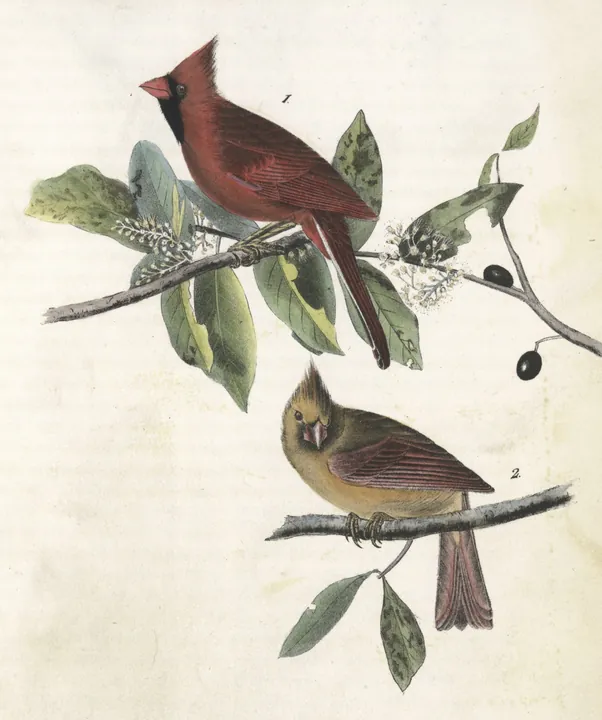
The picture on this page is the octavo version of his cardinal, plate 203; the large Havell edition has its own cardinal plate, plate 159. More cardinal paintings are on our Northern Cardinal painting page.
Where can you see cardinals in Ohio?
In any county, in any month. The natural resources department says cardinals “can be found across Ohio year-round,” especially in woodlands, brush and forest edges.
Backyards count. The National Audubon Society's guide lists suburban gardens and towns among the cardinal's homes and says it “readily comes to bird feeders, where it favors sunflower seeds.”
In spring, watch the windows. Male cardinals defend their territory so hard that they attack other males, and even their own reflection in windows and mirrors, the guide says. The female sings too, mainly in spring before nesting begins, and a pair raises two or three broods a year, rarely four.
Ohio's birders keep their records in a journal named for the bird. The Ohio Cardinal began in 1978 as “a permanent record of bird occurrences in the state,” and it now comes out four times a year from the Ohio Ornithological Society, the society says.
For the longest-lived wild cardinal on record, see our page of the oldest wild birds.
What are Ohio's other state symbols?
The natural resources department describes 12 nature symbols in its coloring book, each with its year. The Ohio buckeye has been the state tree since 1953; the white-tailed deer became the state mammal in 1988, the ladybug the state insect in 1975 and the black racer the state reptile in 1995 (ODNR coloring book).
Newer ones include the bullfrog and the spotted salamander, both chosen in 2010; the pawpaw, the state native fruit, in 2009; and Dunkleosteus, an armored fish that grew to more than 20 feet long, named the state fossil fish in 2020. The large-flowered trillium has been the state wildflower since 1986.
The cardinal is the only bird among the 12.
Which other states have the cardinal as their state bird?
Six more: Illinois, Indiana, Kentucky, North Carolina, Virginia and West Virginia. With Ohio that makes seven, more states than any other bird has. They chose it between 1926 and 1950, and Ohio and Indiana tied for third, both in 1933.
Our guide to the cardinal state bird compares all seven, with each state's year, its law and what its records say about why.
Questions about the Ohio state bird
When did Ohio adopt the cardinal as its state bird?
In 1933, by the Ohio General Assembly. The law today is Ohio Revised Code 5.03, whose current version is dated October 1, 1953.
Why is the cardinal the state bird of Ohio?
The Ohio History Connection credits its popularity: cardinals live in all 88 counties. No school vote or campaign for it is on record.
Do cardinals stay in Ohio all winter?
Yes. Cardinals don't migrate, and the Ohio Department of Natural Resources says they can be found across the state year-round.
What is the Ohio state animal?
The white-tailed deer, the state mammal since 1988, says the Ohio Department of Natural Resources. The cardinal is the state bird.
What is Ohio's state bird and flower?
The cardinal is the state bird, and the scarlet carnation is the state flower, adopted “as a token of love and reverence for the memory of William McKinley,” Ohio's law says. Since 1986 the state wildflower has been the large-flowered trillium.
Birdfolio prints a birder’s life list as a book, each species beside a classic painting. Look inside a Birdfolio.