State birds
What is the Minnesota state bird?
The Minnesota state bird is the Common Loon. Governor Elmer L. Andersen signed House File 79 on March 13, 1961, and the law, now Minnesota Statutes Section 1.145, says: “The loon, Gavia immer, is the official bird of the state of Minnesota.”
Updated
Which birds did Minnesota consider before the loon?
Several, over 14 years. The Minnesota Legislative Reference Library lists the eastern goldfinch in 1947, then the mourning dove, the scarlet tanager and the wood duck in 1951, and the pileated woodpecker in both 1951 and 1953. Audubon painted three of the runners-up: see our pages on the Mourning Dove, the Wood Duck and the Pileated Woodpecker.
The loon's turn came in 1961. The successful bill was authored by Senator Norman Walz and Representative Loren Rutter, the library records, and it became chapter 76 of that year's session laws, approved on March 13 (Minnesota Session Laws 1961).
That fall a writer in the Gopher Historian called the loon “a fitting symbol” for “the Land of Ten Thousand Lakes” (Gopher Historian, Fall 1961). The official record doesn't say why lawmakers chose it.
Why does Minnesota keep a photograph of a loon?
Because the law says so. The 1961 act's second section orders that “a photograph of the loon shall be preserved” in the Secretary of State's office, and the words are still in Minnesota Statutes § 1.145 today.
The Secretary of State's office even says where its loon lives: the bird in the photograph “nests on Larch Lake, near the Gunflint Trail.”
Where and when can you see loons in Minnesota?
On lakes across central and northeastern Minnesota, from ice-out until fall. The Minnesota Department of Natural Resources says the state has more Common Loons than any other state except Alaska, and the Secretary of State puts the summer population at about 12,000.
In spring they move north as the ice leaves the lakes, the 1961 Gopher Historian says, stopping on Twin Cities lakes such as Lake Como and Lake Nokomis.
In September the adults leave for the Atlantic coast, from North Carolina to Florida, or for the Gulf of Mexico. The young follow “a month or so later,” the DNR says.
Before they go, loons gather on big lakes. In fall 1998 the DNR counted 1,599 on Lake Winnibigoshish on October 21, and 1,688 on Mille Lacs on October 20, “a record high count for any lake in Minnesota at any time” (DNR migration study).
How did the Gulf oil spill reach Minnesota's loons?
Through their winter waters. When the Deepwater Horizon well spilled oil into the Gulf of Mexico in 2010, the DNR worried that “some Minnesota lakes could become hauntingly silent” (DNR, 2010).
A 2016 settlement paid for what the DNR calls a “7.52 million dollar project” back home: protecting nesting lakes, adding nesting platforms and cutting the use of lead fishing tackle in eight northern counties, Becker, Clearwater, Beltrami, Hubbard, Cass, Crow Wing, Itasca and Aitkin (Minnesota Loon Restoration Project).
Volunteers keep watch. “For over 40 years, volunteers have recorded their loon observations on lakes,” the DNR says of its LoonWatcher survey.
Where else does Minnesota show its loon?
At the center of the state seal. The new seal, in use since May 11, 2024 (Minnesota Statutes § 1.135), shows “the common loon (gavia immer), the official state bird of Minnesota, including a red eye,” in the words of the State Emblems Redesign Commission. Among the public's design entries the commission counted 291 with “Common loon cameos.”
On the state quarter. Minnesota's quarter, released on April 4, 2005, shows a tree-lined lake with two people fishing and “a loon on the water” (US Mint).
In Ojibwe the loon is maang. “Many Ojibwe people are members of the Maang Doodem (Loon Clan),” writes Peter DeCarlo in MNopedia, the Minnesota Historical Society's encyclopedia.
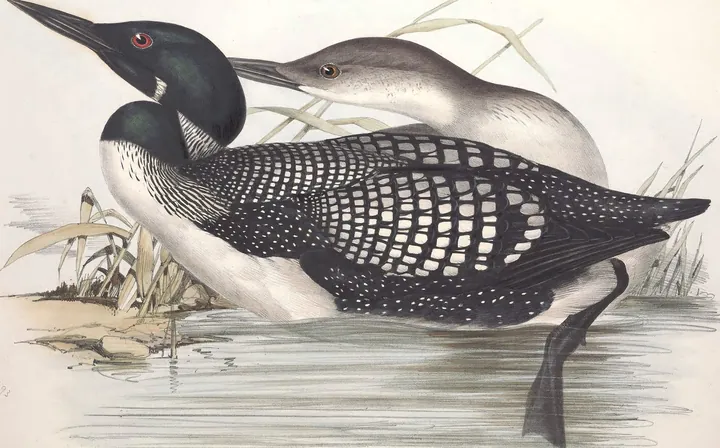
Why are there two loons in the painting?
Because young and old look so different. John Gould painted the loon for The Birds of Europe as the Northern Diver, Colymbus glacialis, “this noble species of Diver, the largest and most typical of its genus.” He wrote that the difference between young and adult birds “has caused much confusion in its nomenclature”: first-year birds had once been named as a separate species (Gould's text).
So he showed both. “The Plate represents an adult male and a young bird of the year,” he wrote: the black-and-white loon in front, and behind it the gray one, which is not a winter adult but a young bird. More loon paintings, among them Audubon's plate 306, are on our Common Loon painting page.
Does any other state have the Common Loon?
No. Minnesota is the only state with the Common Loon as its state bird. Its neighbors chose other birds: Wisconsin the American Robin, Iowa the American Goldfinch, North Dakota the Western Meadowlark and South Dakota the Ring-necked Pheasant.
Questions about the Minnesota state bird
When did the loon become Minnesota's state bird?
On March 13, 1961, when Governor Elmer L. Andersen signed House File 79. The law is now Minnesota Statutes § 1.145.
How many loons live in Minnesota?
About 12,000 in summer, says the Secretary of State's office; the DNR says only Alaska has more Common Loons.
When do loons leave Minnesota?
The adults leave in September and the young about a month later, the DNR says. Before they go, many gather on big lakes such as Mille Lacs.
Is the loon on Minnesota's state seal?
Yes. The seal used since May 11, 2024, shows a Common Loon with a red eye.
Birdfolio prints a birder’s life list as a book, each species beside a classic painting. Look inside a Birdfolio.
Orders open on November 1.