State birds
What is the Connecticut state bird?
The Connecticut state bird is the American Robin. The General Assembly adopted it in 1943, and the law today, General Statutes § 3-109, names “The American robin, Turdus migratorius”; since July 1, 2026, the same law makes the basketball player Sue Bird a second state bird every March.
Updated
Why is Sue Bird a Connecticut state bird?
Because a 2026 law makes her one, every March. Section 48 of Public Act 26-76 rewrote the state bird law: the robin stays the state bird, but in March of each year the American robin and “Suzanne Brigit Bird, also known as Sue Bird,” are “the state birds” (Public Act 26-76).
The act doesn't say who she is. The legislature's Office of Legislative Research does, in its summary of the act: “Sue Bird was a top University of Connecticut basketball player” (OLR summary). Neither document says why March.
The change rode in a budget bill. Section 48 is one of more than a hundred sections of Substitute Senate Bill 477, an act carrying out the state budget for the two years ending June 30, 2027, which the Governor approved on May 27, 2026; the bird section took effect on July 1, 2026.
No other state's bird, in our table of all 50 states, is a person. When we checked on October 8, 2026, the General Assembly's online statutes still showed the old one-line § 3-109 (General Statutes, chapter 33); the new wording has been law since July 1.
When did Connecticut adopt the robin as its state bird?
In 1943. The State of Connecticut says the General Assembly adopted the American Robin “as the official State Bird” that year, and the 1947 State Register and Manual gives the law: its state bird page is headed “(Gen. Statutes, 1943 Suppl. Sec. 472g),” section 472g of the 1943 supplement to the General Statutes (Register and Manual, 1947).
It closed a gap another state had pointed out. North Carolina's state bird act, ratified on March 8, 1943, opened by naming North Carolina and Connecticut as the only states without an official bird (Session Laws of North Carolina, 1943). Both chose that year: North Carolina the cardinal, Connecticut the robin. The act overlooked New York, which had no state bird law until 1970.
The posted statutes trace today's sentence to the 1949 revision of the statutes, section 3583; the bird itself dates from 1943.
Do robins stay in Connecticut in winter?
Many do. “Most people do not know that many Robins spend the entire winter in New England,” says the state's page; they “roost among the evergreens in the swamps where they feed on winter berries.”
The 1947 Register went further. The habit was so little known, it said, that “nearly every winter the newspapers publish articles predicting an early spring” because the robins had “arrived early.” They hadn't: they had been there all along, coming out into the fields when a thaw melted the snow.
Audubon saw the same in the 1830s, farther north. Despite the snow of Massachusetts and Maine, he wrote, “flocks remain in those States the whole season” (Audubon's text, vol. 2). The National Audubon Society's guide adds that a northerner's “first robin of spring” may be a bird that wintered only a few miles away.
Is the American Robin a real robin?
Not by the English meaning of the word, as Connecticut has long admitted. The “real ‘Robin Red-breast’ is a native of the Old World,” the 1947 Register explained, a little bird with a reddish-orange throat and breast; the American bird is “a large migratory thrush” that the colonists named after it.
Naturalists objected, and lost. The name stuck “despite the protests of naturalists,” the Register said; the state's page today says “some naturalists.” The scientific name in the law, Turdus migratorius, means migratory thrush, as the Register noted.
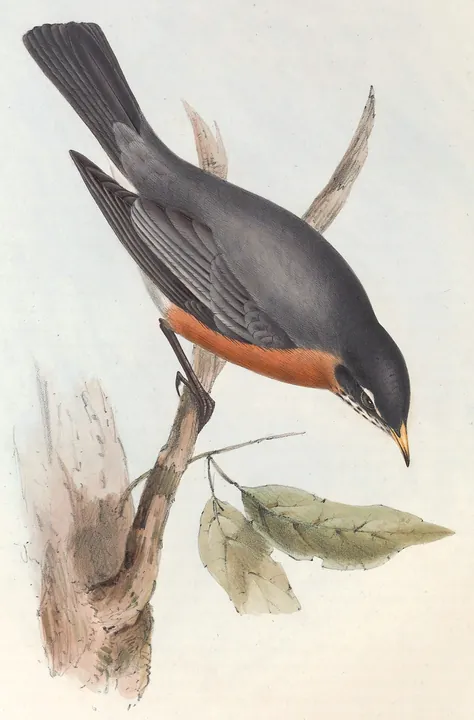
John Gould gave it one more name, the “Migratory Ouzel,” in The Birds of Europe: the picture on this page. Why an American bird is in a book of European birds is told on our Wisconsin state bird page, and Audubon's own robin family is plate 131.
Where can you see robins in Connecticut?
On lawns in summer, and in swamps and berry thickets in winter. In the warm months robins are familiar birds “running and hopping on lawns with an upright stance,” often nesting on porches and windowsills, says the Audubon guide; in fall and winter they “may gather by the hundreds in roaming flocks,” wherever there is food.
For winter robins, go where the state's page points: evergreen woods in swamps, where the birds find berries. In spring, listen at first light; the robin's caroling is “among the earliest bird songs heard at dawn,” the guide says.
The oldest wild robin on record is on our page of the oldest wild birds, and more robin paintings are on our American Robin painting page.
Which other states have the robin as their state bird?
Two: Michigan, where a 1931 resolution named the “robin redbreast,” and Wisconsin, where schoolchildren voted for the robin in 1926–27 and the Legislature made it law in 1949.
The robin almost had a fourth state: in Tennessee's statewide vote of 1933 it finished second, just 480 votes behind the mockingbird.
Questions about the Connecticut state bird
What is the Connecticut state bird?
The American Robin, since 1943. Since July 1, 2026, the law also names Sue Bird, who played basketball for the University of Connecticut, a state bird every March.
When did the robin become Connecticut's state bird?
In 1943, by the General Assembly. The 1947 State Register and Manual cites section 472g of the 1943 supplement to the General Statutes.
Is Sue Bird really a Connecticut state bird?
Yes, in March. Public Act 26-76, approved on May 27, 2026, makes the American robin and Sue Bird the state birds each March, from July 1, 2026.
Do robins stay in Connecticut all winter?
Many do. The state says many robins spend the winter in New England, roosting in evergreen swamps and eating winter berries.
What is Connecticut's state bird and flower?
The American Robin is the state bird, and the mountain laurel is the state flower, designated by the General Assembly in 1907. Its white and pink blossoms have caught travelers' eyes since colonial days, the state's website says.
What is Connecticut's state animal?
The sperm whale. The General Assembly made it the state animal in 1975, the state says, for its part in Connecticut's history and because it is an endangered species.
Birdfolio prints a birder’s life list as a book, each species beside a classic painting. Look inside a Birdfolio.
Orders open on November 1.