State birds
What is the Kansas state bird?
The Kansas state bird is the Western Meadowlark. Kansas schoolchildren voted for it in 1925, and twelve years later, in 1937, the Legislature wrote their choice into law: K.S.A. 73-901 names “the western meadow lark, Sturnella-Neglecta (Audubon), as preferred by a vote of Kansas school children.”
Updated
Which birds lost the 1925 Kansas state bird vote?
The bobwhite came closest. In 1925 the Audubon Society of Kansas held a statewide election among schoolchildren, and the meadowlark won; the Kansas Historical Society says “the bobwhite and the northern cardinal took second and third.” The Kansas Register, published by the Secretary of State, puts the turnout at more than 120,000 votes and names the quail, the cardinal and the robin as the closest rivals.
It was closer than a win sounds. By the count Neil Byer printed in Heritage of Kansas in 1957 (Byer's essay), the meadowlark had 48,395 votes, the bobwhite 38,544 and the cardinal 19,863. The 1937 act's preamble, as Byer reprints it, says “nearly 125,000 votes” were cast in all. So the winner had well under half of the ballots, and the bobwhite finished fewer than 10,000 votes behind.
When did the meadowlark become the Kansas state bird by law?
In 1937, twelve years after the vote. Chapter 319 of that year's session laws named the bird, and the statute, now K.S.A. 73-901, still says why: the meadowlark is the official bird “as preferred by a vote of Kansas school children.” The same year, the Kansas Register adds, the Legislature made the cottonwood the state tree, “the pioneer tree of Kansas.”
Bird lovers outside Kansas counted it as the state's bird long before that. In 1927, ten years before the law, The Condor, the journal of California's Cooper Ornithological Club, noted that “Kansas has the Meadow-lark, Texas has the Mockingbird” (The Condor, November–December 1927). Our California state bird page tells what that note started.
The act explained itself in a preamble. As Byer reprints it, the preamble says it had been “the practice of various states of the union to designate an official bird,” and that the meadowlark “received many more votes than any other bird, as the most popular bird in Kansas.” Michigan's 1931 resolution for the robin, as the Michigan Manual quotes it, used almost the same words; our Michigan state bird page has them.
Why is the Western Meadowlark losing ground at Tallgrass Prairie?
Its look-alike cousin likes taller grass. At Tallgrass Prairie National Preserve in the Flint Hills, the National Park Service counts the Western Meadowlark as a year-round resident and a grassland obligate, one of the “species that require grassland habitat to survive.” Its monitoring shows Western Meadowlarks declining in the preserve while Eastern Meadowlarks increase.
The preserve has changed. Since 2005 it has burned less and grazed fewer cattle, and in the Windmill Pasture “bison replaced cattle in 2009.” Western meadowlarks “prefer shorter vegetation,” and the Park Service says the changes “may explain these trends.” That is one preserve, not all of Kansas; across the wider region, the Park Service counts the meadowlark among grassland birds “declining at alarming rates.”
Where can you see a meadowlark in Kansas?
On the fence posts along country roads. Meadowlarks nest “on the ground in a clump of grass,” the Kansas Historical Society says, and fence posts are “often where Meadowlarks are visible as people drive through Kansas.” A Kansas naturalist quoted in the 1984 Kansas Register called the bird abundant in every county, and said that anyone traveling by car or train could hardly miss it, perched along the fences.
Some of the meadowlarks in a Kansas winter may have nested farther north. A meadowlark fitted with a GPS backpack in North Dakota spent its winter in central Kansas, North Dakota Game and Fish reported in 2024, while two others wintered in southern Nebraska; our North Dakota state bird page has the study.
The oldest Western Meadowlark in the federal banding records lived at least 6 years and 6 months. It was banded in Colorado on March 3, 1960, and found dead in Colorado on December 3, 1965 (USGS Bird Banding Laboratory; more on our page of the oldest wild birds).
What did Audubon make of the meadowlark's song?
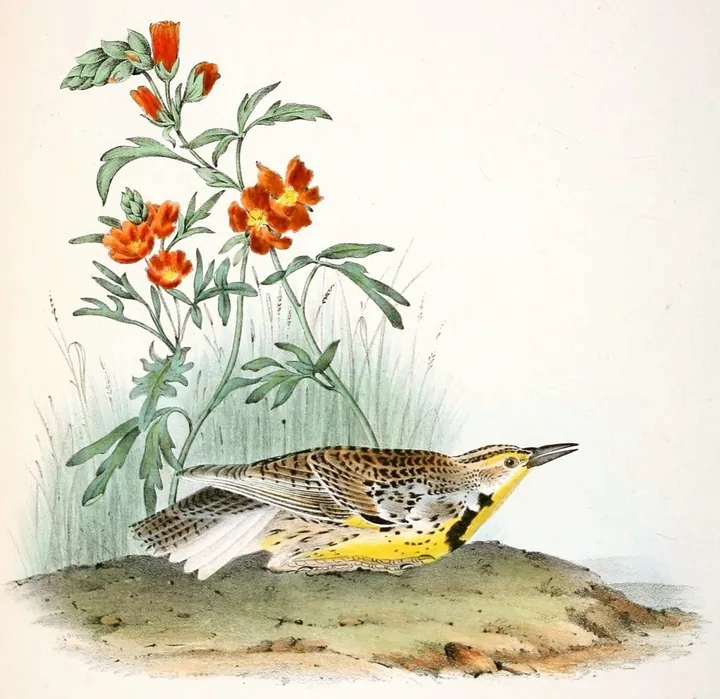
At first he got it wrong. In the octavo Birds of America (vol. 7, 1844), Audubon wrote that its notes sounded so like those of the Yellow-headed Troupial, a blackbird, that “I took them for the notes of the Troupial.” Then he heard the difference, and named a new species: the “Missouri Meadow-Lark” in the painting above (Audubon's text).
He wasn't writing about Kansas; he met the bird on his 1843 journey up the Missouri River. His verdict on it: “very shy, but abundant on all the prairies.” How it got its scientific name, neglecta, is on our Montana state bird page.
Which other states share the Kansas state bird?
Five: Montana, Nebraska, North Dakota, Oregon and Wyoming. With Kansas that makes six meadowlark states, more than for any other bird except the cardinal.
The cardinal, third in Kansas in 1925, did better elsewhere: it is the state bird of seven states (why the cardinal won so often).
Questions about the Kansas state bird
When did the Western Meadowlark become the Kansas state bird?
In 1937, by chapter 319 of that year's session laws, now K.S.A. 73-901. Kansas schoolchildren had voted for it in 1925.
Which bird came second in the Kansas state bird vote?
The bobwhite, the Kansas Historical Society says, with the cardinal third. In Neil Byer's 1957 count the bobwhite had 38,544 votes to the meadowlark's 48,395.
Is the Kansas state bird the same as Nebraska's?
Yes. The Western Meadowlark is the state bird of Kansas and Nebraska, and of Montana, North Dakota, Oregon and Wyoming too.
Where do meadowlarks nest in Kansas?
On the ground, in a clump of grass, according to the Kansas Historical Society.
Birdfolio prints a birder’s life list as a book, each species beside a classic painting. Look inside a Birdfolio.
Orders open on November 1.