State birds
What is the Oklahoma state bird?
The Oklahoma state bird is the Scissor-tailed Flycatcher. The Legislature adopted it in 1951, in a law printed at page 356 of that year's session laws, and Title 25, Section 98, of the Oklahoma Statutes still names “The scissor-tailed flycatcher, Muscivora Forficata,” an old scientific name.
Updated
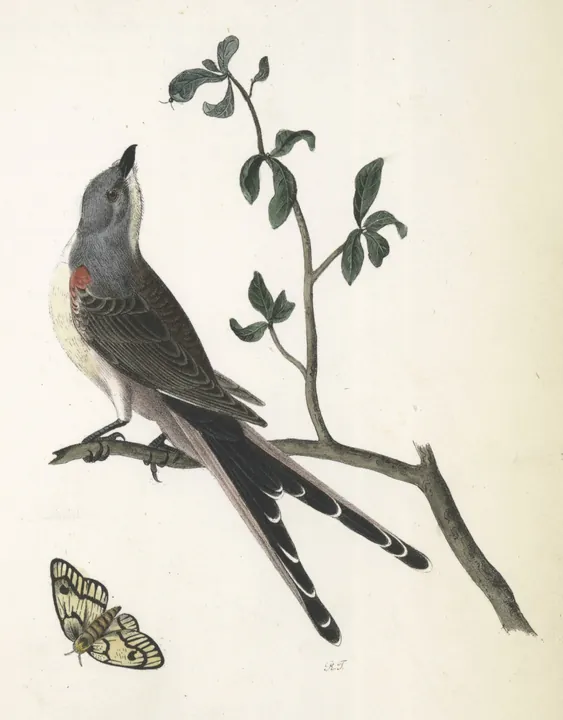
How long is a scissortail's tail?
Up to nine inches, on a bird only 11 to 15 inches long. The tail “may reach nine inches in length,” says the Oklahoma Department of Wildlife Conservation, which makes it “proportionately longer than any other Oklahoma bird.”
The name comes from what the tail does: “During flight, the bird opens and shuts its tail like a pair of scissors,” the department says, and folds it shut when the bird perches. Females have shorter tails than males, and young birds' tails are shorter still and only slightly forked.
Up close it is pearl gray and white, with black wings, “a touch of scarlet at the shoulders” and pink sides and wing linings, the department adds.
When did the scissor-tailed flycatcher become Oklahoma's state bird?
In 1951. Section 1 of a 1951 law, printed at page 356 of that year's session laws, designated “The scissor-tailed flycatcher, Muscivora Forficata” as “the state bird of the State of Oklahoma” (Oklahoma Statutes, Title 25). It is now Title 25, Section 98, with no later amendment listed.
The same law gave Oklahoma a day for birds. Its Section 2 made May 1 of each year “Bird Day,” to be marked “in such manner as the Societies for the Preservation of Wildlife may prescribe.”
Why the scissortail? The 1951 law gives no reason. In 2012 the wildlife department offered one on its website: the birds eat “agriculturally harmful insects” and so “are economically beneficial” (Department of Wildlife Conservation, 2012).
What does “Muscivora Forficata” mean in Oklahoma's law?
It is the scissortail's old scientific name. Oklahoma's 1951 law used the genus Muscivora; by 1983 the American Ornithologists' Union's Check-list of North American Birds had moved the bird into Tyrannus, the kingbirds, and listed Muscivora as a former name (AOU Check-list, 1983). Today's world list, AviList, calls it Tyrannus forficatus.
The kingbird link is real. The Scissor-tailed Flycatcher “is closely related to the kingbirds,” says the National Audubon Society's guide, “and like them it will fearlessly attack larger birds that come near its nest.”
The species was named in 1789 by Gmelin, mainly from an English description of a “Swallow-tailed Flycatcher,” and its type locality, the place the described bird came from, is Mexico, the Check-list says. That old English name is the one Audubon gave the plate on this page.
Did Audubon ever see a scissortail?
Not alive, by his own account. “Not having seen this handsome bird alive,” he wrote in his Ornithological Biography (vol. 4, 1838), he could give no account of its habits from his own observation, so he printed his friend Thomas Nuttall's notes instead (Audubon's text, vol. 4).
Nuttall had seen the birds in the right place. He found them “rather common near the banks of Red River,” the river that now forms much of Oklahoma's border with Texas, and watched a pair nest on the horizontal branch of an elm, the male attacking “every bird which approached their residence.”
The tail struck him too: it made the bird “conspicuously beautiful to the most careless observer.” In the big Havell edition of The Birds of America, Audubon put the scissortail on plate 359 with two other western flycatchers: his “Arkansaw Flycatcher,” today's Western Kingbird, and Say's Flycatcher, today's Say's Phoebe.
When can you see scissortails in Oklahoma?
From early April to late October. “As a rule, scissortails are seen in Oklahoma from early April to late October,” the wildlife department says; a few arrive in the last week of March and some stay until mid-November.
Look along country roads. Scissortails favor “open prairies dotted with trees” and tree-lined roads, and perch on telephone lines, flagpoles and fences around ranches and small towns. From those perches they dart out after bees and wasps or drop to the grass for grasshoppers, which at times make up more than half of what they eat.
In spring, watch for the sky dance. Soon after the birds arrive, the male climbs “to about 100 feet” and makes “a series of v-shaped flights,” zigzagging down with a rolling, cackling call, and he may keep it up all summer. The Audubon guide adds that males may even turn backward somersaults in the air.
They nest 7 to 30 feet up in isolated trees, and also on windmill towers and the crossbars of utility poles. A female lays four to six eggs and often raises two broods in a summer.
Late summer brings the roosts. From late August scissortails gather in the evenings in roost trees; numbers peak in late September, and “More than 1,000 birds may gather at a roost,” though most hold 100 to 300. Some roosts have been used for more than 20 years. Then they leave, flying by night, for south Texas, southern Florida, Mexico and Central America.
The oldest Scissor-tailed Flycatcher in the federal banding records was a female banded in Texas on June 25, 2019, already at least in her third calendar year by the Banding Lab's age code (age codes). Caught and released there on July 6, 2021, she was at least 4 years and 1 month old (USGS Bird Banding Laboratory; see the oldest wild birds).
What are Oklahoma's other official birds?
Two more, both chosen later: the wild turkey, the state game bird since 2006, and the red-tailed hawk, the state raptor since 2018 (Title 25, §§ 98.13 and 98.17). Audubon's versions are on our Wild Turkey and Red-tailed Hawk painting pages.
The scissortail also has a place in song. Oklahoma's official children's song, “Oklahoma, My Native Land,” by Martha Kemm Barrett, adopted in 1996, names the Scissortail Flycatcher in its words.
Does any other state have the scissor-tailed flycatcher?
No. Oklahoma is the only state with the Scissor-tailed Flycatcher as its state bird. Its neighbors chose the mockingbird (Texas and Arkansas), the Western Meadowlark (Kansas), the Eastern Bluebird (Missouri), the Lark Bunting (Colorado) and the Greater Roadrunner (New Mexico).
Questions about the Oklahoma state bird
When did Oklahoma adopt the scissortail as its state bird?
In 1951. The law, now Title 25, Section 98, of the Oklahoma Statutes, also made May 1 Oklahoma's Bird Day.
When do scissortails come back to Oklahoma?
Usually in early April, and a few in the last week of March. Most leave by late October; some stay until mid-November.
Where do scissor-tailed flycatchers go in winter?
South: to southern Florida and the Florida Keys, south Texas, Mexico and Central America, Oklahoma's wildlife department says.
Why is it called a scissor-tailed flycatcher?
In flight it opens and shuts its long, forked tail like a pair of scissors, and it catches insects on the wing.
What is Oklahoma's state bird and flower?
The scissor-tailed flycatcher is the state bird, and the Oklahoma Rose has been the official state flower since 2004. Mistletoe, chosen by Oklahoma Territory in 1893, is still the state's floral emblem.
What is Oklahoma's state animal?
The American bison, adopted as the state animal in 1972, the Oklahoma Historical Society says.
Birdfolio prints a birder’s life list as a book, each species beside a classic painting. Look inside a Birdfolio.
Orders open on November 1.