State birds
What is the Maine state bird?
The Maine state bird is the chickadee, named by a resolve the Legislature approved on April 6, 1927. The law, Title 1, Section 209 of the Maine Revised Statutes, says only “the chickadee.” The Secretary of State's page names the Black-capped Chickadee, a year-round bird of Maine's woods and backyard feeders.
Updated
Which chickadee is Maine's state bird?
The law doesn't say. It reads “The state bird shall be the chickadee” (1 M.R.S. § 209), and Maine has two kinds. The Black-capped Chickadee is the familiar one, and the Secretary of State's page names it, by an older scientific name, Parus atricapillus. The Boreal Chickadee lives in Maine's North Woods and is disappearing from coastal areas, according to the Bangor Daily News.
In 2019, fourth graders at the Margaret Chase Smith School in Skowhegan asked the Legislature to decide. Their bill, LD 572, presented by Rep. Austin of Skowhegan, “proposes to specify the black-capped chickadee or the boreal chickadee as the state bird.” In their own vote, most of them favored the boreal, the Bangor Daily News reported.
Maine Audubon testified, and Maine Public's report noted that boreal chickadees have “been reported a number of times at deer carcass sites eating frozen meat.” The committee voted the bill Ought Not to Pass (Legislative Digest), unanimously, the Bangor Daily News says. So the state bird is still simply “the chickadee.”
When did the chickadee become Maine's state bird?
On April 6, 1927. That day the 83rd Legislature approved Chapter 111 of its Resolves, “Resolve, to Designate the State Bird,” which says “the chickadee is hereby declared to be the state bird” (the 1927 Resolves). Some websites give March 21, 1927; the resolve itself says April 6.
Where can you see a chickadee in Maine?
Almost anywhere with trees, in every season. The Secretary of State calls it “a common sight in the woods and at backyard bird feeders throughout the state.” The National Audubon Society's guide says it is mostly a permanent resident, most common in open woods and forest edge, especially where birches or alders grow, and that it often stores food to eat later.
To see both of Maine's chickadees, go north: the Boreal Chickadee is a bird of the North Woods.
What did Audubon write about the chickadee?
That it already had a nickname. In the octavo Birds of America he titled it the “Black-cap Titmouse,” then wrote: “The Black-cap Titmouse, or Chickadee, as it is generally named in our Eastern States” (vol. 2, on the Internet Archive). He also wrote: “The sound of an axe in the woods is sufficient to bring forth several.”
He watched a pair dig their own nest hole in a crab-apple tree, one bird coming out “with a small chip in its bill,” which he set against those who said a titmouse's bill was “not shaped for digging.”
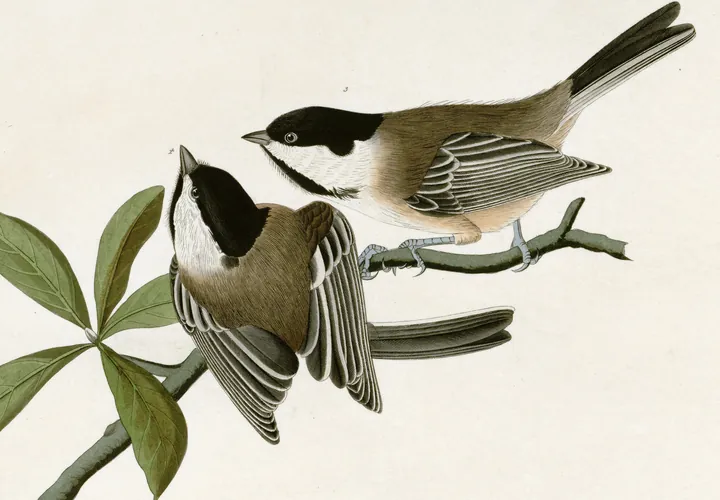
The painting on this page comes from his plate 353, which shows three species; the Black-capped Chickadee is the “Black-capt Titmouse” (plate 353 among all of Audubon's plates). More classic portraits are on our Black-capped Chickadee painting page.
Does any other state have the chickadee?
One: Massachusetts, whose law also names the chickadee, using another old scientific name, Penthestes atricapillus (Massachusetts General Laws).
Questions about the Maine state bird
Is Maine's state bird the Black-capped Chickadee?
Maine's law says only “the chickadee.” The Secretary of State's page names the Black-capped Chickadee, and a 2019 bill to choose between it and the Boreal Chickadee did not pass.
When did Maine adopt the chickadee as its state bird?
On April 6, 1927, by Chapter 111 of the Resolves of that year.
Do chickadees stay in Maine all winter?
Yes. The National Audubon Society's guide calls the Black-capped Chickadee mostly a permanent resident, and it often stores food to eat later.
Birdfolio prints a birder’s life list as a book, each species beside a classic painting. Look inside a Birdfolio.
Orders open on November 1.