State birds
What is the Idaho state bird?
The Idaho state bird is the Mountain Bluebird. The legislature adopted it in February 1931, in chapter 64 of that year's session laws, and Idaho Code § 67-4501 still declares “The Mountain Bluebird (Sialia currucoides)” the state bird. The same session made the Syringa the state flower.
Updated
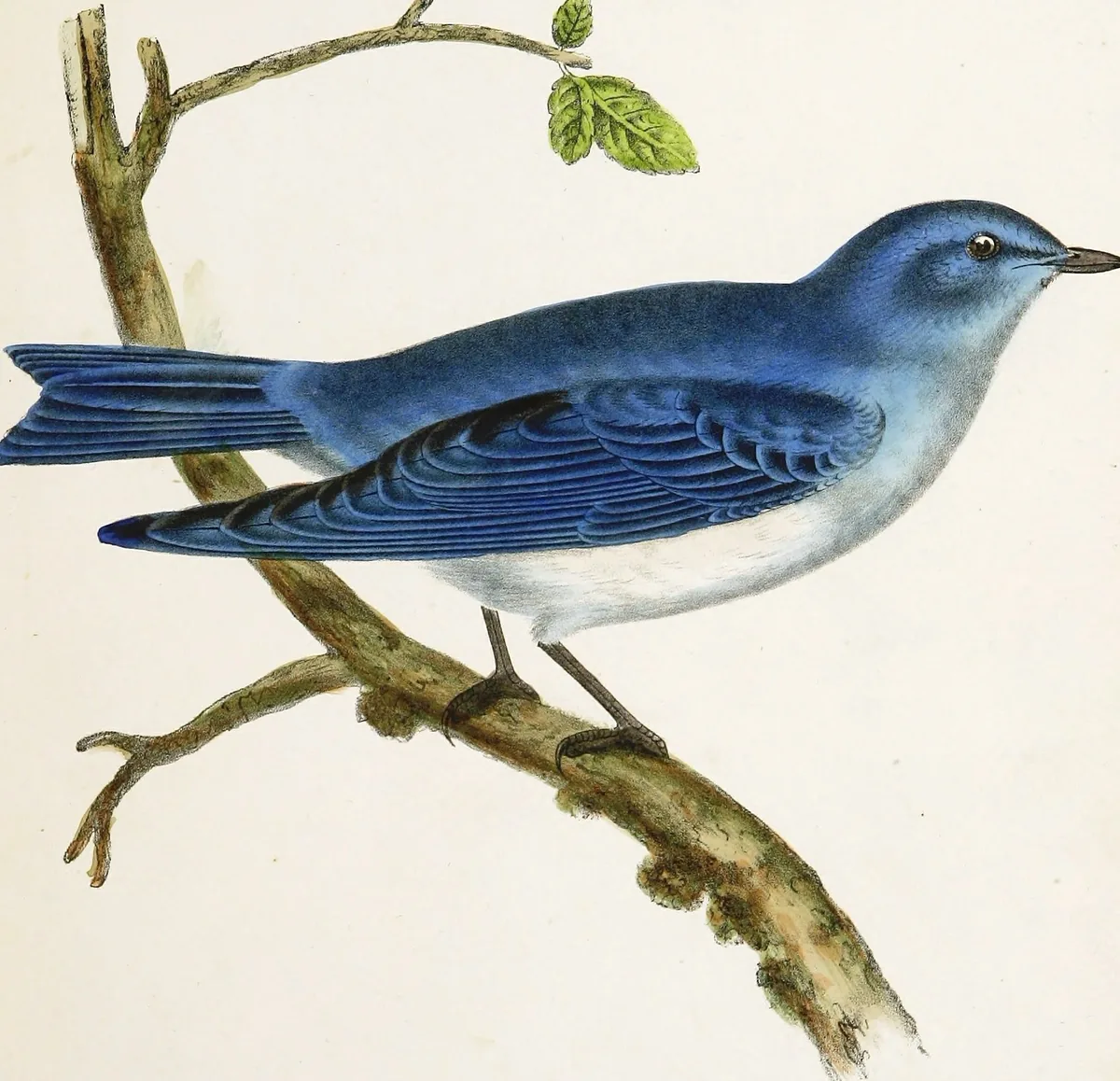
Why do Idaho's own pages call it Sialia arctcia?
It is a misprint of an old name. Idaho's law gets the bird right: the code says “The Mountain Bluebird (Sialia currucoides)” (Idaho Code § 67-4501). But the Secretary of State's symbols page and the state's Blue Book for 2025–2026 both print “Sialia arctcia,” a slip for Sialia arctica.
Sialia arctica was a real name once. The report printed with the plate on this page lists the bird as “SIALIA ARCTICA, Swainson,” the “Arctic Bluebird,” and describes it in a phrase: “Entirely blue; paler beneath” (the plate and its text).
Its specimen, number 7606, was not from Idaho at all: the report gives the place as Cochetope Pass, in the Colorado Rockies. The plate itself names no painter.
The code's history line records an amendment in 2015, and today's code uses the current name, Sialia currucoides.
How did Idaho choose the mountain bluebird?
The legislature adopted it in February 1931, the Blue Book says, by chapter 64 of that year's session laws. Chapter 75 of the same session made the Syringa, Philadelphus lewisii, the state flower (Idaho Code § 67-4502), a shrub whose scientific name, the Secretary of State notes, honors Meriwether Lewis.
The groundwork came earlier. In 1928, the Idaho Conservation League writes, a questionnaire went to every women's club in Idaho to find the best-loved bird, and the bluebird, the dove, the sage hen and the western tanager were all discussed.
The tanager was the bluebird's biggest rival, the League says, though few Idahoans of the time knew it. Schoolchildren across the state voted for the mountain bluebird, and the Idaho Federation of Women's Clubs backed it too.
Where and when can you see a Mountain Bluebird in Idaho?
Above all at Craters of the Moon, from March to October. The National Park Service says mountain bluebirds are common in the north of the monument through those months, calls them “one of the most conspicuous birds around Craters of the Moon's Loop Road,” and notes that this is “the only bluebird normally found above 5000 feet.”
The lava is the reason. Bluebirds nest in cavities, and research in the 1980s, the Park Service says, found mountain bluebirds most abundant in the lava fields there: the rock's crevices and pockets make ready-made nest holes, so at Craters “bluebirds don't have to nest in trees!”
Their return marks the turn of the season. Large flocks arrive in early March, the Park Service says, and it calls their arrival “a sure sign the winter is beginning to release its snowy grip.”
Craters of the Moon isn't the only spot. The U.S. Fish and Wildlife Service has a photograph of a Mountain Bluebird taken at Kootenai National Wildlife Refuge, a reminder that this is not only a bird of the lava country.
How to tell a Mountain Bluebird from an Eastern Bluebird
Sialis.org, a site devoted to bluebirds, says that compared with Eastern Bluebirds, mountain bluebirds are a paler blue, slimmer, and longer in the wing and tail. They are about 6 to 8 inches long, the Oklahoma Department of Wildlife Conservation says, and weigh only about an ounce.
Is a mountain bluebird really blue?
Not the way paint is blue. The National Park Service explains that mountain bluebirds have no blue pigment in their feathers: the tiny structure of each feather reflects sunlight, the same way air makes the sky look blue.
That is why a bluebird can look dull under clouds. When the sun goes in, the Park Service says, bluebirds “appear to ‘fade.’”
Who was Idaho's Bluebird Man?
Al Larson, a co-founder of the Golden Eagle Audubon Society. Natural tree holes are scarce, the society says, and nest boxes have helped mountain bluebirds come back: driving through the Owyhee Mountains, or between Mountain Home and Fairfield, you can see “hundreds of bluebird nesting boxes,” thanks mainly to people like Larson.
Larson, “celebrated as ‘Bluebird Man,’” spent nearly five decades looking after hundreds of nest boxes along the society's Bluebird Trails, and its volunteers still keep up most of the boxes he put up.
Does Idaho have a second state bird?
It has a state raptor. Since 2004 the Peregrine Falcon has held that title (Idaho Code § 67-4512), and the Secretary of State's page says its hunting dive can reach 200 miles per hour.
Which other state chose the mountain bluebird?
Nevada, in 1967. Idaho chose it first, thirty-six years earlier, so the two neighbors share it.
Audubon knew it by the old name too: his “Arctic Blue-bird” is one of three birds on plate 393 of The Birds of America. In the East, New York and Missouri chose a cousin, the Eastern Bluebird.
Questions about the Idaho state bird
When did the mountain bluebird become Idaho's state bird?
In February 1931, when the legislature adopted it. The law is now Idaho Code § 67-4501.
Why is the mountain bluebird Idaho's state bird?
Schoolchildren voted for it, says the Idaho Conservation League, and the Idaho Federation of Women's Clubs backed it. The law itself gives no reason.
What is Idaho's state bird and flower?
The Mountain Bluebird is the state bird and the Syringa is the state flower, both adopted in 1931. The flower's scientific name, Philadelphus lewisii, honors Meriwether Lewis.
What is Idaho's state animal?
Idaho has no single state animal. It names a state horse, the Appaloosa, and a state raptor, the Peregrine Falcon.
What is Idaho's state raptor?
The Peregrine Falcon, by a 2004 law that is now Idaho Code § 67-4512.
Birdfolio prints a birder’s life list as a book, each species beside a classic painting. Look inside a Birdfolio.