State birds
What is the Arkansas state bird?
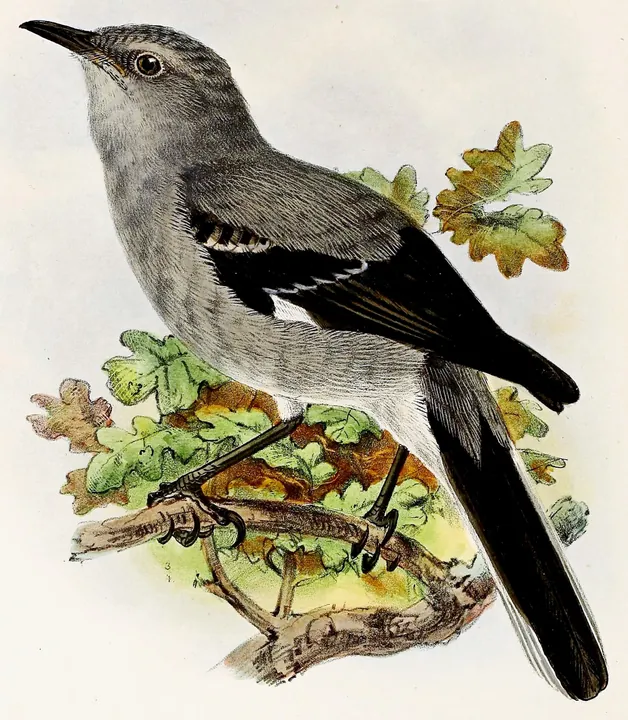
The Arkansas state bird is the Northern Mockingbird. It was adopted in 1929 at the urging of the Arkansas General Federation of Women's Clubs, and Arkansas Code § 1-4-118 says the mockingbird “is declared and everywhere recognized as the state bird of the State of Arkansas.”
Updated
Did Arkansas try to replace the mockingbird?
Yes, with two bills in one week of 2023, and both were gone within seconds of each other. On April 3, 2023, Representatives G. Hodges and A. Collins filed H.B. 1842, which would have made the painted bunting the state bird. The next day Representative B. McKenzie filed H.B. 1849, for the mallard duck.
Both bills printed the law they would change, struck through: the mockingbird “is declared and everywhere recognized as the state bird” (H.B. 1842 as filed; H.B. 1849 as filed).
Neither got any further. On the morning of April 6, 2023, their authors withdrew both bills, 19 seconds apart, and they were recommended for interim study, the work committees do between sessions, as the Legislature's bill histories record.
Is the mallard an Arkansas state symbol?
Yes, since 2025, as the state duck rather than the state bird. Act 215 of 2025, approved on February 27, 2025, says: “The mallard duck is designated the official duck of the State of Arkansas.” It is now § 1-4-141 of the Arkansas Code (H.B. 1417).
The act adds one more sentence: “This section does not grant a protected status to the mallard duck.” The official duck can still be hunted.
The mallard already had a place of honor. Arkansas's state quarter, released on October 20, 2003, shows rice stalks, a diamond and “a mallard gracefully flying above a lake,” and the United States Mint calls Arkansas “renowned for its outstanding waterfowl hunting.” Audubon's mallards are on our Mallard painting page.
Arkansas isn't alone in arguing over its bird. In 2026 Florida's bills to trade its mockingbird for the American flamingo died in the state Senate (Florida Senate; Florida state bird).
How did the mockingbird become the Arkansas state bird?
Through the women's federation that had already given Arkansas its state flower. The Arkansas General Federation of Women's Clubs, founded in 1897, won the apple blossom its place as state flower in 1901, and was “instrumental in securing the adoption of … the mockingbird as the official state bird in 1929,” the Old State House Museum writes.
The adoption “paid tribute to the federation's efforts in protecting the birds of Arkansas,” the museum says. The same women spent decades saving the Old State House itself: they took up its cause in 1904, three years after an act of 1901 had authorized tearing it down, and it opened as a museum in February 1951, with federation member Agnes Loewer as its first curator.
Today the law is Arkansas Code § 1-4-118, and the Secretary of State's activity book for young visitors to the Capitol still labels the mockingbird “The State Bird.”
Where can you see a mockingbird in Arkansas?
Almost anywhere. The University of Arkansas's Arkansas Breeding Bird Atlas found it in 738 of its survey blocks, 84.3 percent of them: a common bird across most of the state.
It will come to a yard with the right food. The university's Cooperative Extension Service lists fruit and suet among the foods that bring Northern Mockingbirds to feeders.
The longest-lived wild mockingbird on record was a Texas bird (USGS Bird Banding Laboratory); more on our page of the oldest wild birds.
What did our painter think of America's mockingbird?
That Americans oversold it, a little. In the text beside this plate, John Gerrard Keulemans wrote: “De Amerikanen echter hebben geen Nachtegaal, geen Zanglijster,” that is, “The Americans, however, have no nightingale, no song thrush” (our translation). No wonder, he went on, that they heaped praise on a songbird of their own.
He added a dig at American salesmanship: it was as if North Americans had an inborn habit “to talk up the qualities of everything meant for trade” (our translation; the book on the Internet Archive). Then, to be fair, he quoted the ornithologist Alexander Wilson's praise of the bird at length.
The plate is lettered “J. G. Keulemans ad nat.,” drawn from life, and titled “De spotlijster.” It carries no plate number; the mockingbird is simply the 14th bird in the book's second volume (the plate). Keulemans's other mockingbird stories are on our Texas and Tennessee pages, and Audubon's on the Northern Mockingbird painting page.
Which states share Arkansas's state bird?
Four: Florida, Mississippi, Tennessee and Texas. Texas and Florida chose the mockingbird in 1927, two years before Arkansas; Tennessee followed in 1933, and Mississippi in 1944, where the state's Women's Federated Clubs backed it too.
The painted bunting, the 2023 challenger, is not the state bird of any state.
Questions about the Arkansas state bird
When did the mockingbird become the Arkansas state bird?
In 1929, at the urging of the Arkansas General Federation of Women's Clubs. The law today is Arkansas Code § 1-4-118.
Is the mallard the Arkansas state bird?
No. The mockingbird is the state bird. Since 2025 the mallard has been the official state duck, by Act 215, which says the title gives it no protected status.
Which birds were proposed to replace the Arkansas mockingbird?
The painted bunting (H.B. 1842) and the mallard (H.B. 1849), both in 2023. Their authors withdrew both bills on April 6, 2023.
Is the mockingbird common in Arkansas?
Yes. The University of Arkansas's breeding bird atlas found it in 84.3 percent of its survey blocks.
Birdfolio prints a birder’s life list as a book, each species beside a classic painting. Look inside a Birdfolio.
Orders open on November 1.