State birds
What is the Michigan state bird?
The Michigan state bird is the American Robin, which the Legislature calls the robin redbreast. It became the official State Bird on May 21, 1931, by House Concurrent Resolution 30, after an election run by the Michigan Audubon Society in which nearly 200,000 votes were cast.
Updated
How did the robin become Michigan's state bird?
By a popular vote. The Michigan Manual, the Legislature's handbook, says the robin redbreast was chosen “as the result of an election conducted by the Michigan Audubon Society.” “Nearly 200,000 votes were cast,” it says, and the robin “received many more votes than any other bird as the most popular bird in Michigan.”
The Legislature made it official on May 21, 1931, with House Concurrent Resolution 30, which called the robin “the best known and best loved of all the birds in the state of Michigan.” The State of Michigan's symbols page adds that the robin “had been favored by the Michigan Audubon Society.”
A concurrent resolution is not a statute, so the robin has no section of Michigan's compiled laws to itself.
Which bird did Henry Ford vote for?
The Song Sparrow. Henry Ford cast his vote for it in the Audubon Society's 1929 election, Michigan Public reports, citing a Detroit Free Press article of April 19, 1929, and Governor Fred Green reportedly voted for the Ruffed Grouse, the bird Pennsylvania adopted two years later (Pennsylvania's 1931 act).
Anyone could take part. The poll looked for the bird that “gives the greatest joy to the majority of Michiganders,” Michigan Public says, drawing on an interview with an archivist at the Archives of Michigan. The Society nominated 21 birds, people of all ages could vote through April 1929, and churches, organizations and clubs mailed in votes as groups.
It was closer than the resolution makes it sound. In Michigan Public's account, the Black-capped Chickadee led until about mid-April and finished second, “almost 10,000 votes behind the Robin.” The Society's president, Edith Munger, at first wanted to run the election again; it was not rerun.
Munger doubted the voters, too. Had they studied birds first, she said in 1929, the result “would have been different,” Interlochen Public Radio reported in 2025, quoting the historian Amy Elliott Bragg.
Has Michigan tried to replace the robin?
Yes, at least twice. In 2000, House Bill 5676, sponsored by Representative Doug Hart, would have repealed the 1931 resolution and made the Kirtland's Warbler the state bird (House analysis of H.B. 5676). In 2001, House Bill 4518, sponsored by Representative Ken Bradstreet, proposed the Black-capped Chickadee (House analysis of H.B. 4518).
Neither became law, and the Legislature's 2023–2024 manual still names the robin. The case for the warbler lives on: in 2021 Audubon magazine argued that the Kirtland's Warbler should be Michigan's state bird, and by its count, “Only 22 percent of the votes were for the robin.”
Audubon painted the chickadee, the robin's runner-up, as well: see our Black-capped Chickadee painting page.
How did Michigan's robins help expose DDT?
Michigan's state bird was at the center of an early warning. From the mid-1950s into the 1960s, Michigan State University ornithologist George Wallace and his graduate students collected dead and dying birds on and around the campus, the Michigan Department of Natural Resources recounts. “Most of these birds were robins,” some of them found “suffering from seizures or tremors.”
Tests showed “elevated levels of DDT.” The pesticide had passed from sprayed leaves to the soil, from the soil to earthworms, and from the earthworms to the robins that ate them. “The U.S. Environmental Protection Agency banned DDT use in 1972,” the DNR notes.
Where and when can you see robins in Michigan?
In almost any yard, and in the woods as well. The DNR's Critter Cards say the robin is “at home in backyards, gardens, and parks,” and in wilder places such as woodlands and forests.
In every month. Michigan Public says you can find robins in Michigan “all year-round”: some go south for the winter while others arrive from farther north. They are easiest to spot in spring, out on the lawns.
Their eggs named a color. “Robin's egg blue is a color named for the hue of my eggs,” says the robin on the DNR's card.
A wild robin can pass 13 years. The oldest in the federal banding records lived at least 13 years and 11 months (USGS Bird Banding Laboratory; more on our page of the oldest wild birds).
Is the robin redbreast the same bird as the American Robin?
Yes. The Legislature's manual uses the old name, robin redbreast, and the state's symbols page names the same 1931 choice the “AMERICAN ROBIN (Turdus migratorius).” It is the American bird, not the European Robin.
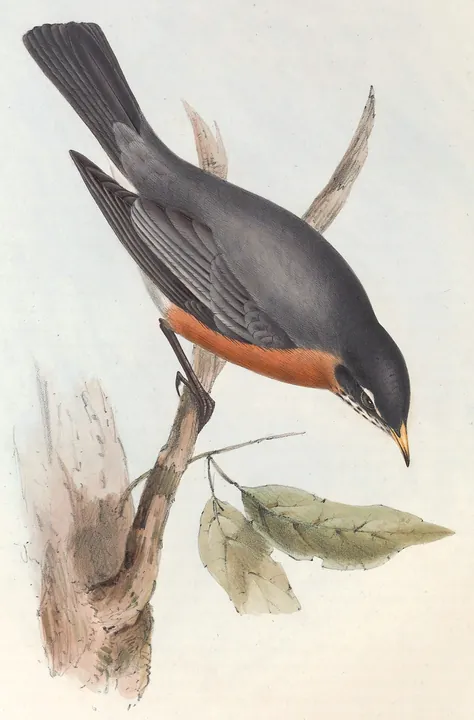
Painters gave it still more names. John and Elizabeth Gould put it in The Birds of Europe as the “Migratory Ouzel,” Merula migratoria, on a plate lettered “Drawn from Nature & on Stone by J. & E. Gould” (Gould's plate). Our Wisconsin state bird page tells why an American robin is in a book about European birds.
Audubon painted it as plate 131 of The Birds of America (plate 131 among Audubon's plates). Writing of Labrador, he recalled that “its joyful notes were the first that saluted my ear” (Audubon's text). More robins are on our American Robin painting page.
Which other states chose the robin?
Two: Connecticut, which adopted it in 1943 (CT.gov), and Wisconsin, which made it law in 1949 (Laws of Wisconsin 1949).
The robin was a runner-up elsewhere: second in New York's 1928 vote, as Eugene Kinkead told it (New York State Bluebird Society; New York state bird), and second in Tennessee's in 1933, by just 480 votes (The Migrant, March 1933; Tennessee state bird).
Questions about the Michigan state bird
When did the robin become Michigan's state bird?
On May 21, 1931, by House Concurrent Resolution 30, after an election run by the Michigan Audubon Society.
Why is the robin Michigan's state bird?
It won the Michigan Audubon Society's election, and the 1931 resolution called it “the best known and best loved of all the birds in the state of Michigan.”
Do robins stay in Michigan in winter?
Some do. Robins can be found in Michigan all year, Michigan Public says; some go south while others arrive from farther north.
Has Michigan tried to change its state bird?
Yes. Bills in 2000 and 2001 would have replaced the robin with the Kirtland's Warbler and the Black-capped Chickadee. Neither passed.
Birdfolio prints a birder’s life list as a book, each species beside a classic painting. Look inside a Birdfolio.
Orders open on November 1.