State birds
What is the New York state bird?
The New York state bird is the Eastern Bluebird. Governor Nelson Rockefeller signed it into law on May 18, 1970, according to the New York State Library, and State Law Section 78 says: “The bluebird (Sialia Sialis) shall be the official bird of the state of New York.”
Updated
Why did New York wait until 1970 for a state bird law?
It already had a bird, just not a law. As Eugene Kinkead told the story in The New Yorker in 1973 (an excerpt is on the New York State Bluebird Society's site), Mrs. Charles Cyrus Marshall of the New York State Federation of Women's Clubs ran an informal referendum, and its result was announced on Bird Day, April 13, 1928. The bluebird won and the robin came second. For the next 42 years, Kinkead wrote, the bluebird was New York's unofficial state bird.
In 1943, North Carolina's state bird act said North Carolina and Connecticut were “the only states in the Union that have not adopted an official state bird” (Session Laws of North Carolina, 1943). The act said so, but it missed New York, whose bluebird would have no law behind it for another 27 years.
The law began with a request. In spring 1969, Kinkead wrote, Mr. and Mrs. Allen Christopher of Marathon, in Cortland County, asked Assemblyman George M. Michaels of Auburn to make the bluebird official, and the Senate passed the bill, S.6245, on February 18, 1970, 49 votes to none.
Governor Nelson Rockefeller signed it on May 18, 1970, the New York State Library records, and its one sentence is now New York State Law § 78. The Department of Environmental Conservation keeps it short: “The Eastern Bluebird was named New York's state bird in 1970.”
Who objected to New York's bluebird?
An assemblyman from the Bronx. In Kinkead's telling, Assemblyman Seymour Posner objected that city people knew the sparrow and the pigeon, and asked: “how are we going to go along with a bird we never saw?”
Michaels, who had introduced the bill wearing a bluebird pin, carried the day. On March 2, 1970, by Kinkead's count, the Assembly passed it 144 to 1.
The Bronx assemblyman was half right: bluebirds are birds of open country. The DEC tells people to “look for them in fields, meadows, and orchards,” and its state symbols page explains why they grew scarce. Until the 1920s they nested in fence posts and apple trees on small farms, and when the farms were abandoned, “Fence posts rotted and fields gave way to trees.”
How did New York bring its bluebirds back?
With nest boxes, by the mile. Along U.S. Route 20 there is “a trail of bluebird boxes that stretches nearly 400 miles,” says the DEC's state symbols brochure. According to the New York State Bluebird Society, Ray Briggs started the Route 20 trail in 1993, and it runs from the Massachusetts line to the Pennsylvania border; a second trail follows Route 11.
The brochure credits the bird's return to “the ban of the pesticide DDT, protection of open spaces, and volunteer efforts,” and the DEC's symbols page names the volunteers: “the North American Bluebird Society and its state and local affiliates.” The State Library says the bluebird has been “making a comeback from low numbers in the 1950s.”
Anyone with a yard can join in. The DEC suggests boxes on posts five to six feet up, set out in pairs: “one for the bluebirds, the other for the competition.”
Bluebirds have crashed and recovered before. After “the severe winter of 1895,” the naturalist Elon Howard Eaton wrote in Birds of New York (1914), he found “perhaps one pair nesting” where 20 or more pairs had been, yet “within 5 years this species was as abundant as ever throughout the State” (Eaton, vol. 2).
Eaton also saw how little a bluebird asks: it “will build even in cigar boxes nailed to the top of fence posts,” though he found it liked boxes 7 to 9 feet up best, where English sparrows bothered it less.
Where and when can you see bluebirds in New York?
In open country with a place to nest. Bluebirds nest “in cavities in standing dead trees and in nesting boxes,” the DEC says, and it names two good places to see them: the Five Rivers Environmental Education Center in Delmar and the Stony Kill Farm Environmental Education Center.
Look early in spring. The bluebird “is one of the first birds to return north in the spring,” the DEC's brochure says, and the Bluebird Society says they generally come back “in early to mid-March.”
Some never leave. “Bluebirds may be present year-round,” the DEC says; most migrate to southern states in the fall, but some stay “if they can find enough food.” They also keep each other warm: “roosting flocks of up to 50 birds huddle together at night to stay warm.”
The oldest Eastern Bluebird in the federal banding records started life in New York. It was banded there on May 23, 1989, at the age the Banding Lab calls “Local”: “A nestling or young bird incapable of sustained flight” (Banding Lab age codes). It was found dead in South Carolina on November 30, 1999, at least 10 years and 6 months old (USGS Bird Banding Laboratory; more on our page of the oldest wild birds).
Did Audubon know about bluebird boxes?
He did, nearly two centuries ago. In his Ornithological Biography (vol. 2, 1834) Audubon described the little box people made for the bluebird, set on the roof of a house or a barn or on a fence stake, and noted that the bird “returns to it even during the winter” (Audubon's text).
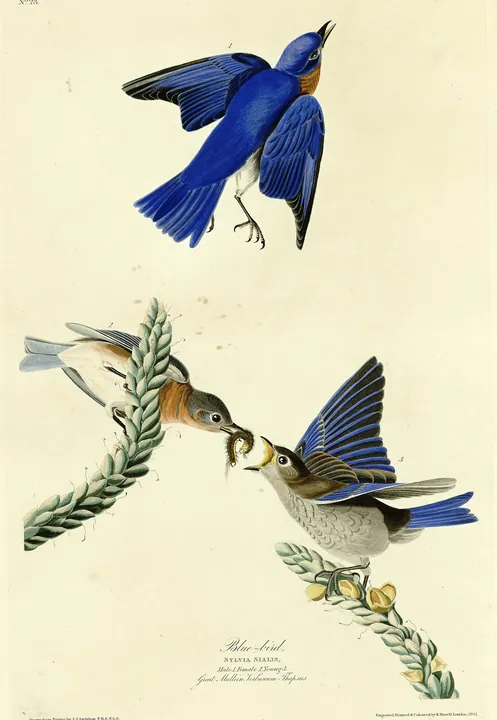
The painting on this page is his plate 113, which he called the “Blue-bird” (plate 113 among Audubon's plates). In Eaton's Birds of New York, Louis Agassiz Fuertes painted the bluebird beside the robin, as it happens the two front-runners of 1928. More of Audubon's bluebirds, and his stories about them, are on our Eastern Bluebird painting page.
Which other state has the bluebird?
One: Missouri, which adopted it in 1927. “The bluebird is also Missouri's state bird,” the State Library notes, and Missouri's law names the native bluebird, Sialia sialis (Missouri Secretary of State).
It came close in another state. Illinois schoolchildren made the bluebird their runner-up, 30,306 votes to the cardinal's 39,226 (Illinois State Museum); that vote is on our Illinois state bird page. And the robin, New York's runner-up in 1928, is the state bird of Connecticut, Michigan and Wisconsin.
Questions about the New York state bird
When did the bluebird become New York's state bird?
In 1970. Governor Nelson Rockefeller signed the law on May 18, 1970, and it is now State Law § 78.
Is New York's state bird the Eastern Bluebird?
Yes. The law names “the bluebird (Sialia Sialis),” the species birders call the Eastern Bluebird.
Do bluebirds stay in New York in winter?
Some do, if they can find enough food, the DEC says. Most go south in the fall and come back in early to mid-March.
Where is New York's bluebird trail?
Along U.S. Route 20, where nest boxes stretch nearly 400 miles across the state. A second trail follows Route 11 from the Canadian border to Pennsylvania.
Birdfolio prints a birder’s life list as a book, each species beside a classic painting. Look inside a Birdfolio.
Orders open on November 1.