State birds
What is the South Dakota state bird?
The South Dakota state bird is the Ring-necked Pheasant, a bird from Asia that is not native to the state. South Dakota Codified Law 1-6-9 adopts “the ring-neck pheasant” as the official state bird, and the Department of Game, Fish and Parks dates the choice to February 13, 1943.
Updated
How much did South Dakota pay for its pheasants?
Less than 20,000 dollars, for all of them. Between 1911 and 1921 the state bought about 5,500 pheasants, starting with 200 pairs in 1911, and the whole stock cost less than 20,000 dollars, according to the Department of Game, Fish and Parks' Data Book.
Now compare one recent season. In 2022 an estimated 54,000 resident and 74,000 nonresident hunters, from all 50 states, took about 1,158,000 pheasants, and pheasant hunting brought an estimated 257.3 million dollars into South Dakota's economy, says the department's 2024 management plan. The two sums are a century apart, and we have not adjusted either for inflation.
That was part of the case for making it the state bird. In 1943 State Representative Paul Kretschmar of Eureka asked the Legislature “to reward a bird of fine table delicacy, sporting blood, vigorous and hardy,” found across the state, “responsible for a substantial part of our state income,” and a bird that had brought the state national recognition, as the Data Book reprints his case from the South Dakota Conservation Digest.
When did the pheasant become South Dakota's state bird?
In 1943. “On February 13, 1943, South Dakota adopted the ring-necked pheasant as the official state bird,” the Data Book says. The law is South Dakota Codified Law 1-6-9, first passed as chapter 272 of the 1943 session laws; chapter 1-6 of the code, where it sits, names no other bird.
The pheasant is not native to South Dakota, as Game, Fish and Parks' 2024 plan notes. Of the 50 state birds in our table, it is the only one brought from another continent as a wild bird; Delaware's and Rhode Island's state birds are farm chickens.
How did pheasants get to South Dakota?
Not on the first try. Early attempts by Dr. A. Zetlitz of Sioux Falls failed, and hunters likely shot those birds, the Data Book says.
The birds that lasted came in 1908 or 1909, and Game, Fish and Parks' own books disagree on the year. The Data Book argues for 1909: seven newspapers in March 1909 reported that three Redfield men, Harland Packard, Henry Schalkle and Bert Hagman, had received “a shipment of a dozen Chinese pheasants” from Gene Simpson's farm in Corvallis, Oregon. The department's 2024 plan still dates the first successful releases to 1908.
Six of the Oregon birds were let go in Hagman's grove north of Redfield, in Spink County. Their young, Hagman recalled in 1921, were “roosting in the chicken coop until the middle of the next winter.” Oregon had a head start: the Data Book says the bird was “successfully introduced into the United States in 1881 in Oregon.”
The first hunting season, on October 30, 1919, lasted one day, in Spink County: “A few hundred hunters harvested an estimated 200 birds.” By 1945 there were 16 million pheasants, which the Data Book calls “the largest population ever recorded.” Between 1926 and 1941 the department trapped some 33,000 birds and moved them west, to seven counties, the 2024 plan adds.
Where can you see pheasants in South Dakota?
In farm country, all year. Pheasants live in South Dakota's mix of cropland and grassland in every season, and they took hold first in the central and eastern parts of the state, the 2024 plan says.
In winter, look near thick cover. They gather in “cattail wetlands and dense shrubs or woodlands,” and pheasants “have been found to move 5–10 miles” to reach good winter cover. They are short-lived birds that breed fast, the plan explains.
The opening weekend of pheasant hunting, in October, is a statewide event, the plan notes.
Is the pheasant on South Dakota's state quarter?
Yes. The South Dakota quarter, released on November 6, 2006, as the 40th coin of the 50 State Quarters Program, shows “the Chinese ring-necked pheasant in flight above the Mount Rushmore National Memorial,” framed by wheat, the United States Mint says.
Who painted the pheasant on this page?
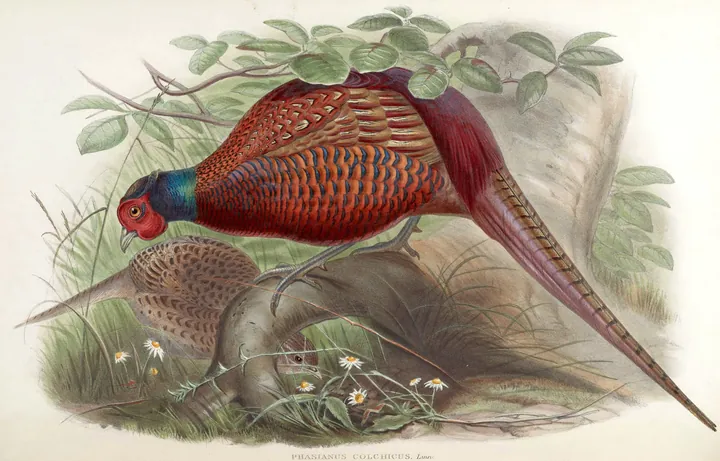
Joseph Wolf drew it, and Henry Constantine Richter put it on the lithographic stone: the plate is signed “J. Wolf & H. C. Richter, del. et lith.,” Latin shorthand for drew and lithographed. It appeared in John Gould's The Birds of Asia, in the part of April 1869, where Gould's text calls the bird the “Common Pheasant” (the plate and text on the Internet Archive).
Gould's text explains the scientific name. The bird's true home, he wrote, is the shore of the Black Sea, “the ancient Colchis, from which the specific name is derived.” The pair on the plate were drawn from “specimens killed in Asia Minor,” and the cock has no white collar; the ringed Chinese bird has a plate of its own in Gould's book, from May 1856.
The Redfield shipment of 1909 and the 2006 quarter both call South Dakota's birds Chinese pheasants.
Does any other state have the Ring-necked Pheasant?
No. South Dakota is the only state with the pheasant as its state bird, though pheasants are hunted as game birds in many others.
Its neighbor North Dakota chose the Western Meadowlark, a bird whose first specimens Audubon's party collected in 1843 in what is now South Dakota, by North Dakota Game and Fish's account.
Questions about the South Dakota state bird
Is the pheasant native to South Dakota?
No. The Ring-necked Pheasant comes from Asia, and Game, Fish and Parks notes that it is not native to the state. The first birds to take hold were released in Spink County in 1908 or 1909.
When did the pheasant become South Dakota's state bird?
In 1943. Game, Fish and Parks gives the date as February 13, 1943, and the law is South Dakota Codified Law 1-6-9.
Why is the pheasant South Dakota's state bird?
Its champion in 1943, Representative Paul Kretschmar of Eureka, praised its taste, its sporting blood and its hardiness, and the income it brought the state.
Where did South Dakota's first pheasants come from?
Oregon. In March 1909 three Redfield men received a dozen Chinese pheasants from a farm in Corvallis, Oregon, the Data Book reports.
Birdfolio prints a birder’s life list as a book, each species beside a classic painting. Look inside a Birdfolio.
Orders open on November 1.