State birds
What is the Missouri state bird?
The Missouri state bird is the Eastern Bluebird. It became the official state bird on March 30, 1927, according to the Secretary of State's Official Manual, and the law today, Revised Statutes of Missouri § 10.010, names “the native ‘bluebird’ (Sialia Sialis).”
Updated
How did Kentucky's state bird lead to Missouri's?
Through a letter, in the account Sterling P. Jones wrote for the St. Louis Bird Club in 1947. In 1926, Jones wrote, Jane Wynne, a St. Louis news writer, sent a letter to Alfred F. Satterthwait of the Webster Groves Nature Study Society, “mentioning that Kentucky had recently selected a State Bird.” The Secretary of State cites Jones's story, and the Missouri Birding Society reprinted it in 2021 (Jones, “The Story of the Bluebird”).
Kentucky's bird was the cardinal, chosen by a resolution approved on February 17, 1926 (Kentucky Legislature). Satterthwait's society polled its members, and, in Jones's words, “the unanimous verdict was ‘Bluebird.’”
Jones lists the reasons: the bluebird's popularity, beauty and song; its place as a “symbol of happiness” and a sign of spring; the sky on its back and the earth on its breast; and its value against insect pests.
Bird clubs, the Audubon Society of Missouri and teachers took it up, and only Kentucky's bird was ever put forward against it: “with the exception of one call for the cardinal, no other bird was mentioned,” Jones wrote. Luther Ely Smith, president of the St. Louis Bird Club, drew up a petition, newspapers and radio spread the word, and “Senator Kinney introduced the bill.”
It was Senate Bill 321, the Secretary of State records, and on March 30, 1927, the Official Manual says, “the native bluebird (Sialia sialis) became the official state bird.” Today it is Revised Statutes of Missouri § 10.010, in its present wording since August 28, 1957.
What was the Missouri Bluebird Trail?
A road lined with nest boxes, and then a national one. Jones tells how Mrs. Erle R. Jackson's Better Gardens Club of Kirkwood put up the first house of a Missouri Bluebird Trail on March 2, 1942, heading toward Route 50. When the house was photographed three days later, bluebirds had already moved in.
Missouri's garden clubs dedicated the trail on May 6, 1942, at their convention in Columbia, with 2,680 houses up, Jones wrote. Other states joined between 1942 and 1944, and a “National Bluebird Trail” was dedicated on May 9, 1945, in Springfield, Missouri. “By 1946, 6,728 bird houses had been put up.”
The war ended one effort, Jones noted: students in Cape Girardeau had started a chain of bluebird houses in 1938, and stopped when “the war call stopped them.”
Did nest boxes save Missouri's bluebirds?
Largely, says the Missouri Department of Conservation. Bluebirds declined through habitat loss, pesticides and competition with house sparrows and starlings, and were rescued “in large part by a widespread effort to erect and protect special bluebird nest boxes.”
Jones, in 1947, hadn't counted the sparrows as a problem; he called the house sparrow “not a serious menace.” The Conservation Department now names it among the causes of the bluebird's decline.
Bluebirds stand up for themselves, too. Audubon warned in 1834: “Martins and House-wrens! be prepared to encounter his anger” (Audubon's text). How martins took over his own bluebird boxes is on our Eastern Bluebird painting page.
Missouri honors the martin as well: a 2003 law names Adrian “the purple martin capital of the state of Missouri” (RSMo § 10.141).
Why is the Eastern Bluebird blue?
Not because of pigment. Tiny prism-like structures in the feathers make the color, the Conservation Department explains, and if you crush a blue feather, “the crushed part will turn black or brown.” Bluebirds also “may attack their reflections in mirrors and glass,” it says.
The Secretary of State sees the flag in them: the bluebird's “red, white and blue coloring” makes it “a natural choice for an American symbol,” and “The bluebird is considered a symbol of happiness.”
Did Audubon know the bluebird was a thrush?
He suspected it. Audubon filed the bluebird under Sylvia, the warblers, yet wrote in his Ornithological Biography (vol. 2, 1834): “I might conceive it proper to assign the Blue Bird a place among the Thrushes.” The Conservation Department today puts the Eastern Bluebird in the thrush family, Turdidae.
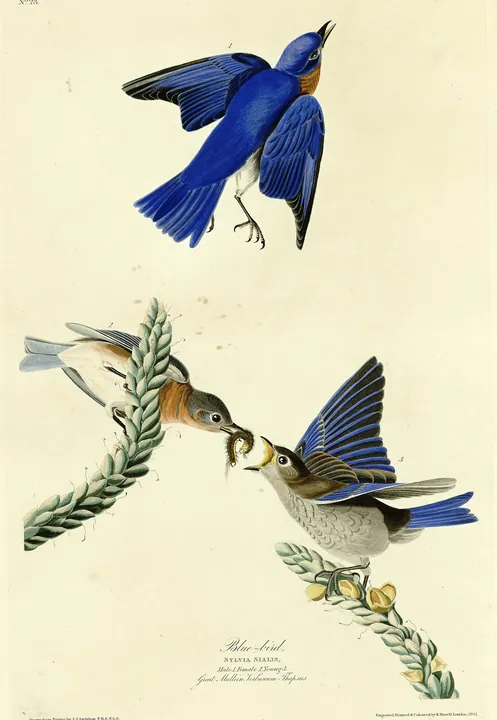
He also passed on an older name: “the first settlers in Massachusetts named our bird the Blue Robin.” Plate 113, the picture on this page, is the one he titled the “Blue-bird” (plate 113 among Audubon's plates).
The species' scientific story begins in South Carolina. Linnaeus named the species in 1758, “Based mainly on ‘The Blew Bird’ Catesby,” as the Check-list puts it, from Mark Catesby's book; its type locality, the place the described bird came from, is South Carolina (AOU Check-list, 1983).
When can you see bluebirds in Missouri?
From spring to late fall, all over the state. The Conservation Department says bluebirds arrive “in March and April,” leave “in October and November,” and are most abundant “from mid-March through the end of November”; the Official Manual calls them “common in Missouri from early spring until late November.”
In winter, head south. Winter bluebirds are “uncommon in the south and rare in the north,” and in southern Missouri they stay all year. In summer, look over “grasslands with scattered trees, farmland, and backyards in rural areas,” where a pair can raise two broods, with 2 to 7 eggs in a clutch.
Our page of the oldest wild birds has the longest-lived Eastern Bluebird on record.
Which other state has the Missouri state bird?
One: New York, which adopted it in 1970 (New York State Library). Two more states, Idaho and Nevada, chose a different bluebird, the Mountain Bluebird.
Missouri's other official bird is a game bird: the bobwhite quail, named in 2007 (RSMo § 10.012). And the cardinal, the one rival in Jones's account, is the state bird of seven states (why so many states chose the cardinal).
Questions about the Missouri state bird
When did the bluebird become Missouri's state bird?
On March 30, 1927, says the Secretary of State's Official Manual. The bill was Senate Bill 321, and the law is now Revised Statutes of Missouri § 10.010.
Why did Missouri choose the bluebird?
In Sterling P. Jones's 1947 account, its backers praised its beauty, song and popularity, called it a symbol of happiness and a sign of spring, and valued it against insect pests.
Do bluebirds stay in Missouri in winter?
Some do. In winter they are uncommon in the south and rare in the north, the Conservation Department says, and in southern Missouri they live all year.
What was the Missouri Bluebird Trail?
A trail of bluebird nest boxes that Missouri garden clubs began in 1942, Sterling P. Jones wrote. By 1945 it had become a National Bluebird Trail, dedicated in Springfield, Missouri.
What is Missouri's state bird and flower?
The bluebird is the state bird, and the hawthorn blossom is the state floral emblem, named in 1923. Missouri has about 75 kinds of hawthorn, the Secretary of State says, all with white, five-petaled blossoms.
What is Missouri's state animal?
The Missouri mule, the official state animal since 1995. A mule's mother is a horse and its father a donkey, and for decades Missouri was the nation's leading mule producer, the Secretary of State says.
Birdfolio prints a birder’s life list as a book, each species beside a classic painting. Look inside a Birdfolio.
Orders open on November 1.