Classic bird paintings
Red-winged Blackbird painting: Audubon's plate and other classic portraits
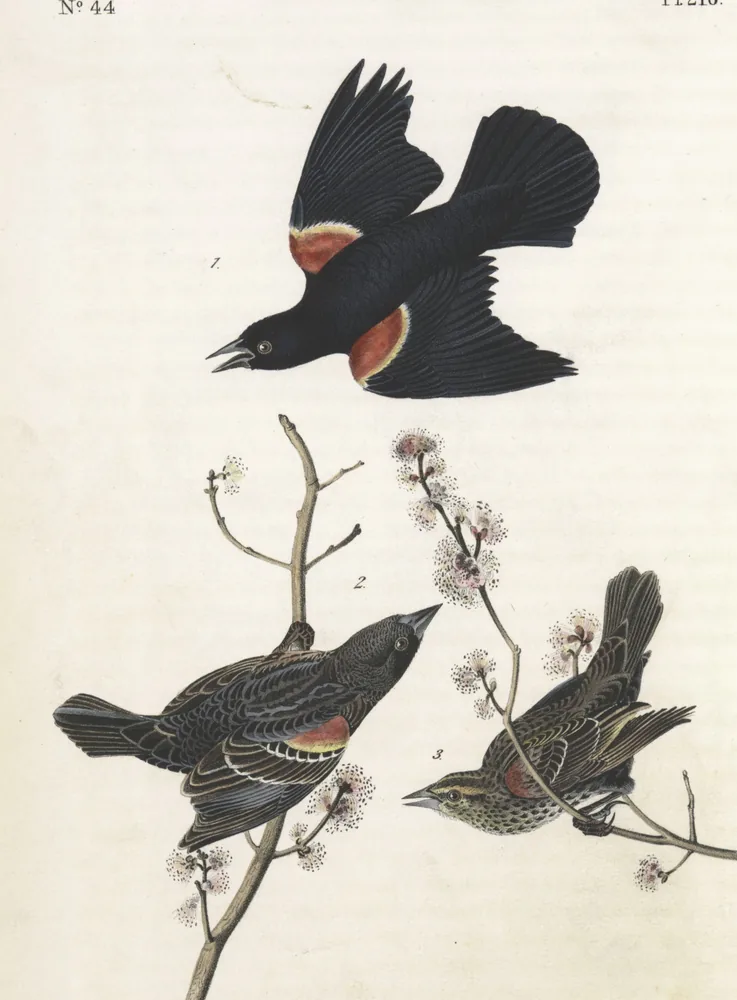
John James Audubon painted the Red-winged Blackbird as plate 67 of The Birds of America (1827–38), four birds on red maple, under the name Red-winged Starling. Audubon.org has a free high-resolution scan. The picture here is plate 216 of the octavo edition (1840–44), with three of the four birds.
Updated
About this painting
This is the octavo edition’s plate 216, Red-winged Starling, from the 1840s: an adult male in flight, with a young male and a female on a red maple twig, three of the big plate’s four birds.
Audubon’s Red-winged Blackbird: plate 67, “Red-winged Starling”
By early August, when the second broods are flying, Red-winged Blackbirds come down on the cornfields of the Middle States in such numbers that they seem to veil them. A shot from the farmer's gun only moves them to another part of the field, Audubon wrote, and they treat his scarecrows as lookout posts. Even so, he took their side: the millions of insects they eat in spring were “a full equivalent for the corn which they eat at another period.”
In spring the farmers leave them alone, and the birds follow the plowman for grubs as if they knew the good they were doing. A male guarding his nest dives at anyone who comes near, scolding. At Roxbury, near Boston, Dr. Brewer knew a pair whose eggs were taken twice; each time they built again in the same clump of bushes, and the third time they were left in peace.
Audubon called it the Red-winged Starling, or Marsh Blackbird, though he thought it no more a starling than a crow is. Plate 67 shows four birds on red maple, a tree they visit in early spring to pick insects from the blossoms: an adult male, a young male in his first spring, a female and a young bird.
Story: Audubon, Ornithological Biography, vol. 1 (1831), pp. 348–352; vol. 5 (1839), pp. 487–489. See plate 67 free at Audubon.org. See plate 420 free at Audubon.org.
More classic portraits, free to see
- John James Audubon, The Birds of America, octavo edition (1840–44): plate 215: “Red-and-black-shouldered Marsh-Blackbird”; plate 216: “Red-winged Starling” (the painting shown above). (Free scans: New York Public Library Digital Collections)
- Louis Agassiz Fuertes, for Elon H. Eaton’s Birds of New York (1910–14), plate 73: “Red-winged Blackbird”, with Rusty Blackbird and Bobolink. Free scan (Internet Archive)
About the Red-winged Blackbird
- Red-winged Blackbirds usually search the ground for food, and outside the nesting season they feed in flocks. (Source: National Audubon Society)
What is the black bird with red wings?
Almost always a male Red-winged Blackbird. The red sits on his shoulders, in patches usually bordered with yellow, National Audubon's guide says, and he keeps them half hidden under his body feathers much of the time, then flashes them when he sings. Females and young look nothing like him: streaky brown, a little like big sparrows. For a blue head, a white belly, yellow eyes and other marks, see black birds by field mark.
In the Pacific states, look twice. The Tricolored Blackbird lives only there, and the male's patch is a deeper red with a white border, not a yellow one; even the sooty brown female has a small reddish shoulder patch, the US Fish and Wildlife Service notes. It nests in packed colonies, some once over 100,000 nests, and it is now considered endangered. In central California, some male Red-wings show all-red patches with no yellow edge, a form called the Bicolored Blackbird.
Sources: National Audubon Society guide, Red-winged Blackbird; National Audubon Society guide, Tricolored Blackbird; US Fish and Wildlife Service, Tricolored Blackbird.
What is the black bird with orange on its wings?
Often a male American Redstart, a small warbler that is mostly black with red-orange patches on its wings, tail and sides, National Audubon's guide says. It is only 4.3 to 5.1 inches long and often holds its wings and tail partly spread, as if showing off the patches.
A bigger black bird, 6.7 to 9 inches, with the color only at the shoulder, is a male Red-winged Blackbird. His patches are red and usually bordered with yellow, which is also the answer to the black bird with red and yellow wings.
Sources: National Audubon Society guide, American Redstart; National Audubon Society guide, Red-winged Blackbird.
Is the red-and-black bird in Texas a Red-winged Blackbird?
If the red is a patch on each shoulder, yes. A glossy black male with red shoulder patches edged in yellow is a Red-winged Blackbird, and no other Texas bird should be mistaken for one, the Texas Breeding Bird Atlas says. Only males in their third year or older look like that. Younger males range from brown, like a female, to black with brown sides; females are streaky brown with a white eyebrow. Most males win no territory until their third year, and until then they hang about the colonies as “floaters.”
They nest in much of Texas from mid-March to late July, most commonly east of the 100th meridian and across the Panhandle. From late July to late April, migrants from the north make them common all over the state, sometimes in enormous flocks with other blackbirds, grackles and cowbirds. Audubon found the islands of Galveston Bay “most plentifully supplied” with them, some nesting a few yards from houses, and saw flocks of females there, apparently migrating.
Sources: Texas Breeding Bird Atlas, Red-winged Blackbird (Tweit, 2006); Audubon, Ornithological Biography, vol. 5 (1839), pp. 487–488.
What are the small black birds in Texas?
Most are blackbirds and cowbirds, or European Starlings. A male Brown-headed Cowbird is glossy black with a brown head, and his mate is a plain dusty brown; she lays her eggs in other birds' nests, up to 40 in a season, National Audubon's guide says.
Two more depend on the season, the Texas Breeding Bird Atlas says. Brewer's Blackbird is a common winter visitor to most of Texas, mainly from late September to late April, and nests here only rarely. In South Texas the summer cowbird is the Bronzed Cowbird: a hunched black male with a red eye, more abundant there than anywhere else in the United States. Its favorite hosts are orioles, and Red-winged Blackbirds are on its list too.
The European Starling was first found in Texas in 1924. Today it nests widely everywhere but the Trans-Pecos, where its nests are scattered, and its Texas numbers doubled between 1966 and 2003.
Sources: National Audubon Society guide, Brown-headed Cowbird; Texas Breeding Bird Atlas, Brewer's Blackbird (Tweit, 2006); Texas Breeding Bird Atlas, Bronzed Cowbird (Tweit, 2005); Texas Breeding Bird Atlas, European Starling (Tweit, 2005).
What are the noisy black birds in Texas towns?
Most likely Great-tailed Grackles. Nearly all of them nest around people, in city parks, along streets and on farms, the Texas Breeding Bird Atlas says, and in the Southwest, flocks that feed in open country by day often come into town at night to roost, noisily, in park trees, National Audubon's guide adds.
The male is glossy black with yellow eyes and an outsized tail, 18 to 23 inches long in all; the female is smaller, brown and buff below. Once a bird of the Texas coastal plains, it spread inland: in Brazos County it was a vagrant in 1940, a resident by 1951 and one of the commonest birds by 1973. Its nests may include toilet paper and plastic.
Texas has two more grackles. The Boat-tailed, a little smaller and usually brown-eyed here, keeps to the coastal marshes; the Common Grackle, smallest of the three, lives mostly in the wooded east and north.
Sources: Texas Breeding Bird Atlas, Great-tailed Grackle (Arnold, about 1993); National Audubon Society guide, Great-tailed Grackle; Texas Breeding Bird Atlas, Boat-tailed Grackle (Tweit, 2006); Texas Breeding Bird Atlas, Common Grackle (Tweit, 2005).
How long does a Red-winged Blackbird live?
Pennsylvania's Game Commission gives an average life span of two to four years for the Red-winged Blackbird. Snakes, feral cats, crows, Marsh Wrens, raccoons and minks raid its nests. The oldest known wild Red-winged Blackbird was at least 14 years and 11 months old (USGS Bird Banding Laboratory): it was banded in Maryland in 2010 and found there again in 2023.
Sources: Pennsylvania Game Commission; USGS Bird Banding Laboratory. A banding record is the minimum age of one bird when it was found again, not a typical lifespan. How long do wild birds live?
How can you tell if a plate 67 print is an original?
By its size: an original plate 67 is a hand-colored sheet about 26 by 38 inches; the Red-winged Blackbird’s octavo versions, plates 215 and 216, are book-size, from 1840–44. Many prints sold today are reproductions: how to tell an original from a reproduction. Modern editions print all 435 plates, from pocket size to coffee-table size: which Birds of America book to buy.
In a Birdfolio hardcover, this painting sits beside the date and place you first saw a Red-winged Blackbird. See your own list as a book, free.