State birds
What is the Colorado state bird?
The Colorado state bird is the Lark Bunting, a prairie bird adopted on April 29, 1931, and found today in Colorado Revised Statutes 24-80-910. According to the Denver Public Library's history of the choice, what won lawmakers over was that no other state had claimed it.
Updated
How did the Lark Bunting become Colorado's state bird?
It took four years of campaigning. Roy Langdon, a Fort Collins educator and president of the Colorado Audubon Society, began pushing for the Lark Bunting in 1927, according to a 2023 history by the Denver Public Library. A poll of 2,281 Larimer County schoolchildren named 34 different birds, and the Lark Bunting took 60 percent of the vote, though the library's historian points out that Larimer was Langdon's home county.
Not everyone was sold. Katherine L. Craig, the State Superintendent of Public Instruction, ran her own ballot without the Lark Bunting on it, and the meadowlark won with 39 percent. Others found Langdon's bird too plain. His 1929 pamphlet, Seventeen Reasons Why the Lark Bunting Should Be Colorado's State Bird, answered that black and white were the “‘colors’ best and most economically adaptable to trade mark and letterhead uses.”
Rarity settled it. By then the meadowlark was already the bird of four states, the robin of three and the bluebird of two, and no state had the Lark Bunting. On April 21, 1931, Langdon spoke to lawmakers while dozens of Larimer County schoolchildren cheered in the State House. The Lark Bunting was adopted eight days later.
The Colorado State Archives gives that date, April 29, 1931, and the statute, C.R.S. 24-80-910. The law appears in the 1931 Session Laws as Chapter 153, “In Relation to the State Bird” (University of Colorado Law School).
When can you see a Lark Bunting in Colorado?
In the warm months. “The Lark Bunting is a migrant bird,” the State Archives says: flocks arrive in April, live on the plains and in areas up to 8,000 feet, and fly south again in September.
Look in grassland. The National Audubon Society's guide says it breeds mostly on native shortgrass prairie, and Colorado Parks and Wildlife names the Lark Bunting among the grassland birds of Lory State Park, with the Horned Lark and the Western Meadowlark.
In spring the male “performs a spectacular courtship flight” while singing, the State Archives notes. By winter he has changed to gray-brown, like the female.
Did Audubon paint the Lark Bunting?
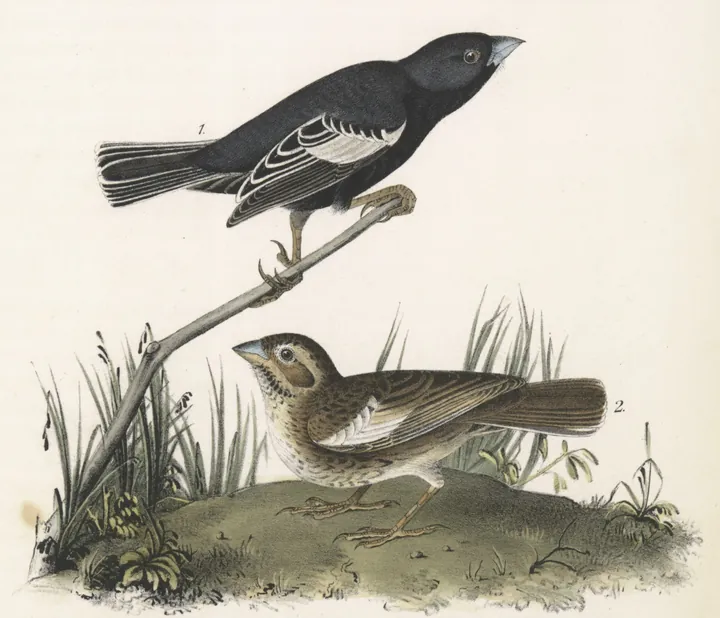
Yes, twice. First as the “Prairie Finch,” one of three birds on plate 390 of The Birds of America, “Lark Finch; Prairie Finch; Brown Song Sparrow,” with a Lark Sparrow and a Song Sparrow (plate 390 among all of Audubon's plates). In his later octavo edition the pair has a plate to itself as the “Prairie Lark-Finch,” plate 202: the painting on this page, with the black male above and the brown female below.
The text beside it says the bird was discovered by the naturalists Nuttall and Townsend “on the plains of the Platte,” and quotes Nuttall calling it “one of the sweetest songsters of the prairie” (Audubon's text, vol. 3). Audubon's plate 390 is free to see at Audubon.org.
Is the Lark Bunting declining?
Yes. Colorado Parks and Wildlife lists it as a Tier 2 Bird of Greatest Conservation Need in its State Wildlife Action Plan. The Audubon guide says it was once extremely abundant and has declined as prairie was lost, and puts the population at about 12 million birds.
Does any other state have the Lark Bunting?
No. Colorado is the only state with the Lark Bunting as its state bird, which was the point in 1931. The meadowlark, winner of Superintendent Craig's ballot, is today the state bird of six states, among them Colorado's neighbors Kansas, Nebraska and Wyoming.
Questions about the Colorado state bird
When did the Lark Bunting become the Colorado state bird?
On April 29, 1931. The law today is Colorado Revised Statutes 24-80-910.
Why did Colorado choose the Lark Bunting?
Its backers, led by Roy Langdon of Fort Collins, wanted a bird no other state had. According to the Denver Public Library, that point won over lawmakers in 1931, when the meadowlark, robin and bluebird were already taken.
Can you see Lark Buntings in Colorado in winter?
They leave for the winter: the State Archives says flocks arrive in April and fly south again in September.
What did Audubon call the Lark Bunting?
The “Prairie Finch,” on plate 390 of The Birds of America, and the “Prairie Lark-Finch” on plate 202 of his octavo edition, the painting on this page.
Birdfolio prints a birder’s life list as a book, each species beside a classic painting. Look inside a Birdfolio.
Orders open on November 1.