Classic bird paintings
Canada Goose painting: Audubon's plate and other classic portraits
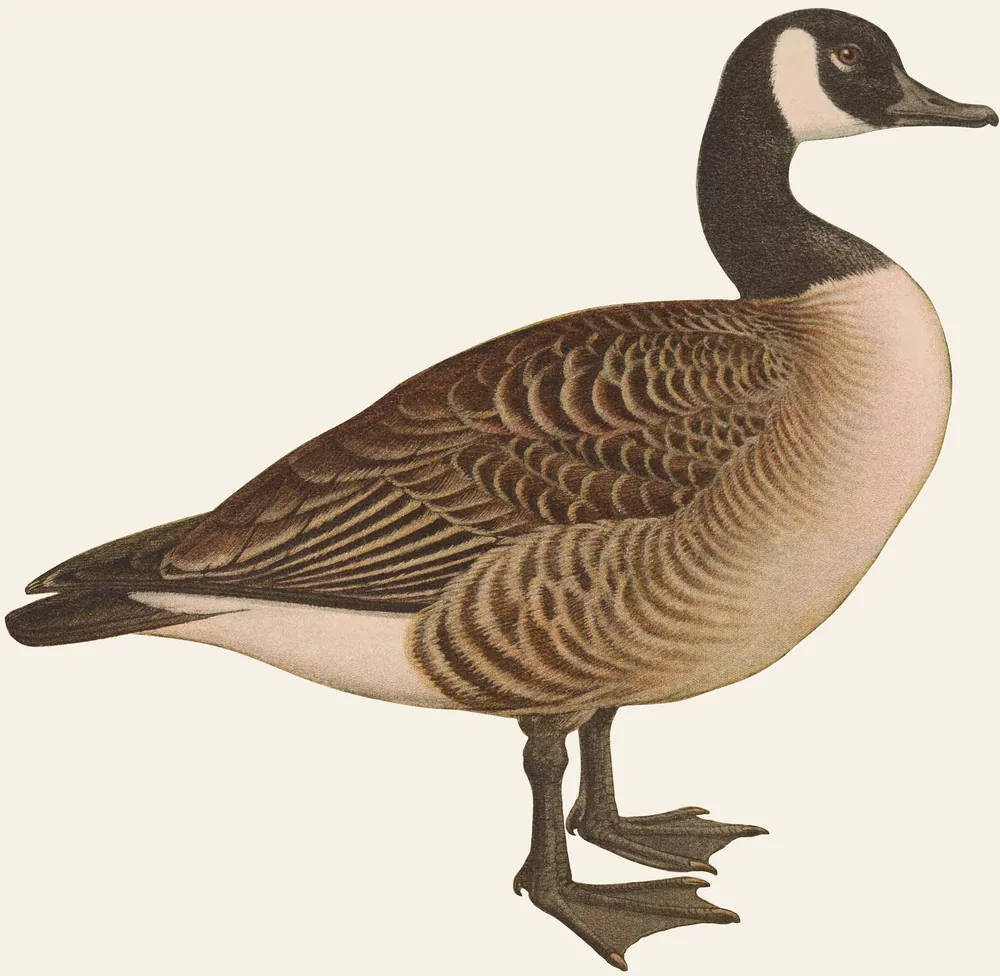
John James Audubon painted the Canada Goose as plate 201 of The Birds of America (1827–38), a male and a female, under the same name. A free high-resolution scan is on Audubon.org. The goose shown here is by the Dutch painter Marinus Adrianus Koekkoek, from E. D. van Oort's Ornithologia Neerlandica (1922).
Updated
The story of this painting
Shot in the Anna Paulowna polder on July 22 and 28, 1876, two male Canada Geese are in the collection of the national natural history museum at Leiden. E. D. van Oort, the museum's director, listed them in his Ornithologia Neerlandica (1922), with a female shot near Nieuwediep on September 3, 1890, and another caught in an eel trap at Den Hoorn, on Texel, in January 1902.
Canada Geese had long been kept in captivity in Europe, he noted, so birds shot there might be escapes, probably including the earliest three. Still, he thought wild ones sometimes strayed across, and so, like H. Schlegel before him, he counted it among the birds seen in the Netherlands. Its voice, he added, is more like a swan's than a goose's.
The publisher, Martinus Nijhoff, took up the plan at once and, van Oort wrote, first put the artist M. A. Koekkoek to work at its own expense, painting plates at the museum under van Oort's direction, with every bird seen wild in the Netherlands to be shown, in both sexes and different ages where needed. This one, plate 50, is an adult male.
Story: Van Oort, Ornithologia Neerlandica, vol. 1 (1922), plate 50; vol. 1 (1922), pp. 147–148; vol. 1 (1922), pp. v–vi.
Audubon’s Canada Goose: plate 201, “Canada Goose”
Near the mouth of Green River in Kentucky, a big gander with a cream-colored breast returned to the same pond three years running, and twice struck Audubon so hard on the right arm with a wing that he thought it was broken. Audubon won the pair over with shelled corn, until they fed in his sight and let him come within a few feet, though the gander bit his fingers when he tried to touch them.
Then he trapped the gander in a baited coop, caught the mother and all the goslings, pinioned them, a cruel method, he admitted, and turned them loose by the pond in his garden at Henderson. That December, when the cold came, the gander would spread his wings and call, the others answered one by one, and all ran as far south as the garden allowed, trying to fly off. He kept the flock three years.
Plate 201 shows a male and a female. Wild geese had once been far more common in the settled country, he believed: General George Clark told him that fifty years earlier he had geese shot to feed his soldiers near Vincennes, Indiana.
Story: Audubon, Ornithological Biography, vol. 3 (1835), pp. 1–9. See plate 201 free at Audubon.org.
More classic portraits, free to see
- John James Audubon, The Birds of America, octavo edition (1840–44), plate 376: “Canada Goose”. Free scan (New York Public Library Digital Collections)
- Louis Agassiz Fuertes, for Elon H. Eaton’s Birds of New York (1910–14), plate 22: “Canada Goose”, with Tundra Swan and Brant. Free scan (Internet Archive)
About the Canada Goose
- Canada Geese graze on land, and also feed underwater by dipping their head and neck below the surface. (Source: National Audubon Society)
How long does a Canada Goose live?
The Indiana Department of Natural Resources gives the Canada Goose an average life span of 10 to 25 years. Alaska's Department of Fish and Game says geese that survive to adulthood may live 10 to 20 years. Goslings have the hardest time: by the time a family takes to the air, six to nine weeks after hatching, only about half of the goslings are still alive. The oldest known wild Canada Goose was at least 33 years and 3 months old (USGS Bird Banding Laboratory): it was banded in Ohio in 1969 and found in Ontario in 2001.
Once grown, a goose is far safer: more than 90% of Indiana's breeding adults survive each year, and the department reports one isolated case of a captive goose living past 40. Pairs usually stay together for life, but if one dies, the other usually finds a new mate within the same breeding season.
Sources: Indiana Department of Natural Resources; Alaska Department of Fish and Game; Hinterland Who's Who; USGS Bird Banding Laboratory. A banding record is the minimum age of one bird when it was found again, not a typical lifespan. How long do wild birds live?
How can you tell if a plate 201 print is an original?
By its size: an original plate 201 is a hand-colored sheet about 26 by 38 inches; the Canada Goose’s octavo version, plate 376, is book-size, from 1840–44. Many prints sold today are reproductions: how to tell an original from a reproduction. Plate 201 and the other 434 also come bound in one modern book: which Birds of America book to buy.
In a Birdfolio hardcover, this painting sits beside the date and place you first saw a Canada Goose. See your own list as a book, free.