State birds
What is the Tennessee state bird?
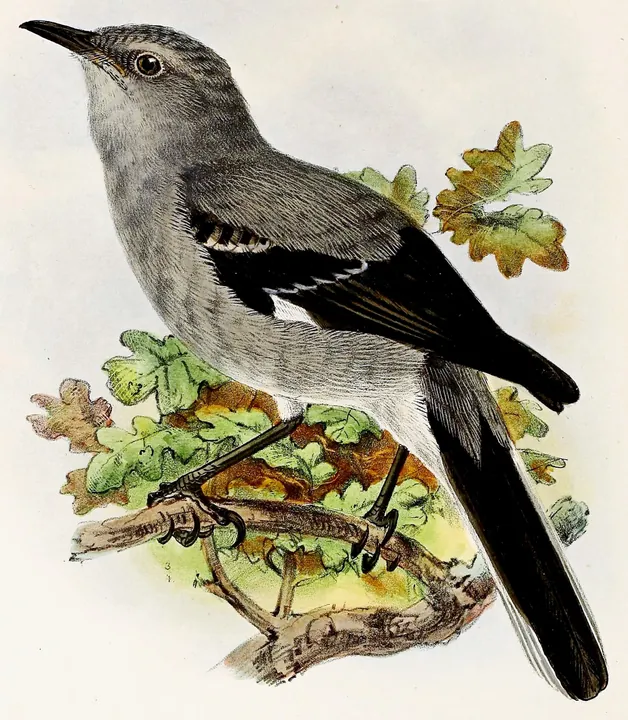
The Tennessee state bird is the Northern Mockingbird. It won a statewide election run by the Tennessee Ornithological Society in 1933 by just 480 votes, 15,553 to the robin's 15,073, and the 68th General Assembly confirmed the choice with Senate Joint Resolution 51.
Updated
How did Tennessee vote for its state bird?
In a campaign run through newspapers and schools. The Tennessee Ornithological Society's president, Ben B. Coffey of Memphis, proposed it more to “awaken an interest in birds” than to win an emblem, Wayland Hayes wrote in the society's journal, The Migrant, in March 1933. The society, founded in Nashville in October 1915, ran it as an open election (Tennessee Encyclopedia).
On the ballot were the mockingbird, robin, cardinal, bluebird, wood thrush, chickadee, Bewick's wren, pileated woodpecker, flicker, brown thrasher, field sparrow, sparrow hawk, towhee, meadowlark and bob-white. John Cross of the Nashville Banner drew the candidates, and articles ran “in seven of the leading daily newspapers.” Schools joined in through the state's Department of Fish and Game, its Department of Education and the PTA, and children kept a State Bird Day.
The Department of Fish and Game handled the count: mockingbird 15,553, robin 15,073, cardinal 13,969, bob-white 10,460, bluebird 9,125 and all the others 8,751, “a total of 72,931.” The mockingbird won by 480 votes. The Tennessee Secretary of State, citing the Nashville Banner of April 16, 1933, dates the choice to April 11, 1933, and says it was “confirmed by Senate Joint Resolution 51, adopted by the 68th General Assembly.” TN.gov gives the year as 1933.
What other birds did Tennesseans suggest in 1933?
A few in jest. “In view of current beer legislation, one man suggested the Swallow,” Hayes reported. “One editor would choose the Stork, and another the Dodo,” and someone put up the Jay.
The society's president had no doubts about the winner. In one of the campaign's newspaper articles, printed in The Migrant, Coffey called the mockingbird “this high-born Southerner” and “an ideal choice for Tennessee's state bird.”
Where can you hear a mockingbird in Tennessee?
Across the state, in every season. The Tennessee Wildlife Resources Agency calls it “a common permanent resident across the state, though it has been declining” for several decades. Look in open ground with shrubs: parks, farmland and suburbs.
Its scientific name, Mimus polyglottos, means “many-tongued mimic,” the agency says, and a male's repertoire “may contain as many as 200 distinct song types.” It is known for “singing on moonlit spring nights.”
In 1933 Coffey wrote that in southwestern Tennessee “the song period extends thruout the year,” and that elsewhere in the state it lasts 9 to 10 months.
The oldest mockingbird on record lived at least 14 years and 10 months, banded and found in Texas (USGS Bird Banding Laboratory; more on our page of the oldest wild birds).
Why did our painter give his mockingbird away?
Because it spoiled his other birds. John Gerrard Keulemans, who painted the plate on this page for his Dutch book Onze Vogels in Huis en Tuin, kept a mockingbird himself. “I had a mockingbird that made the same ugly screech,” he wrote, and within days his other birds were ruined: “The Nightingale, as if it felt its worth unrecognized, fell silent” (our translations; the book on the Internet Archive). He gave the bird away.
His verdict: “the forest is not the room” (our translation). In the American woods the mockingbird was a wonder; in a room full of cage birds it was not. Sixty years later Tennessee's bird club called it an ideal choice.
Texas uses the same plate, and our Texas state bird page tells another of Keulemans's grumbles. Audubon's own mockingbirds are on our Northern Mockingbird painting page.
Does Tennessee have a state game bird?
Yes, the bobwhite quail, which came fourth in the 1933 vote. The Secretary of State says it was “designated the official state game bird in 1988 by Public Chapter 775” of the 95th General Assembly.
Which other states have the mockingbird?
Four: Arkansas, Florida, Mississippi and Texas. Texas and Florida both chose it in 1927 by concurrent resolution, six years before Tennessee voted.
The runners-up did well elsewhere. The robin, second in Tennessee, is Wisconsin's state bird and Connecticut's, and the cardinal, third, is the state bird of seven states: why the cardinal won so often.
Questions about the Tennessee state bird
When did the mockingbird become Tennessee's state bird?
In 1933. It won a statewide vote, dated April 11, 1933, and the 68th General Assembly confirmed it with Senate Joint Resolution 51.
Which bird came second in Tennessee's state bird vote?
The robin, with 15,073 votes to the mockingbird's 15,553. The cardinal was third with 13,969.
What is Tennessee's state game bird?
The bobwhite quail, designated in 1988.
Do mockingbirds sing at night in Tennessee?
Yes, especially on moonlit spring nights, the Tennessee Wildlife Resources Agency says.
Birdfolio prints a birder’s life list as a book, each species beside a classic painting. Look inside a Birdfolio.
Orders open on November 1.