State birds
What is the Indiana state bird?
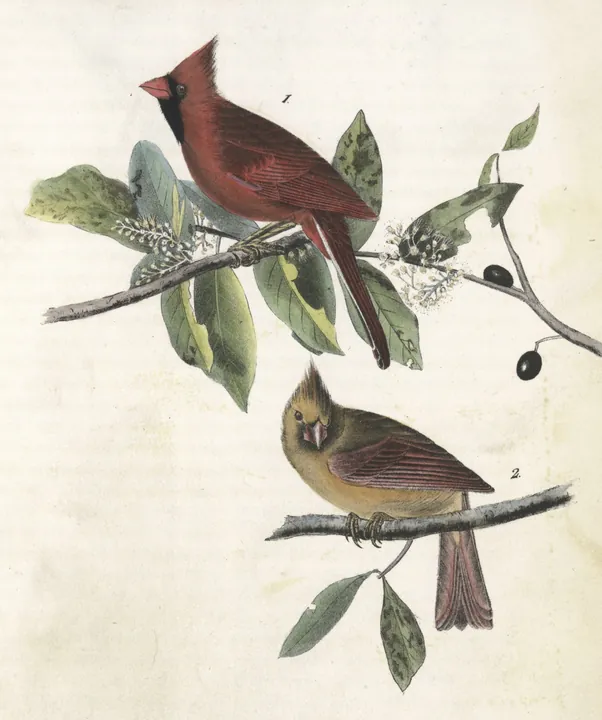
The Indiana state bird is the Northern Cardinal. The 1933 General Assembly adopted it, and the law, now Indiana Code 1-2-8-1, still names “the Red Bird or Cardinal (Richmondena Cardinalis Cardinalis),” with a genus name, Richmondena, that ornithologists have since dropped.
Updated
Why does the Indiana state bird law use an old name?
Because the law has stood since 1933, and the bird's names have not. The Indiana Historical Bureau says the cardinal was “adopted as the state bird by the 1933 General Assembly,” and the statute still carries the genus name it used then, Richmondena, with “Red Bird” ahead of “Cardinal.” Its history line points back to chapter 223 of the Acts of 1933.
Ornithologists moved on. By 1983 the American Ornithologists' Union's Check-list of North American Birds, the standard list of the continent's bird names, put the cardinal in the genus Cardinalis and listed Richmondena, a name from 1918, among its former names (AOU Check-list, 1983).
The English name changed as well. The same Check-list calls the bird the Northern Cardinal and notes that it was “Formerly known as the CARDINAL.” So the name birders use today is younger than Indiana's law, which still puts Red Bird first.
Were Indiana's cardinals once trapped for cages?
Yes, and Indiana's own bird report of 1898 wanted it stopped. Amos W. Butler's The Birds of Indiana, printed in the annual report of the state's Department of Geology and Natural Resources, called the cardinal “the most noticeable feature of our avian fauna” (Butler, 1898).
That made it a prize. Cardinals were “easily tamed and in many localities are much sought, for cage birds,” Butler wrote. Trapping them and robbing their nests had grown less common, but “It should be discouraged by every one and the offenders prosecuted.”
The Indiana Department of Natural Resources tells the same history: “In the 1800s, the cardinal was sought after as a prized cage bird.” Today, it adds, “the cardinal is protected throughout the United States.”
Audubon, writing in 1834, saw why the cage trade came so easily: “They are easily raised when taken from the nest” (Audubon's Ornithological Biography, vol. 2).
Which Indiana poet scolded the cardinal's name?
B. S. Parker, in a poem Butler quoted. Butler's report prints verses by “Hon. B. S. Parker” from Hoosier Bards that cheer the bird on, “Sing on, my redbird!”, and take a swipe at whoever named it: “The boor who named thee for thy beak.”
Our painting makes his point for him. Audubon called the bird the “Common Cardinal Grosbeak,” and grosbeak simply means thick beak, a name taken from the bill rather than the song or the color. Indiana's 1933 law, as it happens, puts “Red Bird” first.
What did Butler see at a cardinal's nest?
A division of labor he didn't think much of. In 1897 a pair nested next door to him in Brookville. The female did all the building, Butler wrote, while the male escorted her and sang from a chimney or a lightning rod.
His explanation: “He is afraid of soiling his bright, new coat.” And then: “Some men do not as well.” The season ended badly anyway, when a storm blew the nest and its eggs out of the bush.
Cardinal fathers come off better in the DNR's account. While the female starts a second brood, the male feeds the young of the first, and “He has been seen stuffing food down the throats of fledglings of other species.”
Where can you see cardinals in Indiana?
Along hedgerows, wood edges and roadsides, in every month. “The cardinal is non-migratory,” says the DNR, and it lives statewide, “with the largest population found throughout central Indiana,” though winter counts are low in the northwest. The Historical Bureau puts it simply: “They remain in Indiana year round.”
The thin northwest is an old pattern. In 1898 Butler found cardinals very common in the south and north at least to Indianapolis, but “quite rare” in parts of the north: “It has not been reported from Lake County,” in the state's far northwest corner. In the northeast the bird “seems to be increasing,” he wrote, and was spreading into Michigan.
Winter brings flocks. Where food is plentiful, the DNR says, cardinals gather “30 or more in a flock.” Nest building “begins in late March or early April,” and a nest holds a few pale, brown-marked eggs, laid at any time from April to September.
How long a wild cardinal can live is on our page of the oldest wild birds.
Which states share the Indiana state bird?
Six: Illinois, Kentucky, North Carolina, Ohio, Virginia and West Virginia. Kentucky was the first of the seven cardinal states, with a resolution approved on February 17, 1926 (Kentucky Legislature), and Indiana's neighbor Ohio named the cardinal in 1933, the same year as Indiana (Ohio Department of Natural Resources).
Why so many states settled on one bird, and how the others chose it, is the subject of our guide to the cardinal state bird.
Questions about the Indiana state bird
When did the cardinal become the Indiana state bird?
In 1933, when the General Assembly adopted it. The law is now Indiana Code 1-2-8-1.
Why does Indiana's law say Richmondena?
It was a genus name in use for the cardinal when the law was written. By 1983 ornithologists had moved the Northern Cardinal to the genus Cardinalis, but the law kept the old name.
Do cardinals stay in Indiana in winter?
Yes. Cardinals don't migrate, and where food is plentiful they gather in winter flocks of 30 or more, Indiana's DNR says.
Were cardinals kept as cage birds in Indiana?
In the 1800s, yes. Indiana's 1898 state bird report complained that they were trapped for cages and wanted the trappers prosecuted; today the cardinal is protected nationwide.
What is Indiana's state bird and flower?
The cardinal is the state bird, and the peony is the state flower, adopted by the 1957 General Assembly. From 1931 to 1957 the state flower was the zinnia, the Indiana Historical Bureau says.
What is Indiana's state animal?
Indiana has none. Its official emblems, as the Indiana Historical Bureau lists them, include a state bird, flower, tree, river and stone, but no state animal.
Birdfolio prints a birder’s life list as a book, each species beside a classic painting. Look inside a Birdfolio.
Orders open on November 1.