Classic bird paintings
American Robin painting: Audubon's plate and other classic portraits
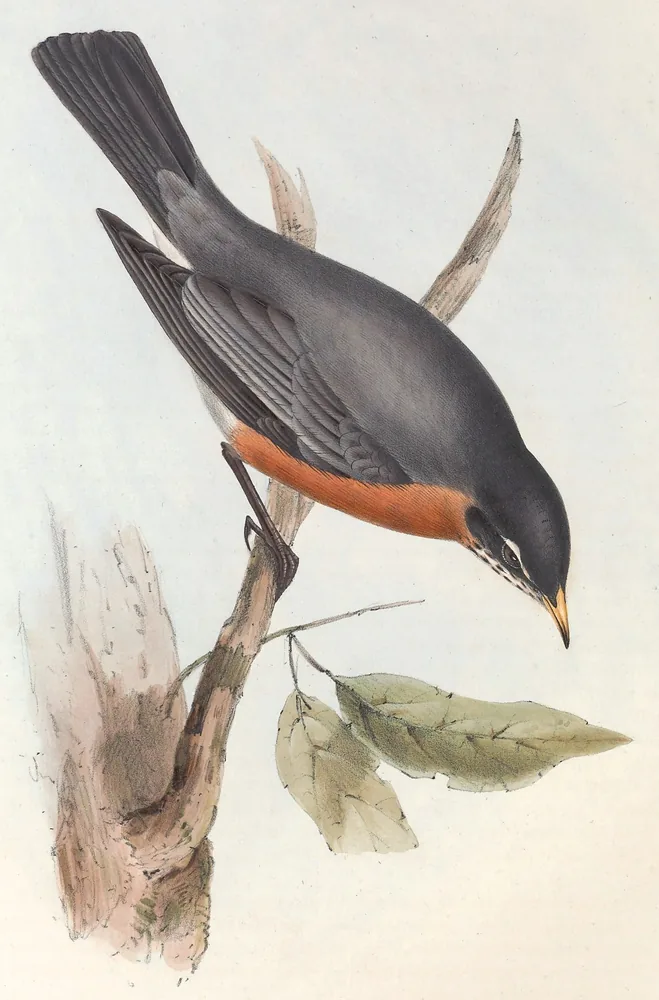
John James Audubon painted the American Robin as plate 131 of The Birds of America (1827–38), under the same name. A free high-resolution scan is on Audubon.org. The robin shown here is by John and Elizabeth Gould, from John Gould's The Birds of Europe (1832–37), where it is called the Migratory Ouzel.
Updated
The story of this painting
John Gould could put an American bird in The Birds of Europe because the robin had turned up there a few times: Temminck reported one killed in Germany, and Brehm one seen near Vienna. A glance at a globe, Gould argued, shows how it happens: a bird migrating from the far north of America needs to stray only a little off course to reach Europe.
And it goes very far north. From Dr. Richardson's notes he quoted its arrival at Fort Franklin, at latitude 65°, on May 20, where its eggs did not hatch until June 11, snow still lay on the ground, and the birds lived at first on berries frozen all winter and uncovered by the thaw.
Gould counted it a true Merula, kin to the European Blackbird, so here it is the Migratory Ouzel, plate 74. He quoted Audubon, who found that a Blackbird flushed from an English hedgerow reminded him of the robin, and the robin in America of the Blackbird. The plate shows one adult at life size, drawn from nature and put on stone by John and Elizabeth Gould.
Story: Gould, The Birds of Europe, vol. 2 (1837), plate 74; vol. 2 (1837), text to plate 74.
Audubon’s American Robin: plate 131, “American Robin”
The first land bird Audubon saw when he stepped ashore in Labrador, with patches of snow still on the ground, was a robin. The bare, chilly country filled him with gloom, and when the robin sang he “could scarcely refrain from shedding tears”; the song called up his youth and gave him heart to go on.
Farther south the robin had a harder time. In winter thousands moved into Louisiana, the Floridas, Georgia and the Carolinas, where gunners brought them home by the bagful and markets sold them cheap. Pokeweed berries stained their flesh crimson, and some birds choked on berries and fell from the trees.
Plate 131 shows a family: young birds that have left the nest before they are fully feathered, hurrying to meet a parent with food. Near Great Egg Harbor, New Jersey, he once found a robin's nest fixed to the timbers of an unfinished well, seven or eight feet underground; robins chose such places, he thought, to keep their eggs from cuckoos.
Story: Audubon, Ornithological Biography, vol. 2 (1834), pp. 190–194. See plate 131 free at Audubon.org.
Is the American Robin related to the European Robin?
Not closely. The American Robin is a thrush, in the same family as Europe's Common Blackbird, while the European Robin belongs to another family, the chats and Old World flycatchers, in AviList, the shared world checklist. John Gould saw the blackbird in it too: he found its habits, song and nest-building “much in accordance” with the Common Blackbird's. The robin on British Christmas cards is the European one: why robins are on Christmas cards.
Sources: AviList v2026; Gould, The Birds of Europe, vol. 2 (1837), text to plate 74.
More classic portraits, free to see
- John James Audubon, The Birds of America, octavo edition (1840–44), plate 142: “American Robin, or Migratory Thrush”. Free scan (New York Public Library Digital Collections)
- John and Elizabeth Gould, The Birds of Europe (1832–37), plate 74: “Migratory Ouzel” (Merula migratoria) (the painting shown above). Free scan (University of Kansas Libraries)
- Louis Agassiz Fuertes, for Elon H. Eaton’s Birds of New York (1910–14), plate 106: “Robin”, with the Eastern Bluebird. Free scan (Internet Archive)
About the American Robin
- American Robins usually look for food on lawns, running a short way and then pausing. (Source: National Audubon Society)
Do robins stay in Texas in winter?
Yes, and there are far more of them then. American Robins live in Texas all year, but migrants from farther north make them common to abundant from early November to late March, the Texas Breeding Bird Atlas says.
In fall and winter their food changes from earthworms and other soft invertebrates to berries and small fruit, and hungry flocks keep checking the berry bushes to see what has ripened. Most robins that nest in Canada go south for the winter, into the United States and Mexico.
Where do robins nest in Texas?
Mostly in the east and north: the Texas Breeding Bird Atlas found the most breeding robins in the Pineywoods, the Post Oak Savannah, the Blackland Prairies and the Panhandle. They nest from early March to August, from near sea level to about 8,000 feet, and in the Trans-Pecos in the mountain conifer forests of the Davis and Guadalupe Mountains.
The female builds a cup of grass and plant stalks, firmed with dried mud, lays 3 or 4 blue-green eggs and sits on them for 12 to 14 days. The young leave the nest 9 to 16 days after hatching, and a pair normally raises two broods a season, sometimes three.
How long does an American Robin live?
Most wild American Robins live about 2 years, the Tennessee Wildlife Resources Agency says. The first summer is the hardest: only about a quarter of young robins live through the summer they hatch in. The oldest known wild American Robin was at least 13 years and 11 months old (USGS Bird Banding Laboratory): it was banded in California in 1962 and found there again in 1975.
Sources: Tennessee Wildlife Resources Agency; USGS Bird Banding Laboratory. A banding record is the minimum age of one bird when it was found again, not a typical lifespan. How long do wild birds live?
How can you tell if a plate 131 print is an original?
By its size: an original plate 131 is a hand-colored sheet about 26 by 38 inches; the American Robin’s octavo version, plate 142, is book-size, from 1840–44. Many prints sold today are reproductions: how to tell an original from a reproduction. Rather have every plate in one book? Here’s which Birds of America book to buy.
In a Birdfolio hardcover, this painting sits beside the date and place you first saw a American Robin. See your own list as a book, free.