State birds
What is the Kentucky state bird?
The Kentucky state bird is the Northern Cardinal. A resolution approved on February 17, 1926, made it the official state bird, the first of the seven cardinal states, and the law today, Kentucky Revised Statutes 2.080, names “The native redbird, commonly known as the Kentucky cardinal.”
Updated
When did Kentucky adopt the cardinal as its state bird?
In February 1926, and the Senate took just one day. On February 8, 1926, Senator Hamilton offered a resolution “on the subject of the Kentucky Cardinal,” and the senators suspended their rules to pass it on the spot. The journal lists 36 senators voting yes, prints no votes against, and records: “And so, said resolution was adopted” (Senate Journal, 1926).
The House adopted it three days later, on February 11, and on February 16 the Speaker signed the enrolled copy in open session (House Journal, 1926). The Legislature's history page, presented by the Kentucky Historical Society, gives the last step: “In a resolution, approved February 17, 1926, the cardinal became the official Kentucky state bird” (Kentucky Legislature).
So the bird the journals call the “Kentucky Cardinal” went from a senator's desk to approval in nine days. No other cardinal state had chosen it yet; Illinois was next, in 1929.
Why is the cardinal Kentucky's state bird?
Because other states had state birds, and the resolution says little more. Its one reason reads: “It being common knowledge that various states have by proper resolutions selected a native bird” of their own. Kentucky's lawmakers then chose “the native red bird commonly known as the Kentucky Cardinal (Cardinalis).”
The journals print no speech, no school vote and no club campaign behind the choice. That sets Kentucky apart from neighbors that held elections: Illinois let schoolchildren pick the cardinal in 1929, and Tennessee held a statewide vote in 1933, which the mockingbird won.
The wording carried into the statute book. Kentucky Revised Statutes 2.080, recodified in 1942 from an older section of the Kentucky Statutes, keeps the old order, redbird first and cardinal second, and gives the scientific name as the genus alone, “(cardinalis)” (KRS 2.080).
Was “A Kentucky Cardinal” a book before it was the law?
Yes, by 32 years. A Kentucky Cardinal is a novel by James Lane Allen, published by Harper & Brothers in 1894, and its title is the very phrase the 1926 resolution used for the state bird (Allen, 1894, on the Internet Archive). Allen wrote about Kentucky: the book's front pages list his The Blue-Grass Region of Kentucky and a volume of his Kentucky tales.
The story opens on New Year's Day of 1850 and is told by a man who keeps the birds fed through a hard winter. He saves his highest praise for the cardinal: a “proud, solitary stranger in our unfriendly land,” he calls it, “the fiery grosbeak,” and, hidden in the evergreens, “this flame-colored prisoner in dark-green chambers.”
Audubon is in the book too. Its frontispiece is titled “The Audubon Drawings,” and one of its characters boasts that “the great, the very great Audubon” lived in Henderson and gave her father some of his early drawings of Kentucky birds.
Whether the novel had anything to do with the resolution's wording, no record we found says. The two simply share a name, and Kentucky's law still uses it.
Did Audubon live in Kentucky?
Yes, for most of a decade. John James Audubon “studied various birds from 1810 to 1819” in the woods around Henderson, says the Kentucky Department of Parks, and John James Audubon State Park there now has a museum on his family's Henderson years. Among its more than 200 objects is “a complete set of his masterwork, ‘The Birds of America.’”
His cardinal account includes a winter scene on a farm. In winter, he wrote, the bird “frequently shews itself in the farm-yard,” picking up food from what is put out daily for the poultry, and at night it shelters by a haystack or among “the thickest branches of the nearest evergreen tree” (Audubon's text, vol. 2).
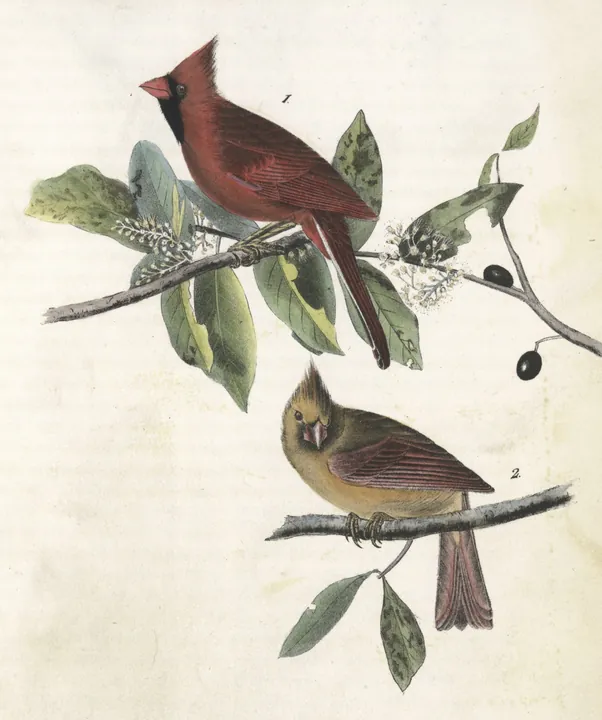
He also wrote of the male singing while his mate sits on the eggs: “Day after day the song of the Red Bird beguiles the weariness of his mate.” The big Havell edition of his Birds of America shows the cardinal as plate 159; the picture on this page is the smaller octavo version, plate 203.
Where can you see cardinals in Kentucky?
Anywhere with thick shrubs, in any month. The cardinal is a “Permanent resident throughout its range,” says the National Audubon Society's guide, and it “brightens winter days with its color.” It hides its nest in dense shrubs, vines or low trees, usually 3 to 10 feet up.
Feeders bring them close: the same guide says feeders stocked with sunflower seeds may have helped cardinals spread north.
For a day out, try John James Audubon State Park in Henderson. Most of its 6.5 miles of trails run through a dedicated state nature preserve, and in winter, the parks department says, the park “plays host to seven woodpecker species, waterfowl, sparrows, and mixed flocks.”
The oldest wild cardinal on record is on our page of the oldest wild birds.
Which other states have the Kentucky state bird?
Six: Illinois, Indiana, North Carolina, Ohio, Virginia and West Virginia. Kentucky came first, in 1926, and Virginia last, in 1950, which makes the Northern Cardinal the state bird of more states than any other bird.
How the others chose it, from Illinois's school vote to North Carolina's 1943 law, is told in our guide to the cardinal state bird.
Questions about the Kentucky state bird
Why did Kentucky choose the cardinal?
The 1926 resolution gives one reason: other states had chosen official birds. It then named “the native red bird commonly known as the Kentucky Cardinal.”
When did the cardinal become Kentucky's state bird?
In 1926. The Senate passed the resolution on February 8 and the House on February 11, and it was approved on February 17, 1926.
Is the Kentucky state bird a redbird or a cardinal?
Both. Kentucky's law calls it the native redbird, “commonly known as the Kentucky cardinal”; birders call the species the Northern Cardinal.
Do cardinals stay in Kentucky in winter?
Yes. Cardinals don't migrate. In winter they visit feeders and shelter in thick evergreens.
What is Kentucky's state bird and flower?
The cardinal is the state bird, and the goldenrod is the state flower: “The goldenrod is the official state flower of Kentucky,” says Kentucky Revised Statutes 2.090.
What is Kentucky's state animal?
Kentucky has no single state animal. Its laws name the gray squirrel the “state wild animal game species” (1968) and, since July 15, 2026, the eastern spotted skunk the official “state nongame mammal.”
Birdfolio prints a birder’s life list as a book, each species beside a classic painting. Look inside a Birdfolio.
Orders open on November 1.