State birds
What is the South Carolina state bird?
The South Carolina state bird is the Carolina Wren. Act No. 693, approved on April 3, 1948, made the wren the state bird in place of the mockingbird, calling it “one of our best known birds,” and the law today is South Carolina Code § 1-1-630.
Updated
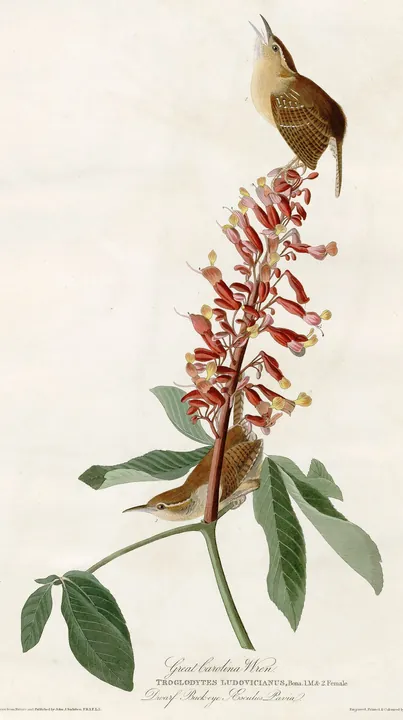
How did the wren replace the mockingbird in South Carolina?
With a law that also made it a crime to kill a mockingbird. Act No. 693 of 1948 set out “To Change The State Bird To The Carolina Wren Instead Of The Mocking Bird,” and in the same act made it a misdemeanor for “Any one intentionally killing the Carolina Wren or the Mocking Bird”: a fine of up to 100 dollars or 30 days in jail (Acts and Joint Resolutions, 1948).
Its stated reason was all about the wren: the Carolina Wren “is one of our best known birds” and is found in every part of the state “throughout the year.”
The act was approved on April 3, 1948, and took effect on the governor's approval; the governor was J. Strom Thurmond.
By then the mockingbird already belonged to Texas and Florida (1927), Arkansas (1929), Tennessee (1933) and Mississippi (1944). Whether that mattered to South Carolina's lawmakers, the act doesn't say.
Was the Carolina Wren South Carolina's bird before 1948?
Unofficially, yes. Before 1939 the wren “had been unofficially recognized as the State Bird of S.C.,” the General Assembly's Legislative Manual says. Then Act No. 311 of 1939 named the mockingbird instead.
The wren won its title back nine years later: “Act No. 693, 1948, was passed repealing the 1939 Act and designating the Carolina Wren,” the Manual goes on. The South Carolina Code now says it in one sentence, § 1-1-630: “The Carolina Wren is the official bird of the State.”
How many official birds does South Carolina have?
Four. Besides the wren, the Code names the wild turkey the state wild game bird (1976), the wood duck the state duck (2009) and the eastern brown pelican the state seabird (2024).
The wood duck, says its law, is “also known as the summer duck and the Carolina duck,” and it became law without the Governor's signature on June 3, 2009. The pelican's act took effect on May 20, 2024, and gave South Carolina a symbol that is also Louisiana's state bird, the Brown Pelican (Louisiana Revised Statutes 49:159).
Paintings of all three are on our Wild Turkey, Wood Duck and Brown Pelican painting pages.
Where can you hear a Carolina Wren in South Carolina?
Almost anywhere, in any weather. The Legislative Manual says the wren is “present in all areas in South Carolina from the coast to the highest mountain,” and that its song, “tea-ket-tle, tea-ket-tle, tea-ket-tle, tea-ket-tle,” can be heard “the year-round, day and night, in all kinds of weather.”
To spot one, the Manual says, look for a bird “slightly smaller than an English Sparrow” (the House Sparrow), rufous-red on the back, with “a conspicuous white stripe over the eyes.” Its tail “is held erect when the bird is excited.”
The oldest Carolina Wren in the federal banding records was a male banded in North Carolina on October 29, 2011. Caught again there on August 9, 2019, at least 9 years and 2 months old, it was released alive (USGS Bird Banding Laboratory; more on our page of the oldest wild birds).
Why does the Carolina Wren have a Louisiana name?
Because the first one described came from New Orleans. The ludovicianus in its scientific name refers to Louisiana: Latham named the species Sylvia ludoviciana in 1790, based on the “Roitelet de la Louisiane,” and its type locality, the place the described bird came from, is Louisiana, along the Mississippi at New Orleans (AOU Check-list, 1983).
Audubon studied the wren in Louisiana too, and found it far beyond: “They are common in Georgia, the Carolinas, Kentucky, Ohio and Indiana” (Audubon's text, vol. 1).
The traffic runs the other way as well. Missouri's Eastern Bluebird and Alabama's Northern Flicker were both named by Linnaeus in 1758 from Mark Catesby's descriptions, and both have South Carolina as their type locality, the Check-list says.
Does any other state have the Carolina Wren?
No. South Carolina is the only state with the Carolina Wren; Arizona's state bird is a different wren, the Cactus Wren. Its neighbors chose the cardinal (North Carolina, in 1943) and the Brown Thrasher (Georgia, in 1970).
Questions about the South Carolina state bird
When did the Carolina Wren become South Carolina's state bird?
In 1948, by Act No. 693, approved on April 3, 1948. It replaced the mockingbird, which had been the state bird since 1939.
What was South Carolina's state bird before the Carolina Wren?
The mockingbird, named by Act No. 311 of 1939. Before that, the wren had been the state's unofficial bird.
Did South Carolina make it a crime to kill a Carolina Wren?
Yes. The 1948 act that made the wren the state bird also made intentionally killing a Carolina Wren or a mockingbird a misdemeanor, with a fine of up to 100 dollars or 30 days in jail.
What are South Carolina's other official birds?
The wild turkey, the state wild game bird; the wood duck, the state duck; and the eastern brown pelican, the state seabird.
What is South Carolina's state bird and flower?
The Carolina Wren is the state bird, and the yellow jessamine is the state flower, adopted by the General Assembly on February 1, 1924. Among its reasons, the Legislative Manual says, the vine is “the first premonitor of coming Spring.”
What is South Carolina's state animal?
The white-tailed deer, named the state animal in 1972 (South Carolina Code § 1-1-650).
Birdfolio prints a birder’s life list as a book, each species beside a classic painting. Look inside a Birdfolio.
Orders open on November 1.