The Goldfinch is a small 1654 oil painting of a chained European Goldfinch by the Dutch painter Carel Fabritius, kept at the Mauritshuis museum in The Hague, the Netherlands. It is real, about 13 by 9 inches, and on view in Room 14. The same year, on October 12, 1654, a gunpowder explosion in Delft killed Fabritius at 32.
The museum's own photograph of the painting is on its collection page, along with its catalogue text.
The little bird has had a big life for a picture barely larger than a magazine page. The Mauritshuis calls it "the most-seen bird in all of art history." It outlived the blast that killed its painter, ended up with the French critic who rescued Fabritius from obscurity, toured San Francisco, Atlanta and New York, gave its name to a Pulitzer Prize-winning novel, and in 2026 "curated" an exhibition about birds.
The bird is real too. It's a European Goldfinch, a cousin of the American Goldfinch at your feeder, and a species that has tried again and again, since 1853, to make a home in the United States. Since 2003 it has finally managed it, in one corner of the Midwest.
The Goldfinch at a glance
| Question | Answer |
|---|---|
| Artist | Carel Fabritius (1622–1654), a pupil of Rembrandt |
| Date | 1654, signed and dated "C FABRITIVS 1654" at the lower center |
| What it is | Oil on a wooden panel, a trick-of-the-eye picture of a pet bird on its feeding box |
| Size | 33.5 × 22.8 cm, about 13 by 9 inches |
| Where | The Mauritshuis, The Hague, the Netherlands: Room 14, inventory number 605 |
| Owned since | 1896 |
| The bird | A European Goldfinch, Carduelis carduelis |
| Dutch title | Het puttertje, after the Dutch nickname for the bird, "water-drawer" |
| The painter's death | The Delft gunpowder explosion of October 12, 1654 |
| In fiction | Donna Tartt's novel The Goldfinch (2013), 2014 Pulitzer Prize for Fiction |
Facts checked: October 21–22, 2026.
Where is The Goldfinch painting?
The Goldfinch hangs in Room 14 of the Mauritshuis, the art museum in The Hague, the Netherlands, which has owned it since 1896. Its collection page listed it as on view when we checked on October 21, 2026. Rooms and loans change, so check the museum's website before a trip.
It rarely travels. While the Mauritshuis was rebuilt from 2012 to 2014, a selection of its most important paintings went on a world tour that helped pay for the work and drew 2.2 million visitors, the museum says. The American leg took The Goldfinch to three cities:
- San Francisco: the de Young museum, January 26 to June 2, 2013.
- Atlanta: the High Museum of Art, June 22 to September 29, 2013.
- New York: the Frick Collection, October 22, 2013 to January 19, 2014.
In 2016 it made a short trip to the Scottish National Gallery in Edinburgh, November 4 to December 18, its first visit to Scotland, and was home in time for Christmas.
In 2026 it stayed at home and starred. From February 12 to June 7, the Mauritshuis ran an exhibition called BIRDS – Curated by The Goldfinch & Simon Schama, about our long fascination with birds, inspired by Fabritius's painting.
Is The Goldfinch painting real?
Yes: The Goldfinch is a real painting by Carel Fabritius, made in 1654 and owned by the Mauritshuis in The Hague since 1896. What isn't real is its adventure in the novel.
In Donna Tartt's The Goldfinch, published on September 23, 2013, the painting hangs in the Metropolitan Museum of Art in New York, where 13-year-old Theo Decker survives a terrorist attack. That museum scene is fiction. The book won the 2014 Pulitzer Prize for Fiction, and John Crowley directed a film of it in 2019.
The real painting was in New York that fall too. A month after the novel came out, on October 22, 2013, the actual Goldfinch went on show at the Frick Collection in New York, as the last stop of its American tour.
Why is The Goldfinch painting so famous?
The Goldfinch is famous because it's a tiny, strikingly modern illusion by Rembrandt's most gifted pupil, painted in the year an explosion killed him, and because a Pulitzer Prize-winning novel turned it into a star.
Fabritius left very little. The Mauritshuis counts no more than twelve surviving paintings, and only four from his years in Delft. The Goldfinch, from his last year, is the one most people know.
It also looks unlike anything around it. Fabritius painted the bird in loose, separate strokes, sparing with detail. He laid the yellow of the wing on thick and scratched into it with the handle of his brush, a trick he had learned from Rembrandt. Up close it's a few dabs of paint; from a short distance, the museum notes, the bird looks very real.
His calm light and his illusions probably inspired Johannes Vermeer, who also worked in Delft, the museum says. And like Vermeer, he was nearly forgotten. After he died, his paintings were bought and sold as Rembrandts, sometimes with a false Rembrandt signature added. In the mid-1800s the French art critic Théophile Thoré "rediscovered" him, as the Mauritshuis puts it. Thoré owned this very painting: the museum's provenance record lists it as given to him in Paris in 1865.
What does The Goldfinch painting mean?
On its surface, The Goldfinch shows a pet: goldfinches were popular pets in the 1600s, taught to draw their own water from a bowl with a bucket the size of a thimble, which is why the Dutch call the bird a puttertje, a "water-drawer."
The museum's catalogue describes the setup in the picture: a feeding box on a wall support, a perch, and a fine chain on the bird's foot. Goldfinches could also learn to open their feeding box with their beak.
The second meaning is the trick. The Goldfinch is a trompe-l'œil, French for "deceive the eye," and it was probably made to make a visitor think, for a moment, that a real bird sat on the wall. The panel is quite thick and was sawn from a much larger one, so nobody knows exactly how it was used. The Mauritshuis lists three ideas:
- part of a real cage, with a painted bird in place of a live one;
- a small door to a niche in a plastered wall, which would explain the white background and the low viewpoint;
- a door on a cupboard that protected another painting from dust.
The bird is painted as if seen from below, so it may have been meant to hang high on a wall. Technology has added to the story. In 2003 The Goldfinch became the first painting in the world to be examined with a CT scanner, the museum says, and X-rays and infrared images show that the bottom perch was painted in afterward, over the white wall, to make the illusion stronger.
The older meaning: a symbol of Christ's Passion
For centuries before Fabritius, painters put goldfinches in the hands of the Christ Child. London's National Gallery explains that the bird alludes to the Passion, the suffering of Christ, through an old legend: the goldfinch got its red face when it pulled a thorn from Christ's head on the way to Calvary and was splashed with his blood.
The best-known example is Raphael's Madonna of the Goldfinch, painted, according to the Renaissance writer Giorgio Vasari, for a wedding celebrated in February 1506, where the young John the Baptist holds out a goldfinch for the baby Jesus to stroke. The Uffizi Galleries read that fragile bird as a foreshadowing of Christ's sacrifice. Raphael's goldfinch survived a disaster too: when a landslide destroyed its owners' house in 1547, the panel broke into seventeen pieces and had to be restored.
Did Fabritius mean any of that? Nobody can say. The Mauritshuis's own catalogue text treats the painting as a portrait of a pet on its feeding box and an illusion, and doesn't mention religion.
How did Carel Fabritius die?
Carel Fabritius was fatally injured on the morning of Monday, October 12, 1654, when the city of Delft's gunpowder store exploded near his studio; he was pulled alive from the rubble but died of his injuries, aged 32.
The store held powder for the city's defense: about 40 metric tons, or about 90,000 pounds. The blast became known as the Delft Thunderclap. London's National Gallery says it was heard more than 70 miles away. The New Netherland Institute, which studies the Dutch colony that became New York, says the keeper of the magazine, Cornelis Soetens, had gone in with a visitor about half an hour before it blew.
How bad it was depends on whom you read. The Mauritshuis says almost a third of the town was destroyed and probably more than 500 people died. The New Netherland Institute says a quarter of the city, with at least a hundred dead. The National Gallery points out that no records of the dead survive.
Fabritius's studio stood "a stone's throw" from the store, in the museum's words, and was wiped out. Many of his paintings must have been destroyed with it. The Goldfinch, painted that year, is one of just four from his Delft years to survive.
Another Delft painter, Egbert van der Poel, painted the ruins at least 20 times. One version, now in the National Gallery in London, shows a pool of water where the store probably stood, with people helping the wounded in the foreground.
Who was Carel Fabritius?
Fabritius was born in 1622 in Middenbeemster, just north of Amsterdam. At 19 he moved to Amsterdam with his new wife and studied with Rembrandt, about 1641 to 1643. He lost his first wife and three children while still young, and moved to Delft with his second wife in 1650. He painted portraits, still lifes, town views and history scenes, and often played with perspective and illusion.
What bird is in The Goldfinch painting?
The bird in The Goldfinch is a European Goldfinch (Carduelis carduelis), the Mauritshuis says: a songbird about 12 centimeters (under 5 inches) long, with a red patch around its eyes and bill and a yellow stripe on a black wing.
Its head is black and white behind the red, and it's a finch of thistles. The Latin carduelis means "thistlefinch," and Britain's bird charity, the RSPB, says its fine bill lets it pull seeds out of thistles and teasels that other birds can't reach. It also eats dandelion seeds and comes to feeders for sunflower hearts and nyjer. A flock is called a "charm," and the oldest known wild goldfinch lived more than 10 years. Young birds are streaky brown and have no red face until they grow up.
It's native to Europe, western Asia and the far north of Africa. Look closely at the painting today and the red on the bird's head is duller than Fabritius painted it: the museum notes the red paint has discolored over time.
European Goldfinch vs. American Goldfinch: what's the difference?
The European Goldfinch and the American Goldfinch are different species in different genera: the European bird, Carduelis carduelis, has a red face and a black-and-white head, while the American bird, Spinus tristis, turns yellow in summer, the male bright yellow with a black forehead.
| European Goldfinch | American Goldfinch | |
|---|---|---|
| Scientific name | Carduelis carduelis | Spinus tristis |
| Head | Red face, black-and-white head | Summer male: bright yellow with a black forehead |
| Body | Warm brown back, white belly | Summer: male bright yellow, female duller yellow-green; winter: both yellowish-brown to gray |
| Wings | Black, with a big yellow patch | Black; bold white or buff wing bars in winter |
| Length | About 12 cm (under 5 in) | 4–5 in (11–13 cm) |
| Native to | Europe, western Asia, North Africa | North America |
| ABA Checklist | Code 2 (added in 2024) | Code 1 |
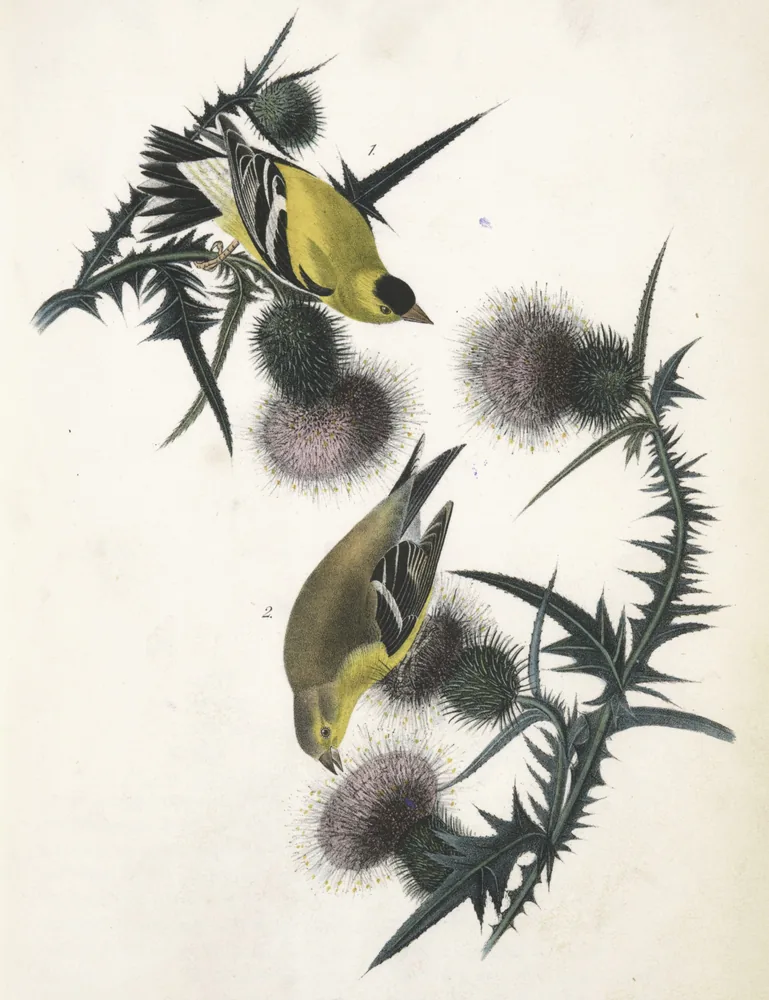
They are close in size and habits. Elon Howard Eaton's Birds of New York (1914) described the European bird as having the "size and shape of the American goldfinch." Both love thistles: the American Goldfinch even lines its nest with thistle down, and it nests late, mostly in July and August, according to the National Audubon Society.
John James Audubon heard the family likeness. Their songs were so alike, he wrote in 1831, that in France and England he often thought he was hearing his own American bird. He also knew of an American Goldfinch, bought in the New York market and kept in a cage for more than ten years, that had been trained to do exactly what Fabritius's bird was famous for. It wore a belt of soft leather on a light chain, and it hauled up a tiny bucket from a glass of water with its bill and foot. In France, he noted, a bird trained this way was called a galérien, a galley slave.
Audubon's own goldfinch plates, and his story of a wild flock on the Mohawk River, are on our American Goldfinch painting page.
Can you see a European Goldfinch in the United States?
Yes, in one corner of the Midwest: European Goldfinches have bred between Milwaukee, Wisconsin, and Chicago, Illinois, every year since 2003, and the American Birding Association added the species to its checklist of North American birds in 2024.
A 2023 study in the journal NeoBiota by Julie Craves and Nicholas Anich gathered more than 7,000 records from 2001 to 2021. The likely founders, they concluded, were birds released by or escaped from a cage-bird importer in northern Illinois. Import records show nearly 159,000 European Goldfinches brought into the US for commercial trade from 2000 to 2014.
The ABA added the species to its official checklist on March 5, 2024, the Wisconsin Society for Ornithology reports. The current checklist, version 8.19, lists it as a Code 2 bird, the code for species with a restricted range or low numbers. The American Goldfinch is Code 1, the code for widespread, common birds. Elsewhere in North America, scattered sightings have long been put down to escaped or released cage birds.
It tried for 150 years first
The Great Lakes birds are the latest of many attempts, the same study shows:
- Brooklyn, 1853. On April 20, 1853, 16 goldfinches that had spent the winter in captivity in New York were let go in Green-Wood Cemetery. None was seen after late summer.
- New York, 1878 to the 1950s. Birds said to have been released in Hoboken, New Jersey, in 1878 reportedly crossed the Hudson and appeared in Central Park the next year. Up to 50 were reported in New York City in the winter of 1902, but they were gone from Central Park by 1907. A small population on Long Island lasted until the 1950s, when development took its habitat.
- Portland, Oregon, 1889 to 1907. Forty or more pairs were released in 1889, 1892 and 1907. They thrived for some years, then disappeared.
- St. Louis and Cincinnati. Attempts in St. Louis in 1870 and Cincinnati from 1872 to 1874 failed.
Eaton watched the New York birds. In the spring of 1900 he saw several pairs trying to nest in Central Park, and he judged it "not likely to become established so easily as the obnoxious European sparrow." Louis Agassiz Fuertes painted a European Goldfinch for Eaton's book, on plate 79, beside a pair of American Goldfinches in summer: the two cousins, from the years they shared New York.
Travelers have one more option. European Goldfinches were brought to Bermuda in 1885 or 1893, and they still live there.
Questions people ask
How big is The Goldfinch painting?
The Goldfinch measures 33.5 by 22.8 centimeters, about 13 by 9 inches: a little bigger than a sheet of letter paper.
How much is The Goldfinch painting worth?
There's no official figure: the Mauritshuis has owned The Goldfinch since 1896, so it hasn't changed hands since, and any dollar value you read online is a guess.
Who painted The Goldfinch?
Carel Fabritius (1622–1654) painted The Goldfinch. He was a Dutch painter whom London's National Gallery calls one of Rembrandt's most talented pupils.
When was The Goldfinch painted?
Fabritius painted The Goldfinch in 1654, the year he died, and signed and dated it "C FABRITIVS 1654" near the bottom.
Did Carel Fabritius teach Vermeer?
Nobody can say he did. The Mauritshuis writes that Fabritius's paintings probably inspired Johannes Vermeer, and its catalogue calls their link an "artistic dialogue" rather than one-way influence.
What does "puttertje" mean?
Puttertje is the Dutch nickname for the goldfinch, meaning "water-drawer," after the trick pet goldfinches were taught: pulling up their drinking water in a tiny bucket. Het puttertje is the painting's Dutch title.
Fabritius is one of nine names on our short list of famous bird painters, from Audubon to Roger Tory Peterson.
A Birdfolio pairs every bird you've seen with a classic painting, like Audubon's goldfinches above. See a Birdfolio.