Classic bird paintings
Great Blue Heron painting: Audubon's plate and other classic portraits
John James Audubon painted the Great Blue Heron as plate 211 of The Birds of America (1827–38), a male in spring, under the same name. That plate is the painting shown here, and a free high-resolution scan is on Audubon.org. His plate 281, the Great White Heron, shows the all-white form he found in the Florida Keys.
Updated
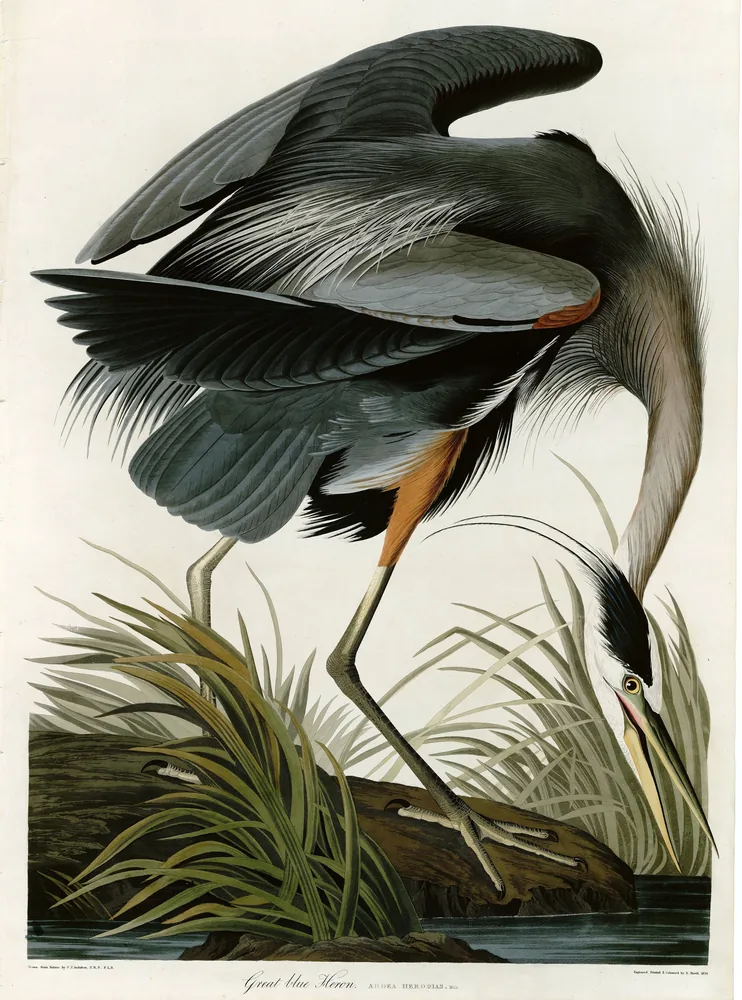
Audubon’s plate: plate 211, “Great blue Heron”
Audubon's plate shows a male in his third spring, the age at which, he wrote, the bird reaches its full dress. In the United States it was then mostly called the “Blue Crane.” He described one standing so still by the Ohio that you might take it for the statue of a bird, until its bill shot out and speared a perch.
Each spring he watched the males fight for mates on sand bars, parrying blows “with as much art as an expert swordsman would employ.” Herons he kept aboard the revenue cutter Marion swallowed a bucketful of young mullets in half an hour. Plate 281 is the Great White Heron, which he first learned of on Indian Key, Florida, in April 1832, when a local pilot brought him two live young birds in a nest cut from a mangrove. Today it counts as a white form of the Great Blue Heron.
Story: Audubon’s Ornithological Biography, vol. 3 (1835). See plate 211 free at Audubon.org. See plate 281 free at Audubon.org.
More classic portraits, free to see
- John James Audubon, The Birds of America, octavo edition (1840–44), plate 369: “Great Blue Heron”. Free scan (New York Public Library Digital Collections)
- John James Audubon, The Birds of America, octavo edition (1840–44), plate 368: “Great White Heron”. Free scan (New York Public Library Digital Collections)
- Louis Agassiz Fuertes, for Elon H. Eaton’s Birds of New York (1910–14), plate 24: “Great Blue Heron”, with Great Egret, Black-crowned Night Heron and Sandhill Crane. Free scan (Internet Archive)
About the Great Blue Heron
- A Great Blue Heron often waits without moving in shallow water, then strikes at a fish that comes close. (Source: National Audubon Society)
The oldest known wild Great Blue Heron lived at least 24 years and 6 months: it was banded in Texas in 1977 and found there again in 2001. That is a record from bird banding, not a typical lifespan. (Source: USGS Bird Banding Laboratory, 2025 longevity table.) How long do wild birds live?
Buying a print?
An original plate 211 is a hand-colored sheet about 26 by 38 inches, printed in Britain in 1827–38; many prints sold today are reproductions or small 1840s octavo prints. How to tell an original from a reproduction.
In a Birdfolio, the hardcover book of your own life list, this painting sits beside the Great Blue Heron with the date and place you first saw one. See your own list as a book, free.