In short: for most people, the Birds of America book to buy is Abbeville's Audubon's Birds of America: The Baby Elephant Folio, with all 435 plates in one big volume, about 15 by 12 inches, edited by Roger Tory Peterson, at a list price of $195. On a smaller budget, the Arcturus edition has all 435 plates for $39.99, and Abbeville's palm-size Tiny Folio has them for $13.95. An original copy from 1827–38 sells only at auction, for millions.
Shopping for The Birds of America is confusing because one name covers three different things: John James Audubon's giant original, his smaller book-size edition, and the many modern books that reproduce them. This guide sorts them out, compares the editions you can buy today, and helps you choose one for yourself or as a gift.
Key facts
- The Birds of America has 435 plates, printed in Britain from 1827 to 1838 on sheets about 26 by 38 inches (University of Pittsburgh). A plate is a full-page printed picture.
- No more than 120 complete sets of that first edition are thought to survive (University of Pittsburgh). When a set sold in 2010, Guinness World Records said only 13 were in private hands.
- The auction record for a complete set is £7,321,250, about $11.4 million, at Sotheby's in London on December 7, 2010 (Guinness World Records).
- The smaller octavo edition (1840–44) has 500 plates in seven volumes, lithographed by J. T. Bowen of Philadelphia (LSU Libraries).
- New books with all 435 plates run from $13.95 (the Tiny Folio) to $195 (the Baby Elephant Folio), at the list prices we read on October 6, 2026.
Facts checked: October 6, 2026.
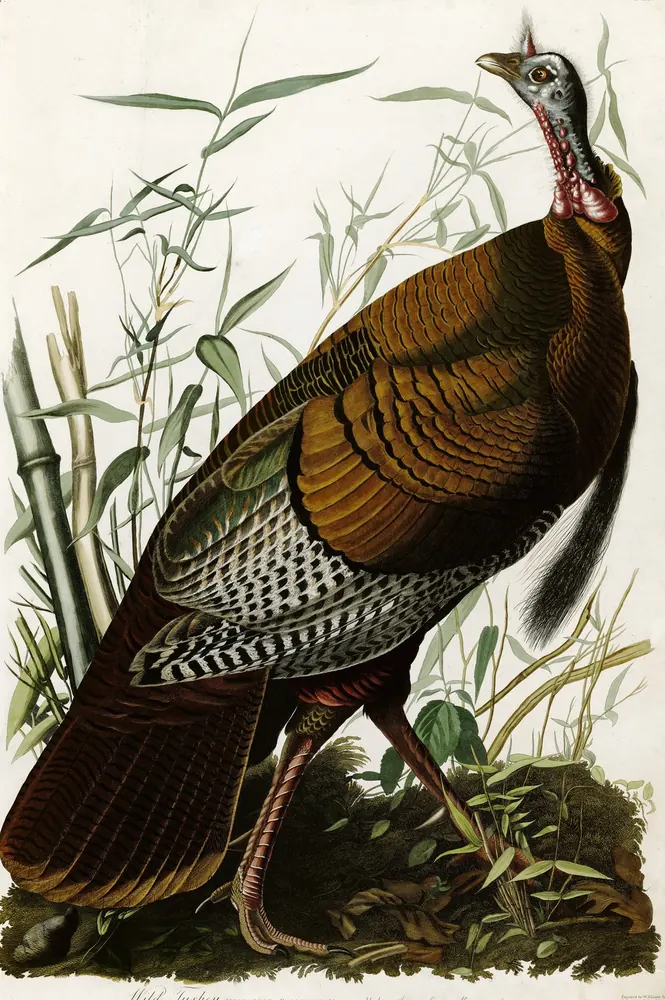
Can you still buy Audubon's Birds of America?
Yes, as a modern book, easily; as an original, almost never. Several publishers print all 435 plates in one volume today, from a pocket-size book to a heavy one that needs a coffee table. A complete original set is a museum piece, and the few that change hands go through the big auction houses.
In between are single original prints, which dealers and auction houses sell one at a time. Our guide on how to tell an original Audubon print from a reproduction covers those in detail.
Here is every edition you're likely to come across, old and new. Prices are list prices from the publisher or a bookstore, read on October 6, 2026. They change, so check before you buy.
| Edition | Years | Size | Plates | Price | Who it's for |
|---|---|---|---|---|---|
| Havell original, the "double elephant folio" | 1827–38 | Sheets about 26 × 38 in | 435 | Auction only: complete sets have sold for $7.9 million and $11.4 million | Museums and major collectors |
| First octavo edition | 1840–44 | Pages about 10 × 6 in, seven volumes | 500 | Rare-book dealers and auctions | Collectors of old books |
| Bien edition | Begun 1858, stopped by 1860 | Nearly as large as Havell | 150 species on 105 sheets | Rare-book dealers and auctions | Specialist collectors |
| Abbeville, The Baby Elephant Folio, edited by Roger Tory and Virginia Marie Peterson | First 1981, new printing 2023 | About 15 × 12 in, 696 pages | 435 | $195 | The best gift; art lovers; birders |
| W. W. Norton, The Bien Chromolithographic Edition, with Joel Oppenheimer | 2013 | About 15 × 23 in, 256 pages, in a cloth slipcase | The Bien prints, complete | $350 | Collectors with a big table |
| Natural History Museum, London, The Birds of America, introduced by David Allen Sibley | 2017 | Hardcover, 448 pages | 435 | Varies by seller | Readers who like a museum's own edition |
| Arcturus Epic Classics, Audubon's Birds of America | 2025 | Hardcover, 384 pages | 435 | $39.99 | A good-value gift |
| Abbeville, The Tiny Folio | Current printing | About 4.5 × 4.3 in, 480 pages | 435 | $13.95 | A stocking stuffer or a small shelf |
| Taschen album | 1999 | Paperback, 96 pages | More than 70 birds | Used copies, about $14 to $60 | A taste of Audubon for very little |
Sources: the University of Pittsburgh, LSU Libraries, the American Antiquarian Society and Skinner for the old editions; Guinness World Records and NPR for the auction prices; Harvard Book Store, the New York Public Library Shop, ACC Art Books, W. W. Norton, NHBS and AbeBooks for the modern books.
What's the difference between the double elephant folio and the octavo?
Size and printing method. The double elephant folio is Audubon's original of 1827–38, printed life-size on the largest paper of the day; the octavo is his smaller, cheaper edition of 1840–44, about the size of an ordinary book.
The names come from the old book trade. A folio is a book made from big sheets folded once, and "double elephant" was the name of the largest paper Audubon could buy, about 26 by 38 inches. An octavo is a book made from sheets folded into eight leaves, so its pages are much smaller.
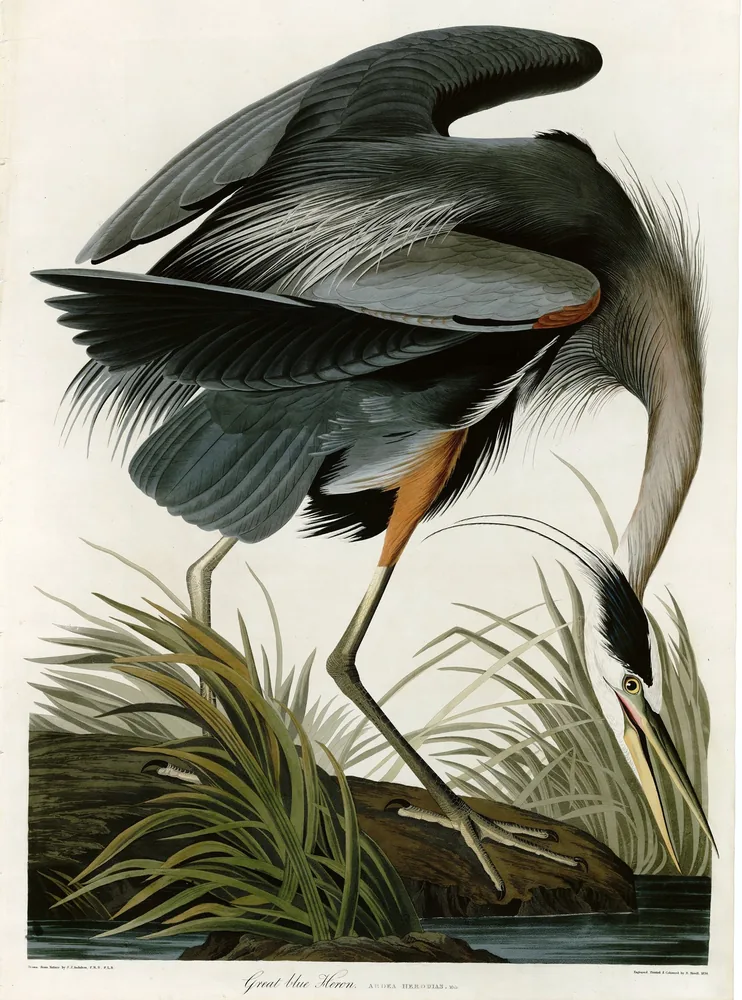
The double elephant folio (the Havell edition). Each plate was engraved on copper, printed, and colored by hand. The engravers also used aquatint, an etching method that gives soft, shaded tones. William Lizars of Edinburgh made the first ten plates, and Robert Havell of London made the rest, which is why collectors call it the Havell edition. Sotheby's notes that the plates went out to subscribers in 87 parts of five plates each. Every bird is shown life-size, so small birds sit in open space and a heron has to bend its neck to fit.
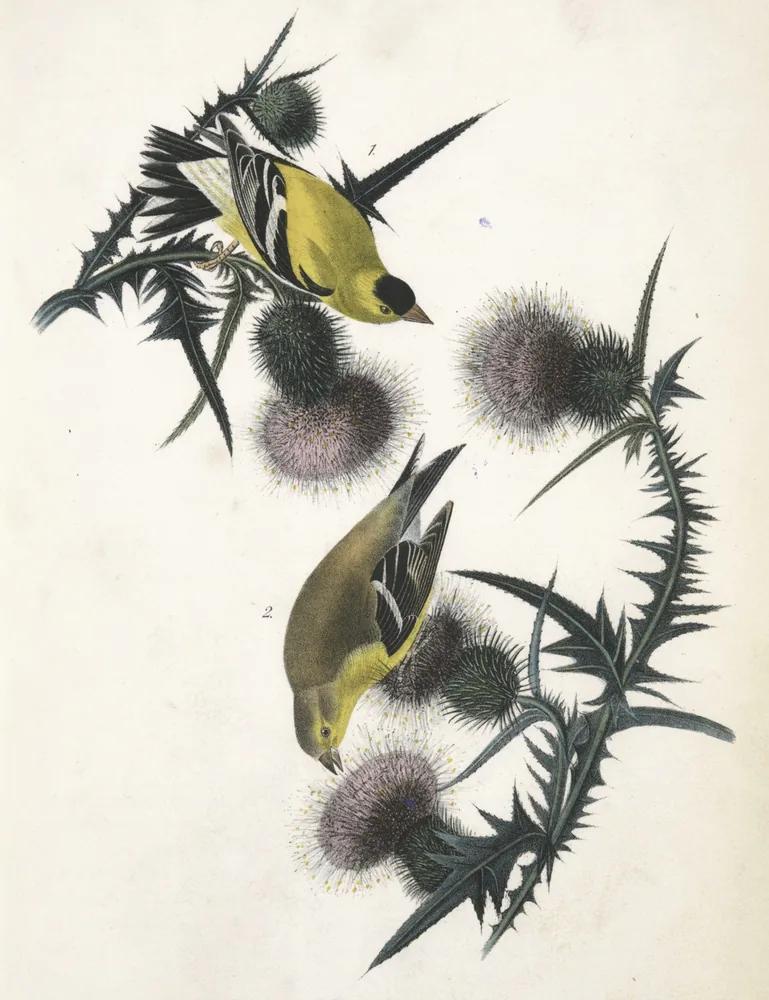
The octavo edition. From 1840 to 1844, Audubon brought out a book-size version, sometimes called the royal octavo. Its 500 plates are lithographs (prints made from drawings on stone), colored by hand at John T. Bowen's firm in Philadelphia. Subscribers bought it in 100 parts, later bound into seven volumes, and it added birds that Audubon saw on his 1843 trip up the Missouri River. The pages are about 10 by 6 inches, according to the Skinner auction house.
Why it matters when you shop. Most modern books reproduce the 435 big Havell plates, shrunk to fit the page. As a rule of thumb, a book with 435 plates follows the Havell edition, and one with 500 follows the octavo. A facsimile is a copy that tries to match the original exactly, ideally at the same size. Most Birds of America books are reproductions, not facsimiles, and that's fine for enjoying the pictures.
How many plates are in The Birds of America?
435 in the original Havell edition. Many plates show more than one species, or a male and a female, so counts of "birds" in the book vary. Our table of all 435 Audubon plates gives each plate's number and the name the bird goes by today.
The octavo edition has 500 plates, because Audubon added birds after his Missouri River trip. The Bien edition never got close to finishing. It stopped after 150 species on 105 sheets.
Before you buy a modern book, check whether it has every plate or a selection. Taschen's slim album, for example, shows more than 70 birds, not all 435.
How much is an original Birds of America worth?
A complete original set is worth millions of dollars. The record is £7,321,250, about $11.4 million, for a set sold at Sotheby's in London on December 7, 2010. Guinness World Records lists it as the most expensive natural-history book ever sold at auction, and at the time it was the record for any printed book.
Another complete set sold at Christie's in New York on January 20, 2012, for $7,922,500. NPR reported that the price was within the expected range of $7 million to $10 million.
The Bien edition is the curious one. Audubon's son John Woodhouse Audubon began it in 1858 with the New York printer Julius Bien, using chromolithography: each color was printed from its own stone, instead of being painted on by hand. By 1860, many Southern subscribers had backed out as the Civil War approached, and printing stopped after 15 of the 45 planned parts. The American Antiquarian Society says historians estimate 75 to 100 bound volumes were made, and that this makes the Bien edition rarer today than the Havell set.
Single original prints cost far less than a set, and the price depends on the edition, the bird and the condition. Skinner notes that big birds tend to sell for more than small songbirds. We don't quote prices for single prints, because they vary so much from one sheet to the next. If you're thinking of buying one, read what to check before you buy an original Audubon print first.
Which Birds of America book is best for a gift?
For most gifts, The Baby Elephant Folio. It's big enough to feel like an occasion, it has every plate, and Roger Tory Peterson and Virginia Marie Peterson arranged the birds in modern order, with notes on each one. Roger Tory Peterson also wrote the best-selling Field Guide to the Birds.
Abbeville's 2023 printing came with new natural-textured paper, a redesigned cover and slipcase, according to ACC Art Books, which distributes it outside the US. If you're buying a used copy of an older printing, ask which year it is.
Think about where the book will live. At about 15 by 12 inches and 696 pages, the Baby Elephant Folio wants a coffee table or a low, deep shelf. It's a book for slow evenings, not for carrying around.
How to choose by who it's for
A gift for a birder
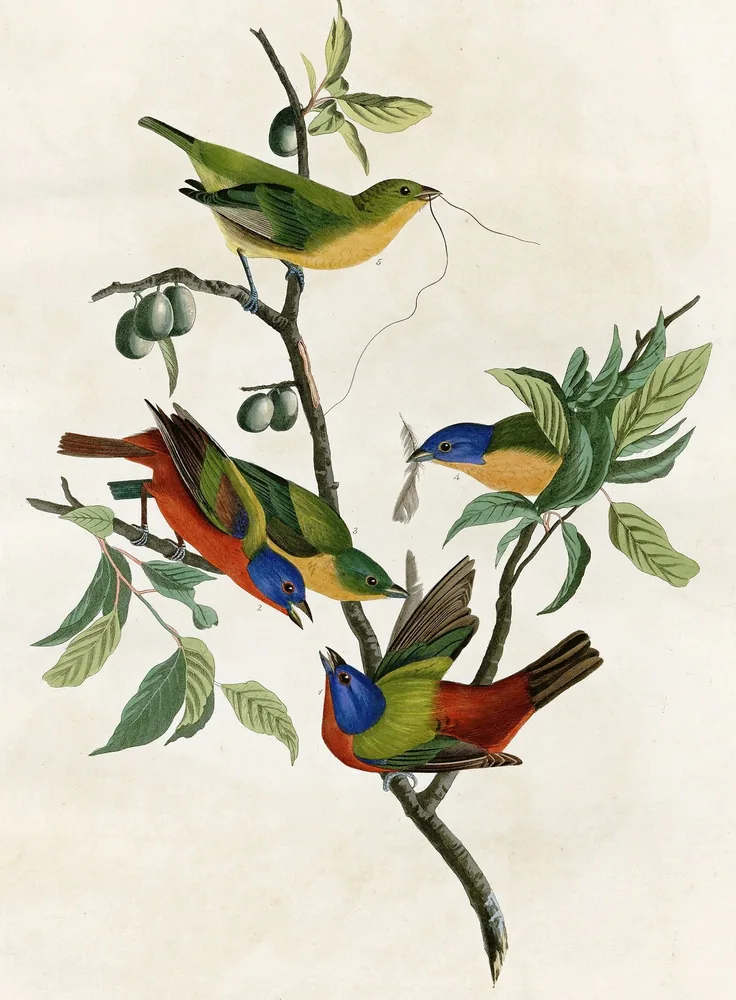
Choose the Baby Elephant Folio, or the Arcturus edition if you want to spend less. Birders will want today's names. Audubon wrote in the 1830s, and many of his bird names have changed: his "Painted Finch" is our Painted Bunting. The Petersons' notes follow modern classification, and the Arcturus edition has an index that gives Audubon's name, the modern name and the scientific name for each bird.
An art lover
The Baby Elephant Folio, for its size and print quality. For someone who has everything, Norton's Bien Chromolithographic Edition is something unusual: the publisher calls it the first complete reproduction of the Bien prints, the rarest version of Audubon's birds, at about 15 by 23 inches.
A collector
Collectors usually want something printed in the 1800s, not a new book. That means a single Havell, octavo or Bien print, or an octavo volume, bought from a reputable dealer or auction house. Complete sets of the big edition are auction-house territory. Start with our checklist for buying an original Audubon print.
A tight budget
The Arcturus edition gives you all 435 plates in a hardcover with gold stamping and printed page edges for $39.99. The Tiny Folio has every plate for $13.95, though at about 4.5 inches across, the pictures are small. A used Taschen album is the cheapest taste of Audubon, with more than 70 of his birds.
What should you check before buying a reprint?
- Every plate, or a selection? Look for "all 435" in the description.
- Which edition it copies. 435 plates points to the Havell edition; 500 points to the octavo.
- The page size. Every modern book shrinks the plates. The bigger the page, the more detail you'll see.
- Modern names. An index or captions with today's names make the book far easier to use.
- The printing. Some books, like the Baby Elephant Folio, have been reprinted many times. A newer printing may have better paper.
Where can you see all 435 plates free?
You can see every plate online at no cost, which is a good way to try before you buy:
- The University of Pittsburgh owns one of the rare complete Havell sets and finished putting all 435 plates online in 2007, with a zoom to study the detail.
- The National Audubon Society lets you explore and download every plate at Audubon.org. Its terms of use, checked on September 30, 2026, allow those files for non-commercial, educational use only.
- The New York Public Library has scans of the octavo edition, free to download in high resolution since 2016.
- Our own list of all 435 Audubon plates shows each plate with the bird's name today, and our classic bird paintings pages bring together Audubon's and other painters' portraits of individual birds.
A book of their own birds
If the person you're shopping for keeps a life list, there's another kind of bird book to consider. A Birdfolio is printed from their own list: a hardcover, 8.5 by 11 inches, with every bird they've seen and the day and place they first saw it.
Where Audubon painted the bird, the picture is usually his plate. His work covers about 300 of the 1,188 birds on our US and Canada list. Most of the other birds get paintings by John Gould, Louis Agassiz Fuertes and other classic painters, and the rest get credited wildlife photos.
It isn't a copy of Audubon's book, and it doesn't try to be. The Birds of America is the birds Audubon saw; a Birdfolio is the birds they've seen.
You can see an example Birdfolio, make one from a list, or give one as a gift and let them add their list when they're ready.
More about Audubon
- The man and how the plates were made: John James Audubon and The Birds of America.
- Buying a single print: original Audubon print or reproduction?
- Hanging one: how to frame a classic bird print.
- The other painters you'll meet in a Birdfolio: famous bird painters.