Reference
How many bird species are in Washington?
Washington has 533 bird species on its official list (Washington Bird Records Committee, November 2025), the 8th highest count of the 49 states with a verified count. Of these, 522 are backed by a specimen, a photo or a recording, and 11 by written descriptions of sightings alone.
Washington’s state bird is the American Goldfinch: our Washington state bird page tells how it was chosen.
Updated
What are the most common birds in Washington?
In summer, the 25 most common birds in Washington are led by the Cliff Swallow, at about 118 birds per survey route, then the Swainson's Thrush and the American Robin, by the USGS Breeding Bird Survey’s counts for 2021–2025. Together these 25 made up 54% of all the birds counted on Washington’s 73 survey routes.
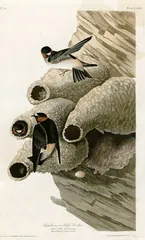
John James Audubon, The Birds of America (1827–38) 1 Cliff Swallowabout 118 per routeon 63% of routesno clear trend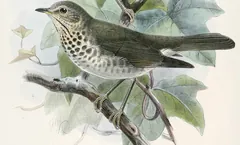
John Gerrard Keulemans, H. E. Dresser’s A History of the Birds of Europe (1871–96) 2 Swainson's Thrushabout 54 per routeon 71% of routesno clear trend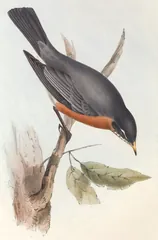
John and Elizabeth Gould, The Birds of Europe (1832–37) about 54 per routeon 100% of routesno clear trend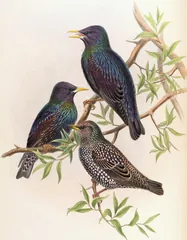
John Gould and Henry Constantine Richter, The Birds of Asia, vol. 5 (1850–83) 4 European Starlingabout 47 per routeon 81% of routesno clear trendintroduced species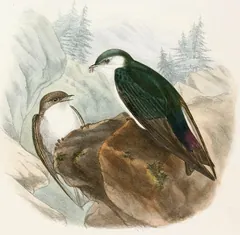
Claude Wilmott Wyatt, Sharpe and Wyatt’s A Monograph of the Hirundinidae (1885–94) 5 Violet-green Swallowabout 42 per routeon 81% of routesno clear trend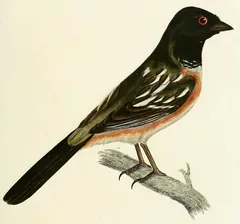
Artist unrecorded, Illustrations of Ornithology (1826) 6 Spotted Towheeabout 30 per routeon 82% of routesno clear trend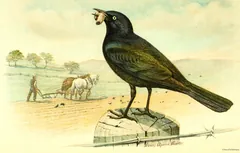
Louis Agassiz Fuertes, Bulletin, Biological Survey (1908) 7 Brewer's Blackbirdabout 27 per routeon 63% of routesfalling since 2015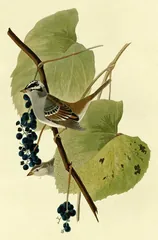
John James Audubon, The Birds of America (1827–38) 8 White-crowned Sparrowabout 25 per routeon 44% of routesfalling since 2015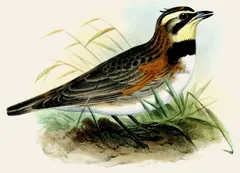
Joseph Wolf, Proceedings of the Zoological Society of London (1855) 9 Horned Larkabout 25 per routeon 30% of routesno clear trend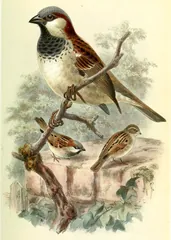
John Gerrard Keulemans, Lord Lilford’s Coloured Figures of the Birds of the British Islands (1885–97) 10 House Sparrowabout 18 per routeon 64% of routesrising since 2015introduced species
Show all 25
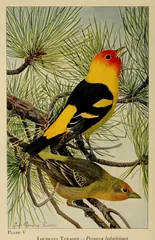
Louis Agassiz Fuertes, Birds of the Rockies (1902) 11 Western Tanagerabout 17 per routeon 79% of routesno clear trend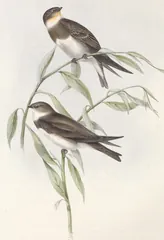
John and Elizabeth Gould, The Birds of Europe (1832–37) 12 Bank Swallowabout 16 per routeon 38% of routesno clear trend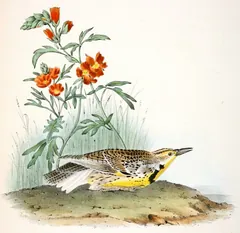
John James Audubon, The Birds of America (1840–44) 13 Western Meadowlarkabout 15 per routeon 45% of routesfalling since 2015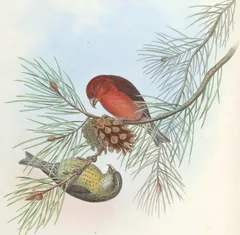
John Gould and Henry Constantine Richter, The Birds of Asia (1850–83) 14 Red Crossbillabout 15 per routeon 63% of routesno clear trend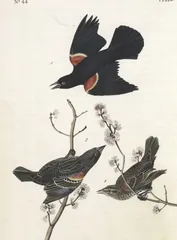
John James Audubon, The Birds of America (1840–44) about 15 per routeon 85% of routesno clear trend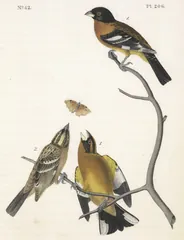
John James Audubon, The Birds of America (1840–44) 16 Black-headed Grosbeakabout 15 per routeon 90% of routesrising since 2015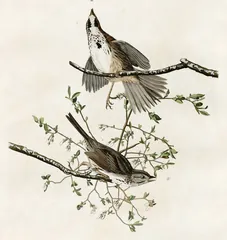
John James Audubon, The Birds of America (1827–38) 17 Song Sparrowabout 15 per routeon 93% of routesno clear trend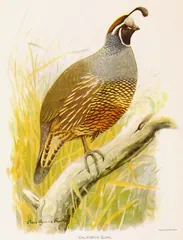
Louis Agassiz Fuertes, Birds of California in Relation to the Fruit Industry (1910) 18 California Quailabout 14 per routeon 60% of routesno clear trend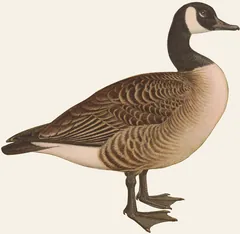
Marinus Adrianus Koekkoek, E. D. van Oort's Ornithologia Neerlandica (1922) 19 Canada Gooseabout 14 per routeon 40% of routesno clear trend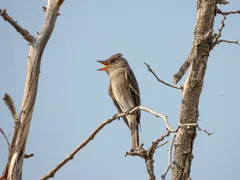
Photo: Jason Alexander, CC BY 4.0 20 Western Wood-Peweeabout 14 per routeon 89% of routesno clear trend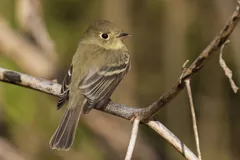
Photo: Matt Felperin, CC BY 4.0 21 Western Flycatcherabout 13 per routeon 71% of routesfalling since 2015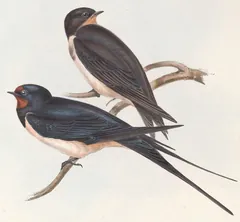
John and Elizabeth Gould, The Birds of Europe (1832–37) 22 Barn Swallowabout 12 per routeon 82% of routesno clear trend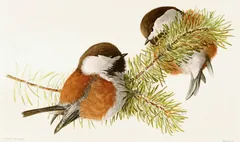
Louis Agassiz Fuertes, Alaska (1901) 23 Chestnut-backed Chickadeeabout 11 per routeon 55% of routesno clear trend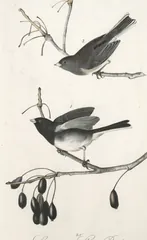
John James Audubon, The Birds of America (1840–44) 24 Dark-eyed Juncoabout 11 per routeon 74% of routesfalling since 2015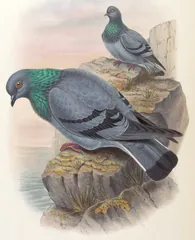
John Gould and William Matthew Hart, The Birds of Asia (1850–83) 25 Rock Pigeonabout 10 per routeon 49% of routesno clear trendintroduced species
Once you know the Cliff Swallow, the American Robin and the rest of these 25, a field guide takes you further into Washington’s list of 533 species; our comparison of the best bird books of 2026 shows which one to start with.
What is the most common bird in Washington?
The Cliff Swallow leads Washington’s summer survey: about 118 a route on average in 2021–2025, more than twice the Swainson's Thrush’s 54, seen on 63% of the 73 routes. USGS finds no clear rise or fall in its Washington numbers since 2015.
The state bird, the American Goldfinch, is found throughout Washington and commonly seen in flocks in fields, bushes and trees, Audubon Washington says. At Olympic National Park, the National Park Service lists the American Crow, Common Raven, Varied Thrush, Pacific Wren and Steller's Jay among the park's most prevalent birds.
Sources: Birds of Washington (Audubon Washington); Birdwatching in Olympic, Olympic National Park (National Park Service), read October 10, 2026.
How was this list made?
Each of Washington’s 73 routes is a roadside count, 50 stops along about 25 miles, run once a year in early summer by a volunteer. We took USGS’s yearly estimate for each species in Washington, the number of birds a typical route records, averaged it over the five latest survey years (there was no survey in 2020) and ranked the birds by it. To keep the list to birds you’re likely to meet across Washington, we left out species recorded on fewer than one in five of its routes, and those USGS can only estimate very roughly, which usually means big flocks or colonies on a few routes.
For Washington that left out the Glaucous-winged Gull and the American White Pelican.
The share of routes is our own count from USGS’s route data for Washington, using only counts that met the survey’s standards; “rising” and “falling” are USGS’s trends for the state since 2015, named only where it finds a clear change. Roadside counts on early-summer mornings miss most of Washington’s owls and waterbirds, and its winter visitors aren’t here at all.
Washington’s counts come from two USGS data releases, the North American Breeding Bird Survey Analysis Results 1966–2025 (Hostetler et al., 2026) and its Dataset 1966–2025 (Ziolkowski et al., 2026), gathered by volunteer observers and free for anyone to use; Birdfolio isn’t connected with the USGS.
How many bird species are in Washington?
| Official count | 533 species |
|---|---|
| List’s date | November 2025 |
| Kept by | Washington Bird Records Committee (Washington Ornithological Society) |
| With physical evidence | 522 species |
| Sight records only | 11 species |
| Introduced | 11 species, each marked (I) on the list (our count) |
| Records committee since | 1989 |
| Among US states | 8th highest of the 49 states with a verified count |
| Official list | Washington State Checklist (Updated November 2025) |
What does Washington’s count include?
- 522 species backed by a specimen, a photo or a recording.
- 11 species known only from sight records, accepted on written descriptions.
- Rare species the committee reviews are part of the 533, not extra.
- Introduced species living wild, marked (I), such as the California Quail, Chukar and Eurasian Skylark.
Why do other sources give a different number?
Washington's committee has pruned its list as well as grown it, and earlier totals still circulate:
- 529. The checklist as we read it in October 2026, with 516 species backed by physical evidence and 13 by sight records alone. It now counts 533 under the same November 2025 date: it adds the Terek Sandpiper, Yellow-green Vireo and Cave Swallow, lists the Great Egret as two species, the Great White Egret and the American Egret, after the American Ornithological Society's split of October 20, 2026, and no longer marks the Common Ringed Plover and White-eyed Vireo as sight-only (our comparison). Source: Washington State Checklist (Washington Bird Records Committee), the Internet Archive's copy of June 21, 2026.
- 515. The total in the committee's 12th report (Western Birds, 2022), which added seven species and removed six that rested on sight records alone. Source: Twelfth Report of the Washington Bird Records Committee, 2016-2018 (Western Birds 53:90-119, 2022).
- 514. The 11th report (2019), after eight additions, among them the Red-flanked Bluetail, Gray Wagtail and Little Bunting, and the merger of Thayer's Gull into Iceland Gull. Source: Eleventh Report of the Washington Bird Records Committee (Western Birds 50:202-231, 2019).
- 430, 421 and 377. The second edition of the committee's checklist (1994); its first (1989), which put 13 more species on a supplementary list; and the last Washington list before the committee, from 1976. Source: First Report of the Washington Bird Records Committee (Washington Birds 3:11-41, 1994).
- 372. The species in The Birds of Washington by William Leon Dawson and John Hooper Bowles, published in Seattle in 1909. Source: The Birds of Washington, vol. 1, by William Leon Dawson and John Hooper Bowles (1909), full text at Project Gutenberg.
Washington’s list follows its own committee’s rules, and so does every other state’s: see why the counts differ from state to state.
Washington rarities, from a gull at its northern limit to a single wing
- Washington's first Swallow-tailed Gull appeared at Carkeek Park in Seattle and moved north to Point Wells in Edmonds and the Everett Marina between August 31 and September 10, 2017, the northernmost record of the species. One at Bodega Head, California, on October 5 may have been the same bird heading back south. Source: Twelfth Report of the Washington Bird Records Committee, 2016-2018 (Western Birds 53:90-119, 2022), read October 5, 2026.
- The state's first Purple Gallinule is a single wing. Surveyors with the Coastal Observation and Seabird Survey Team found it, from an adult, on Hobuck Beach at Neah Bay, Clallam County, on December 14, 2017, and it is now in the University of Washington's Burke Museum. Source: Twelfth Report of the Washington Bird Records Committee, 2016-2018 (Western Birds 53:90-119, 2022), read October 5, 2026.
- Some species on the list have not been documented in the state for 50 years or more, and carry the year of their last record: Allen's Hummingbird (1894), California Condor (1897), Fulvous Whistling-Duck (1905), Red-billed Tropicbird (1941), Kittlitz's Murrelet (1974) and Gray-tailed Tattler (1975). Source: Washington State Checklist, updated November 2025 (Washington Bird Records Committee, Washington Ornithological Society), read October 5, 2026.
- Not every rarity gets in. Of 219 new reports in its 12th report, the committee accepted 163, or 74 percent; it turned down a Whooper Swan over doubts about where the bird came from, and 55 others for want of documentation. Source: Twelfth Report of the Washington Bird Records Committee, 2016-2018 (Western Birds 53:90-119, 2022), read October 5, 2026.
Questions people ask about Washington’s birds
What are common birds in Washington?
The state Department of Fish and Wildlife picks 17 common backyard birds for beginners to learn by song, among them the American Robin, American Crow, Black-capped Chickadee, Dark-eyed Junco, House Finch, Spotted Towhee, Steller's Jay, Northern Flicker, Anna's Hummingbird and Varied Thrush, along with the Black-billed Magpie, Barn Swallow and Great Blue Heron.
Source: Birding and community science (Washington Department of Fish and Wildlife), read October 10, 2026.
What is the rarest bird in Washington state?
The rarest birds living in Washington number only in the hundreds. The state's Greater Sage-Grouse fell to an estimated 429 birds in 2023, 45 percent fewer than in 2020; only about 100 Greater Sandhill Cranes live in the state, with about 40 breeding pairs; and fewer than 1,000 Columbian Sharp-tailed Grouse remain. All three are listed as endangered in Washington.
Among strays, more than 30 species have just one accepted record in the committee's files, such as the Eurasian Kestrel, Woodhouse's Scrub-Jay and Scarlet Tanager (our count).
Sources: Recovery of Greater Sage-Grouse in Washington: Progress Report, December 2023 (Washington Department of Fish and Wildlife); Sandhill crane (Washington Department of Fish and Wildlife); Columbian sharp-tailed grouse (Washington Department of Fish and Wildlife); Summary of Records Accepted by the Washington Bird Records Committee, November 2, 2025 (Washington Ornithological Society), read October 10, 2026.
Which US state has the most bird species?
California, with 696 species, and Texas, with 682, lead every other state by a wide margin, by their committees' lists of October 27 and October 24, 2026. Washington's 533 rank eighth among the 49 states with a verified count, 21 behind its neighbor Oregon (our table).
Sources: Official California Checklist, 696 species, updated 27 October 2026 (California Bird Records Committee, Western Field Ornithologists); Texas State List, 682 species, last updated October 24, 2026 (Texas Bird Records Committee, Texas Ornithological Society); Washington State Checklist, 533 species, dated November 2025 (Washington Bird Records Committee, Washington Ornithological Society), read November 19, 2026.
Which birds live in Washington?
Seabirds on the outer coast, waterbirds on Puget Sound, forest and mountain birds in the Olympics and Cascades, and sagebrush birds in the dry country east of the mountains. Its specialties are rare forms found in few other places: the Streaked Horned Lark, a subspecies of the Horned Lark found only in western Washington and Oregon, and the Columbian Sharp-tailed Grouse, the rarest race of its species, now left in Douglas, Lincoln and Okanogan counties.
Outer coast: Tufted Puffins nest on islands off the northern coast and in the Strait of Juan de Fuca, though only 19 of their 44 historical nesting sites are still used, and Protection Island near Sequim has one of the world's largest colonies of Rhinoceros Auklets.
Old forests: the Marbled Murrelet, a seabird that flies inland to nest in mature and old-growth conifers, and the Northern Spotted Owl both find suitable habitat in the low forests of Mount Rainier National Park.
Cascades: Sooty Grouse and White-tailed Ptarmigan live on Mount Rainier all year, the ptarmigan in its cold alpine areas. In winter the Skagit River, below North Cascades National Park, draws one of the largest wintering gatherings of Bald Eagles in the continental United States.
Puget Sound in winter: loons, grebes and about 50,000 scoters, 80 percent of them Surf Scoters, all of which nest in the Arctic or near it.
East of the Cascades: Sage Thrashers in the sagebrush of the Columbia Basin, Burrowing Owls mostly in Benton, Franklin, Grant and western Adams counties, and each spring more than 35,000 Lesser Sandhill Cranes stopping for a few weeks around Othello, the biggest gathering of migrating Sandhill Cranes on the Pacific Flyway.
Sources: Birds of Washington (Audubon Washington); Streaked horned lark (Washington Department of Fish and Wildlife); Columbian sharp-tailed grouse (Washington Department of Fish and Wildlife); Tufted puffin (Washington Department of Fish and Wildlife); Marine birds (Washington Department of Fish and Wildlife); Marbled murrelet (Washington Department of Fish and Wildlife); Birds, Mount Rainier National Park (National Park Service); Grouse, Mount Rainier National Park (National Park Service); Birds, North Cascades National Park (National Park Service); Surf scoter (Washington Department of Fish and Wildlife); Sage thrasher (Washington Department of Fish and Wildlife); Burrowing owl (Washington Department of Fish and Wildlife); Sandhill crane (Washington Department of Fish and Wildlife), read October 10, 2026.
Why did Washington take six species off its list?
Because it raised the bar for sight records. After years of debate, the committee decided in 2018 to look again at every species on the list supported only by sight reports, with new research on the reliability of eyewitness accounts in mind. Its revised criteria weigh how likely a species is to stray to the Pacific Northwest, so even a credible report of a bird with little history of vagrancy to the region is now less likely to pass. The committee accepted that some accurate reports might be thrown out.
After reviewing 25 reports of 17 species, it removed six: the Ruby-throated Hummingbird, Little Curlew, Great Knot, Whiskered Auklet, Red-faced Cormorant and Gray-cheeked Thrush. Two have since come back: the November 2025 checklist has the Ruby-throated Hummingbird and the Great Knot without the sight-only mark (our comparison). Eleven species still rest on written descriptions alone, among them the Dusky Thrush and the Kentucky Warbler.
Sources: Twelfth Report of the Washington Bird Records Committee, 2016-2018 (Western Birds 53:90-119, 2022); Washington State Checklist, 533 species, dated November 2025 (Washington Bird Records Committee, Washington Ornithological Society), read November 19, 2026.
Did California Condors once fly over Washington?
Yes. On November 18, 1805, as William Clark led ten men overland toward Cape Disappointment on the Pacific shore, in what is now Pacific County, Reubin Field killed a huge vulture near the remains of a stranded whale: the expedition's first California Condor specimen. Clark weighed it at 25 pounds and measured nine and a half feet from wingtip to wingtip and just under 4 feet from bill to tail. Sergeant John Ordway called it a very large turkey buzzard with white under its wings.
Washington's checklist still carries the condor, marked as known from written records only, with 1897 as the year of its last record in the state.
Sources: November 18, 1805, The Journals of the Lewis and Clark Expedition (University of Nebraska-Lincoln); Washington State Checklist, updated November 2025 (Washington Bird Records Committee, Washington Ornithological Society), read October 5, 2026.
Why can a seabird far offshore count as a Washington bird?
Because the committee's area runs 200 nautical miles out to sea. Its bylaws cover the state and its adjacent ocean, defined as the waters within 200 nautical miles of the Washington coast for which Washington is the nearest land, so seabirds seen from boats count. Two Guadalupe Murrelets, for example, were 60 kilometers west-southwest of Westport on July 22, 2017.
The Guadalupe Murrelet seems to arrive with unusual ocean conditions: its three Washington records came in 2003, a strong El Niño year, in 2015, during a very strong marine heat wave, and in 2017. Other ocean birds turn up often enough to drop off the review list: in 2018 the committee removed the Short-tailed Albatross, with 29 Washington records, 19 of them since 2009, and the Mottled Petrel, with 27, 20 since 2009.
Sources: Bylaws of the Washington Bird Records Committee, June 6, 2020 (Washington Ornithological Society); Twelfth Report of the Washington Bird Records Committee, 2016-2018 (Western Birds 53:90-119, 2022), read October 5, 2026.
Where is the official Washington bird list, and how often is it updated?
On the Washington Ornithological Society's website: the Washington State Checklist, updated November 2025, as a web page and a printable PDF, with (s) for sight-only species, (I) for introduced ones and review species in italics. The review list, compiled through November 2025, holds birds with 20 or fewer Washington records in the previous ten years, plus identifiable rare subspecies and forms. Reports of review species, or of any bird not on the checklist, go to the committee with their evidence.
The committee, a standing committee of the society, began work in 1989 and keeps the official state list. It first reviewed every species recorded fifteen times or fewer in Washington before then, and its first report (1994) judged 193 reports of 83 species and accepted 125. Its seven voting members serve seven-year terms, one leaving each year. A record passes with a unanimous vote or a single dissent; four votes against reject it; two or three dissents send it to the committee's meeting and a second round, where two or more negative votes sink it. It follows American Ornithological Society taxonomy and the American Birding Association's guidelines for established exotics, and publishes its reports in Western Birds.
Sources: Washington State Checklist, 533 species, dated November 2025 (Washington Bird Records Committee, Washington Ornithological Society); Review List, compiled through November 2025 (Washington Bird Records Committee); Bylaws of the Washington Bird Records Committee, June 6, 2020 (Washington Ornithological Society); First Report of the Washington Bird Records Committee (Washington Birds 3:11-41, 1994); Past Reports of the Washington Bird Records Committee (Washington Ornithological Society), read October 5, 2026.
How do you count your own Washington list?
Your Washington list is every species you’ve seen in Washington. eBird can filter your life list to Washington, and your eBird data download gives the state of every sighting. On paper, count the species you’ve seen in Washington; what is a life list? explains how birders keep their lists.
To print your whole list, Washington birds and all, see how to print your bird life list, or let Birdfolio make it a hardcover book.
Washington’s state bird
Washington’s state bird is the American Goldfinch (officially, the “willow goldfinch”), the state bird since 1951. Its story, the state flower and animal, and a free picture card for a report are on our Washington state bird page.
Birding festivals in Washington
Our birding festivals calendar lists 7 in Washington, with dates from each festival’s own website:
- Othello Sandhill Crane Festival, Othello: March 18–21, 2027
- Wings Over Water Northwest Birding Festival, Blaine: March 19–21, 2027
- Olympic BirdFest, Sequim: April 15–18, 2027
- Grays Harbor Shorebird and Nature Festival, Hoquiam: April 30 – May 2, 2027
- Leavenworth Spring Bird Fest, Leavenworth: May 13–16, 2027
- Puget Sound Bird Fest, Edmonds: dates not announced yet; expected in June 2027 (2026 festival: June 6–7, 2026)
- Wings over Whidbey Bird Festival, Coupeville: dates not announced yet; expected in September 2027 (2026 festival: September 26, 2026)
Christmas Bird Count in Washington
Washington had 48 Christmas Bird Count circles on Audubon’s map last winter, each counted on a single day between December 14 and January 5. Our guide shows where to find Washington’s counts and lists 10 Washington count dates already announced for this winter; it’s free, and beginners are welcome.
More about bird counts
- How many bird species are in each state: Washington beside all 50 states, DC and Canada.
- Bird lists of nearby states: Idaho and Oregon.
- State birds of all 50 states, Washington’s American Goldfinch among them
- How many bird species are in the US and Canada
- Bird splits and lumps
If you’re shopping for a birder in Washington, our gift guide for birders and our pick of coffee table bird books are good places to start.