Classic bird paintings
American Goldfinch painting: Audubon's plate and other classic portraits
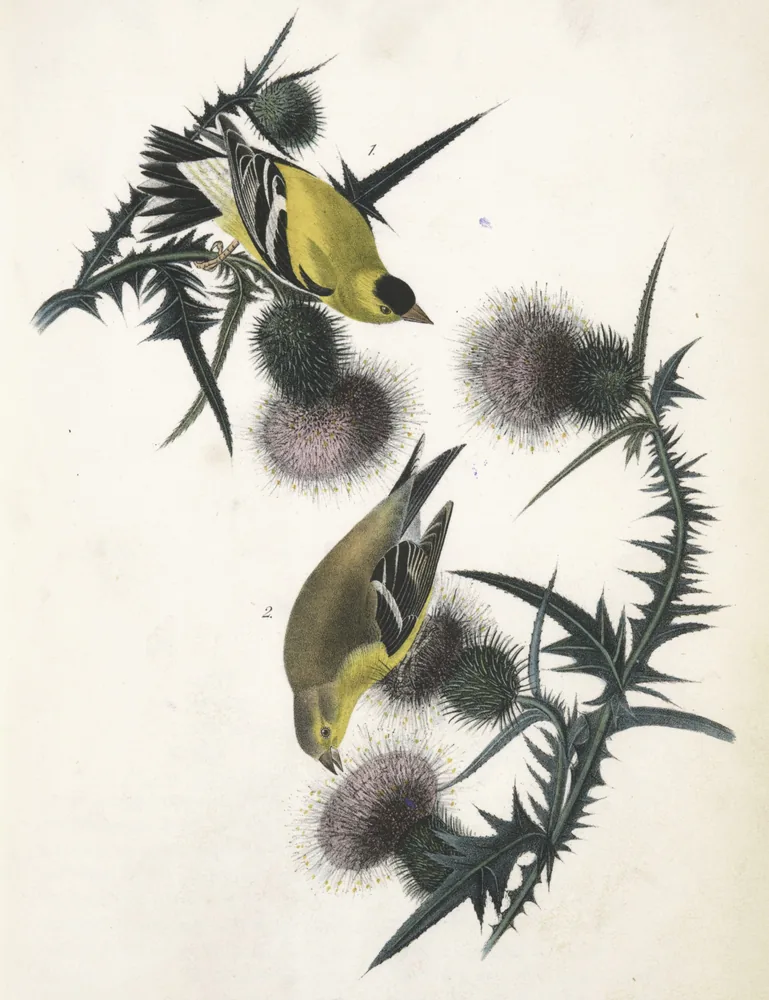
John James Audubon painted the American Goldfinch as plate 33 of The Birds of America (1827–38), a male and a female on a thistle, under the name Yellow Bird or American Goldfinch. You can see it free, in high resolution, on Audubon.org. The picture on this page is the octavo edition’s plate 181 (1840–44).
Updated
About this painting
This smaller version comes from plate 181 of the octavo Birds of America, which kept the male and female on their thistle. Our Audubon guide explains how the octavo prints were made. The bird in Carel Fabritius's famous 1654 painting is its European cousin: The Goldfinch painting and the real bird.
Audubon’s American Goldfinch: plate 33, “Yellow Bird or American Goldfinch”
Audubon knew of two American Goldfinches, bought in the New York market, that lived in cages for more than ten years. One had been trained, as birds more often were in Europe, to draw up its own water: held by a light chain on a tiny leather belt, it hauled a little bucket out of a glass with its bill and foot, and pulled up a little cart of seeds the same way. He pitied it, “doomed to toil through a life of solitary grief.”
Wild goldfinches were another matter. One August, walking up the Mohawk River, he met more in a day than anywhere else: every thistle along the canal “was ornamented with one or more Goldfinches,” tearing open the ripening heads and letting the down float away. He also saw one caught on a twig smeared with birdlime throw itself backward and hang, wings closed, until the lime stretched into a thread, then fly off.
In the octavo picture here, plate 181, the male and the female perch on a common thistle. The song was so like the European Goldfinch's, he wrote, that in France and England he often thought for a moment he was hearing his own American bird.
Story: Audubon, Ornithological Biography, vol. 1 (1831), pp. 172–175. See plate 33 free at Audubon.org.
More classic portraits, free to see
- John James Audubon, The Birds of America, octavo edition (1840–44), plate 181: “American Goldfinch” (the painting shown above). Free scan (New York Public Library Digital Collections)
- Louis Agassiz Fuertes, for Elon H. Eaton’s Birds of New York (1910–14): plate 78: “Goldfinch”, with Redpoll and Pine Siskin; plate 79: “Goldfinch”, with European Goldfinch and Evening Grosbeak. (Free scans: Internet Archive)
About the American Goldfinch
- American Goldfinches climb plants such as thistles to reach the seeds. (Source: National Audubon Society)
Goldfinches at your feeder this winter? You can count them for science with Project FeederWatch, run by the Cornell Lab of Ornithology and Birds Canada from November 1, 2026 to April 30, 2027. Here's how a FeederWatch count works.
Why does the goldfinch at a Texas feeder look olive-brown?
Because Texas sees it mostly in its winter feathers. In winter, males and females alike turn a subtler brown, anywhere from yellowish-brown to gray, National Audubon's guide says; look for bold white or buff bars on black wings, and white spots in the tail.
Oklahoma's wildlife department describes the winter bird as olive brown on the back and head and grayish-brown below, with a yellow tinge on the face and throat. Its flocks at feeders may be as small as five birds or larger than 150. The Pine Siskin, sometimes taken for one, has streaks on its back and breast.
Few Texans see it in summer gold. Nesting has been confirmed only now and then in the north, as along the Canadian River in Hemphill County, where huge cottonwoods line the road, the Texas Breeding Bird Atlas says; the bird is “one of the latest to nest” among songbirds of temperate lands. Audubon noticed that young males get their full colors only in their first spring.
Sources: National Audubon Society guide, American Goldfinch; Oklahoma Department of Wildlife Conservation; Texas Breeding Bird Atlas, American Goldfinch account; Audubon, Ornithological Biography, vol. 1 (1831), p. 174.
What are the small yellow birds in Texas?
In winter, most often American Goldfinches or Yellow-rumped Warblers. The Yellow-rump, which has a page of its own, is the most common warbler in the United States in winter, the Texas Breeding Bird Atlas says, and Common Yellowthroats winter mostly on the Coastal Prairies and across the southern half of the state.
Spring and fall bring Yellow Warblers through every part of Texas, from early April to late May and again from late July to mid-October, though none has been confirmed nesting here since 1956. In summer the Prothonotary Warbler nests in the bottomland swamps and bayous of the east, often in a broken stump over or near water. For its song and bright plumage, the atlas notes, Oberholser (1974) called it a “tiny detached bit of golden swamp-fire.”
Sources: Texas Breeding Bird Atlas, Yellow-rumped Warbler (Tweit, 2004); Texas Breeding Bird Atlas, Common Yellowthroat (Tweit, 2004); Texas Breeding Bird Atlas, Yellow Warbler (Tweit, 2007); Texas Breeding Bird Atlas, Prothonotary Warbler (Downing-Fink, posted with updates 2007).
What is the black and yellow bird in Texas?
Often a goldfinch. American Goldfinches can linger into late spring, when males turn brilliant yellow with black caps and wings, say National Audubon's guide and Oklahoma's wildlife department. In western Texas, the male Lesser Goldfinch is black above, yellow below: see which finches live in Texas.
From mid-March to July in central Texas, it may be a Golden-cheeked Warbler: bright yellow cheeks, black throat and back. It nests only in Texas, in woods of mature Ashe juniper along the Balcones Escarpment and on the Edwards Plateau, the atlas says. Listed as endangered in 1990, it was recommended for downlisting to threatened in a January 2025 federal review.
In South Texas brush, Audubon's Oriole, robin-sized, shows a solid black hood, tail and mostly black wings against a yellow-green back; it stays all year and, though shy, visits seed feeders. From spring to fall in the Trans-Pecos and on the Edwards Plateau, the male Scott's Oriole has a black hood and back over lemon-yellow underparts.
Sources: National Audubon Society guide, American Goldfinch; Oklahoma Department of Wildlife Conservation; Texas Breeding Bird Atlas, Lesser Goldfinch account (Tweit, 2004); Texas Breeding Bird Atlas, Golden-cheeked Warbler (Coldren, about 1993); U.S. Fish and Wildlife Service, January 7, 2025; National Audubon Society guide, Audubon's Oriole; Texas Breeding Bird Atlas, Audubon's Oriole (Brush, about 1995); Texas Breeding Bird Atlas, Scott's Oriole (Tweit, 2005).
How long does an American Goldfinch live?
The state wildlife guides we read give no typical lifespan for the American Goldfinch. The oldest known wild American Goldfinch was at least 10 years and 11 months old (USGS Bird Banding Laboratory): it was banded in Maryland in 2004 and found there again in 2013.
Source: USGS Bird Banding Laboratory. A banding record is the minimum age of one bird when it was found again, not a typical lifespan. How long do wild birds live?
How can you tell if a plate 33 print is an original?
By its size: an original plate 33 is a hand-colored sheet about 26 by 38 inches; the American Goldfinch’s octavo version, plate 181, is book-size, from 1840–44. Many prints sold today are reproductions: how to tell an original from a reproduction. Plate 33 and the other 434 also come bound in one modern book: which Birds of America book to buy.
In a Birdfolio hardcover, this painting sits beside the date and place you first saw a American Goldfinch. See your own list as a book, free.