Classic bird paintings
Northern Cardinal painting: Audubon's plate and other classic portraits
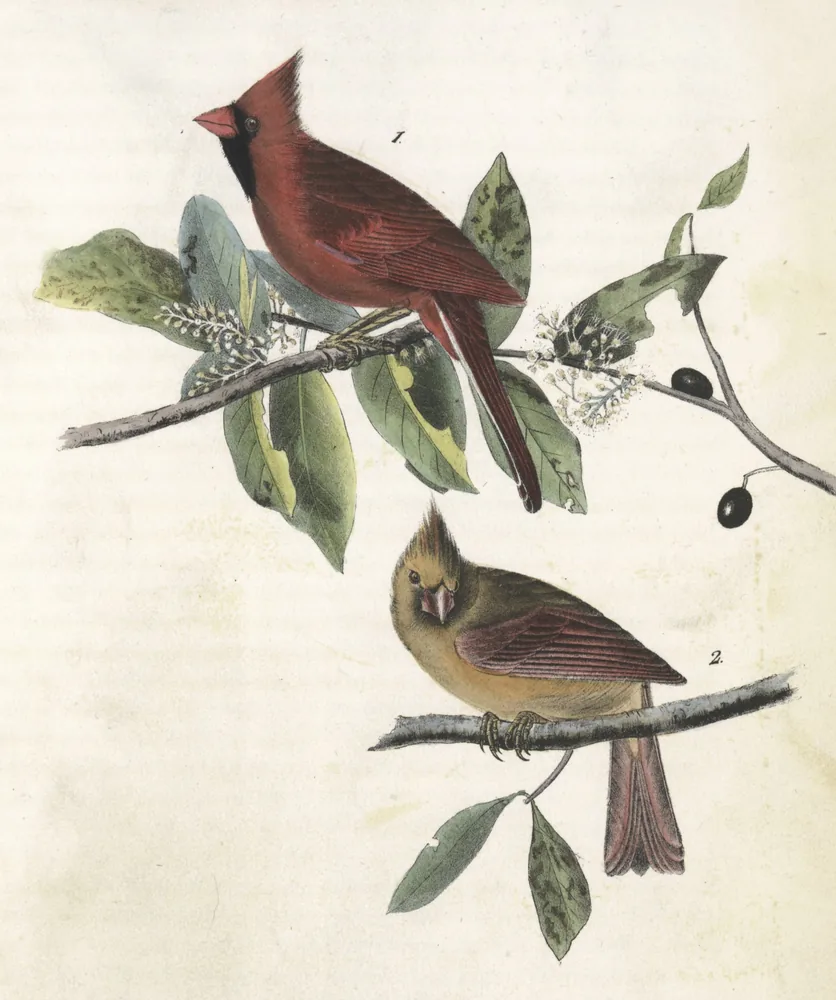
John James Audubon painted the Northern Cardinal as plate 159 of The Birds of America (1827–38), a male and a female, under the name Cardinal Grosbeak. Audubon.org has a free high-resolution scan. The pair shown here is from his smaller octavo edition (1840–44), plate 203, titled Common Cardinal Grosbeak.
Updated
About this painting
Shown here: plate 203 of the 1840s octavo edition, Common Cardinal Grosbeak, with the red male above and the brownish female below. Audubon’s octavo plates were hand-colored lithographs, printed in Philadelphia.
Audubon’s Northern Cardinal: plate 159, “Cardinal Grosbeak”
Audubon's text names the branch as wild olive, though the plant note printed with it is headed wild almond, Prunus caroliniana. He listed other names then in use: Red Bird, Virginia Nightingale and Cardinal Bird. He wrote that wherever it goes it is welcome, and a favorite everywhere.
In Florida he found cardinals already paired by early March, and once as early as February 8; near Charleston and in Louisiana they paired nearly a month later. A friend in Charleston had cardinals breeding in his aviary, where the female laid her eggs in a straw basket and added only a few blades of grass.
Story: Audubon’s Ornithological Biography, vol. 2 (1834). See plate 159 free at Audubon.org.
More classic portraits, free to see
- John James Audubon, The Birds of America, octavo edition (1840–44), plate 203: “Common Cardinal Grosbeak” (the painting shown above). Free scan (New York Public Library Digital Collections)
- Louis Agassiz Fuertes, for Elon H. Eaton’s Birds of New York (1910–14), plate 85: “Cardinal”, with the Rose-breasted Grosbeak. Free scan (Internet Archive)
About the Northern Cardinal
- Northern Cardinals often visit feeders for sunflower seeds, and search for food on the ground and in low shrubs. (Source: National Audubon Society)
The oldest known wild Northern Cardinal lived at least 15 years and 9 months: it was banded in Pennsylvania in 1956 and found there again in 1971. That is a record from bird banding, not a typical lifespan. (Source: USGS Bird Banding Laboratory, 2025 longevity table.) How long do wild birds live?
Buying a print?
An original plate 159 is a hand-colored sheet about 26 by 38 inches, printed in Britain in 1827–38; many prints sold today are reproductions or small 1840s octavo prints. How to tell an original from a reproduction.
In a Birdfolio, the hardcover book of your own life list, this painting sits beside the Northern Cardinal with the date and place you first saw one. See your own list as a book, free.