Classic bird paintings
Carolina Wren painting: Audubon's plate and other classic portraits
John James Audubon painted the Carolina Wren as plate 78 of The Birds of America (1827–38), a pair on a flowering dwarf buckeye, under the name Great Carolina Wren. That plate is the painting shown here, and a free high-resolution scan is on Audubon.org.
Updated
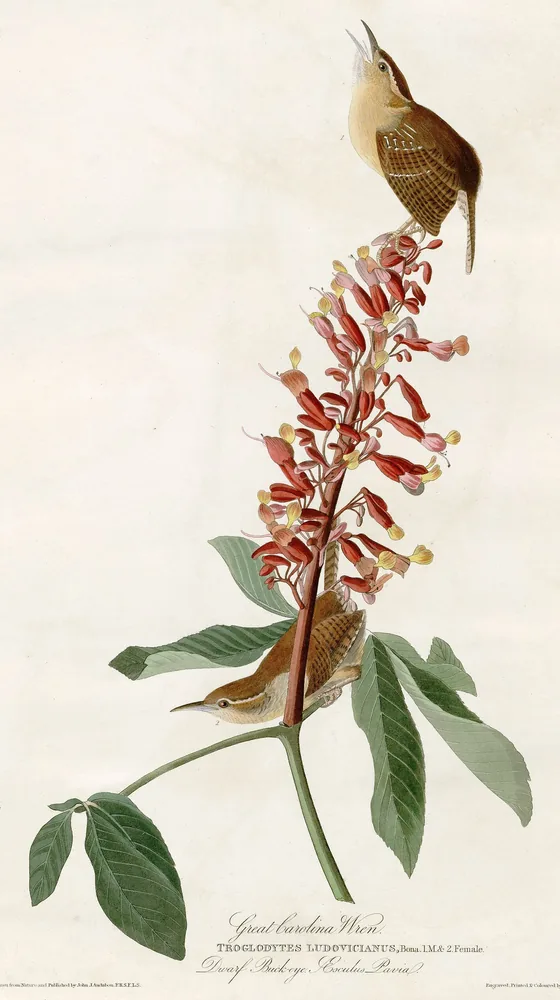
Audubon’s plate: plate 78, “Great Carolina Wren”
At the top of Audubon's plate, one wren sings from a spike of red dwarf buckeye flowers while its mate perches below. He heard the song as “a short ditty something resembling the words come-to-me, come-to-me,” loud and yet mellow, from the first glimpse of day until sometimes after sunset. He studied the bird in Louisiana, where it lived all year, because he thought any creature is best judged in its own country.
It moved, he wrote, as quickly as a mouse. A little below New Orleans he often heard one sing from the roof of an abandoned flatboat, then creep from board to board, squeeze through an auger hole and hunt spiders inside, peeping out at one spot and then another. At Oakley, a friend's plantation near Bayou Sara, a wren made a habit of roosting in an old Wood Thrush nest that autumn leaves had filled, pushing its body in under them.
The dwarf buckeye is a low shrub of swampy ground. Its flowers have no scent, he noted, but hummingbirds visit them as soon as they arrive in spring, and its wood resembles that of the horse chestnut. Beyond that he was blunt: “I know of no valuable property possessed by this beautiful shrub.”
Story: Audubon, Ornithological Biography, vol. 1 (1831), pp. 399–402. See plate 78 free at Audubon.org.
More classic portraits, free to see
- John James Audubon, The Birds of America, octavo edition (1840–44), plate 117: “Great Carolina Wren”. Free scan (New York Public Library Digital Collections)
- Louis Agassiz Fuertes, for Elon H. Eaton’s Birds of New York (1910–14), plate 102: “Carolina Wren”, with 5 other birds. Free scan (Internet Archive)
About the Carolina Wren
- Carolina Wrens usually hunt in pairs, searching low plants, bark and the ground. (Source: National Audubon Society)
Christmas Bird Count records have tracked this wren's spread north, Audubon says, early evidence of how a warming climate moves birds. You can help count them this winter: here's how to join a Christmas Bird Count. (Source: National Audubon Society)
Does the Carolina Wren live in Texas all year?
Yes. It is a resident, common to abundant in eastern Texas and nesting from mid-February to late August, the Texas Breeding Bird Atlas says. Most confirmed nests from 1987 to 1992 were in the Pineywoods, the Post Oak Savannah and Blackland Prairies, on the coast and on the eastern Edwards Plateau and Rolling Plains; farther west they were scattered.
It will nest in almost any hole: a tree cavity, an old woodpecker hole, a crack in a wall or building, a nest box, even an empty flower pot, under a dome of leaves, twigs and moss with a door at the side. The female usually lays four eggs, and a pair may raise three broods a season. Several studies found a Brown-headed Cowbird's egg in about a quarter of nests, and once a House Finch laid in one.
Survey counts in Texas rose about 2.4% a year from 1980 to 2005. Its loud song, tea-kettle, tea-kettle, tea-kettle, goes on all day in every season, National Audubon's guide says.
Sources: Texas Breeding Bird Atlas (Tweit, 2007); National Audubon Society guide, Carolina Wren.
Which other wrens nest in Texas?
Four more live in Texas all year, mostly in the west, the Texas Breeding Bird Atlas says. Bewick's Wren is found across the western two-thirds, and Texas probably has more of them than any other state; Audubon collected and described it in 1821. Unlike the Carolina, it has white corners on its tail, National Audubon's guide notes.
The Cactus Wren of the southwestern brush nests in prickly pear, cholla and mesquite, and birds that eat prickly pear fruit often have faces stained red by the juice. The Canyon Wren's falling too-ee, too-ee, too-ee echoes off rock walls, and the Rock Wren lays a little pavement of stones around its nest.
A fifth, the Marsh Wren, nests all year in the marshes of the upper and central coast. Its males build several nests for a female to choose from, and some know as many as 200 songs. In 2026 the American Ornithological Society split it in two: the Marsh Wren split explains which is which.
Sources: Texas Breeding Bird Atlas, Bewick's Wren (Tweit, 2006); Texas Breeding Bird Atlas, Canyon Wren (Corson, updated 2006); Texas Breeding Bird Atlas, Rock Wren (Tweit, 2008); Texas Breeding Bird Atlas, Marsh Wren (Tweit, 2006); Texas Breeding Bird Atlas, Cactus Wren (Casto, updated 2006); National Audubon Society guide, Carolina Wren.
Does the House Wren nest in Texas?
Yes, though only in a few places. The Texas Breeding Bird Atlas found it nesting almost only in the northwest, on the Rolling Plains and the plains of the Panhandle, along creeks and rivers such as the Canadian. Elsewhere it is a common migrant and an uncommon winter visitor in nearly all of the state.
It is new there as a nesting bird. Observers who visited the eastern Panhandle in summer from the 1930s through 1960 never found one, and only in the early 1970s did House Wrens start to turn up regularly, part of a wider spread south and west. Proving a nest is tricky: a male builds several, whether he has a mate or not, so seeing him build proves nothing until a female lays in one.
Its name has changed, too: AviList, the world checklist, now calls Troglodytes aedon the Northern House Wren, and the House Wren split explains why.
Sources: Texas Breeding Bird Atlas, House Wren (Seyffert, updated 2006); AviList v2026.
How long does a Carolina Wren live?
No typical lifespan for the Carolina Wren could be confirmed from the sources we checked. Hard winters are the danger: cold winters with ice and snow can devastate local populations, the Tennessee Wildlife Resources Agency notes, though numbers recover within a few years. The oldest known wild Carolina Wren was at least 9 years and 2 months old (USGS Bird Banding Laboratory): it was banded in North Carolina in 2011 and found there again in 2019.
Sources: Tennessee Wildlife Resources Agency; USGS Bird Banding Laboratory. A banding record is the minimum age of one bird when it was found again, not a typical lifespan. How long do wild birds live?
How can you tell if a plate 78 print is an original?
By its size: an original plate 78 is a hand-colored sheet about 26 by 38 inches; the Carolina Wren’s octavo version, plate 117, is book-size, from 1840–44. Many prints sold today are reproductions: how to tell an original from a reproduction. Rather have every plate in one book? Here’s which Birds of America book to buy.
In a Birdfolio hardcover, this painting sits beside the date and place you first saw a Carolina Wren. See your own list as a book, free.