Classic bird paintings
Common Loon painting: Audubon's plate and other classic portraits
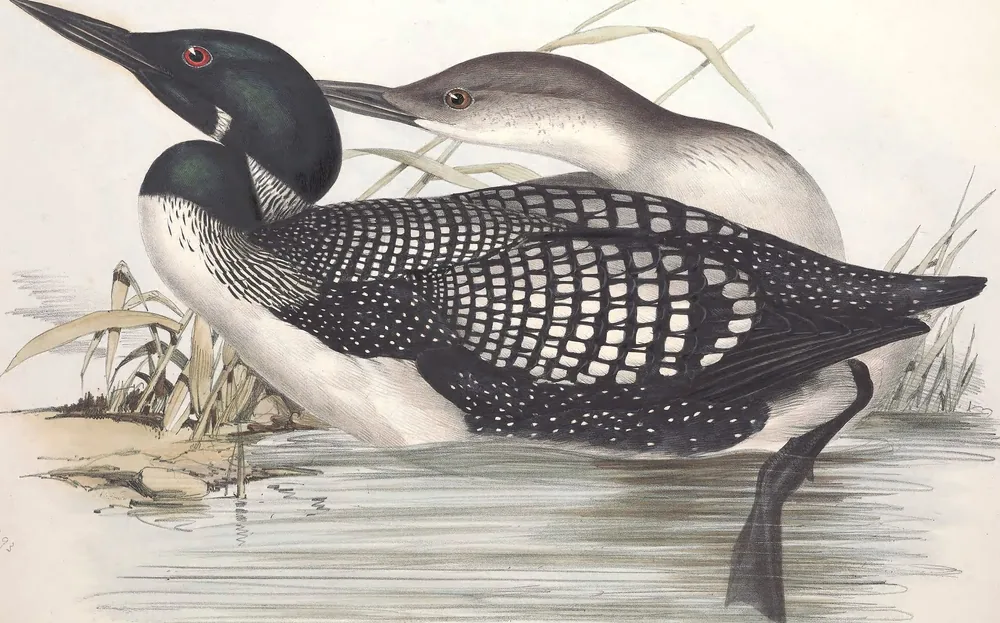
John James Audubon painted the Common Loon as plate 306 of The Birds of America (1827–38), under the name Great Northern Diver or Loon. A free high-resolution scan is on Audubon.org. The loons shown here are from John Gould's The Birds of Europe (1832–37), where he called the bird the Northern Diver.
Updated
The story of this painting
John Gould called the Northern Diver the largest and most typical of its kind, found across the whole northern hemisphere, nesting within the Arctic Circle and moving south in autumn and winter as far as latitude 36°. Most of those seen around Britain were young birds, he noticed, since the young wander farthest from home.
Its plumage changes so much with age, he explained, that first-year and second-year birds had been described as separate species. His plate, number 393, shows an adult male and a young bird of the year at about two-thirds of life size, drawn from nature and put on stone by John and Elizabeth Gould. On land, he wrote, the loon can hardly walk and pushes itself along on its breast.
One sent to the Zoological Society of London from Trebizond, on the Black Sea, made him wonder how it got there; he guessed it had followed big rivers such as the Danube, the Don or the Volga rather than fly round by the Mediterranean. Gould drew it again, with Henry Constantine Richter, for The Birds of Great Britain (1862–73): an adult with a fish in its bill.
Story: Gould, The Birds of Europe, vol. 5 (1837), plate 393; vol. 5 (1837), text to plate 393; Gould, The Birds of Great Britain, vol. 5 (1873), plate 43.
Audubon’s Common Loon: plate 306, “Great Northern Diver or Loon”
Sailing from Charleston to the Florida Keys in May 1832, Audubon several times saw and heard loons heading east, and the crew were sure a hurricane was coming. The passage was very pleasant. He called the belief absurd: he had heard loons most often and loudest on the Ohio in Indian summer, when there was not a cloud for weeks.
He doubted another story found in books, that a loon drops straight from the sky into its nest. Watching at least twenty pairs from cover, he saw each circle the spot, land on the water some way off, look and listen, and only then swim ashore to the nest. Nor was it helpless on land: in Labrador his youngest son, John Woodhouse Audubon, shot one that fell broken-winged on bare granite, and it ran about a hundred yards to the water ahead of him, though he was no slow runner.
Plate 306 shows an adult male and a young male. The young bird was drawn in October 1819 from one taken on the Ohio.
Story: Audubon, Ornithological Biography, vol. 4 (1838), pp. 43–48. See plate 306 free at Audubon.org.
More classic portraits, free to see
- John James Audubon, The Birds of America, octavo edition (1840–44), plate 476: “Great North Diver-Loon”. Free scan (New York Public Library Digital Collections)
- John and Elizabeth Gould, The Birds of Europe (1832–37), plate 393: “Northern Diver” (Colymbus glacialis) (the painting shown above). Free scan (University of Kansas Libraries)
- John Gould and Henry Constantine Richter, The Birds of Great Britain (1862–73), vol. 5, plate 43: “Great Northern Diver” (Colymbus glacialis). Free scan (University of Kansas Libraries)
- Louis Agassiz Fuertes, for Elon H. Eaton’s Birds of New York (1910–14), plate 2: “Common Loon”, with the Red-throated Loon. Free scan (Internet Archive)
About the Common Loon
- Common Loons swallow small fish underwater but bring bigger prey to the surface. (Source: National Audubon Society)
How long does a Common Loon live?
A loon's typical lifespan is hard to pin down: the National Park Service describes the often-quoted 15 to 30 years as a best case. In Washington, Bald Eagles have likely been the largest cause of death for loon chicks in recent years, the state's Department of Fish and Wildlife says. The oldest known wild Common Loon was at least 33 years and 9 months old (USGS Bird Banding Laboratory): it was banded in Michigan in 1987 and found there again in 2021.
Sources: National Park Service; Washington Department of Fish and Wildlife; USGS Bird Banding Laboratory. A banding record is the minimum age of one bird when it was found again, not a typical lifespan. How long do wild birds live?
How can you tell if a plate 306 print is an original?
By its size: an original plate 306 is a hand-colored sheet about 26 by 38 inches; the Common Loon’s octavo version, plate 476, is book-size, from 1840–44. Many prints sold today are reproductions: how to tell an original from a reproduction. Modern editions print all 435 plates, from pocket size to coffee-table size: which Birds of America book to buy.
In a Birdfolio hardcover, this painting sits beside the date and place you first saw a Common Loon. See your own list as a book, free.