Classic bird paintings
Pileated Woodpecker painting: Audubon's plate and other classic portraits
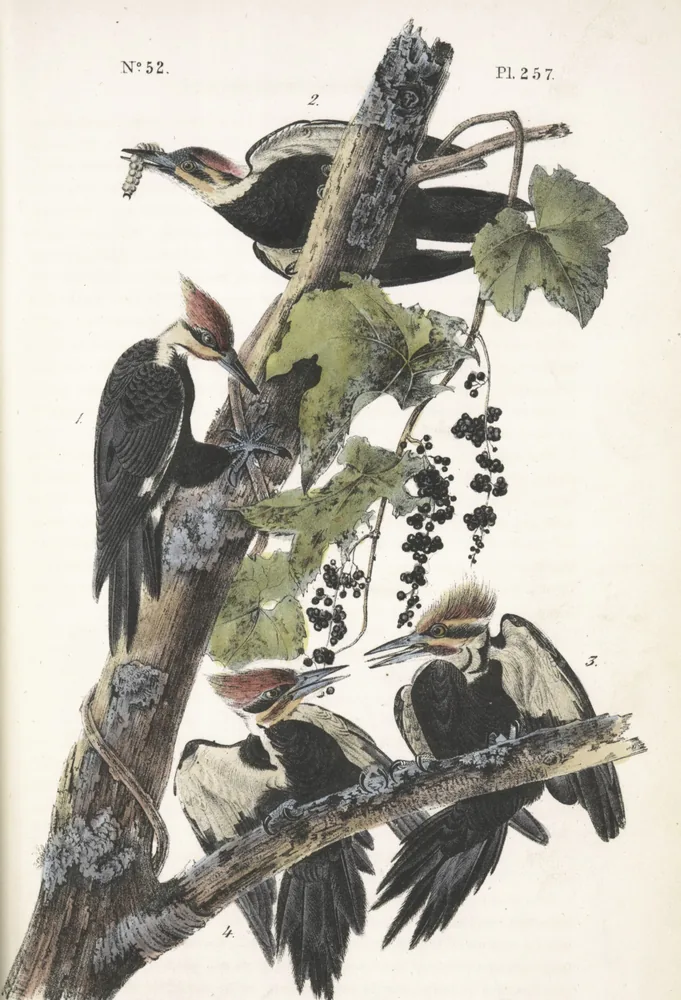
John James Audubon painted the Pileated Woodpecker as plate 111 of The Birds of America (1827–38), two adults and two young males on a grapevine, under the same name. A free high-resolution scan is on Audubon.org; the picture here is the book-size octavo version (1840–44), plate 257.
Updated
About this painting
The picture is the octavo edition’s plate 257, from the 1840s: all four woodpeckers of the big plate, on the same grapevine, reduced to book size.
Audubon’s Pileated Woodpecker: plate 111, “Pileated Woodpecker”
John Bachman of Charleston tried to raise two young Pileated Woodpeckers, and wrote to Audubon about it. They wrecked a cage of pine boards every two days, so he built one of oak. Each morning they upset their water dish, and they smashed their food trough to pieces. One morning he opened his study door: one bird dashed past him, and “the other was hammering at my books.” He let them go. They sat together in an apple tree for half an hour, then flew off south over the snow.
Audubon found the bird everywhere in wild woods but scarce and shy where people had settled. Country people called it Woodcock or Logcock, and its hammering carried a quarter of a mile. In Louisiana he several times crept up to one feeding on a low rotten stump and struck the stump with his cap; the bird fell to the ground as if dead, then came to and flew off faster than usual.
Plate 111 shows a male, a female and two young males on a raccoon grape vine. He added the young, he wrote, to show that a woodpecker's bill is longest just after it leaves the nest: he measured a young bird's bill seven-eighths of an inch longer than an adult's.
Story: Audubon, Ornithological Biography, vol. 2 (1834), pp. 74–80; vol. 5 (1839), p. 533. See plate 111 free at Audubon.org.
More classic portraits, free to see
- John James Audubon, The Birds of America, octavo edition (1840–44), plate 257: “Pileated Woodpecker” (the painting shown above). Free scan (New York Public Library Digital Collections)
- Louis Agassiz Fuertes, for Elon H. Eaton’s Birds of New York (1910–14), plate 63: “Northern Pileated Woodpecker”. Free scan (Internet Archive)
About the Pileated Woodpecker
- Pileated Woodpeckers dig into dead wood for insects, sometimes breaking rotten stumps apart. (Source: National Audubon Society)
- They grew scarce as eastern forests were cleared, then began to increase again around the start of the 20th century. (Source: National Audubon Society)
How long does a Pileated Woodpecker live?
No wildlife agency we checked publishes a typical lifespan for the Pileated Woodpecker. A 2003 research summary from the US Forest Service says only that Pileated Woodpeckers “may live as much as 10 years or more in the wild.” In a US Forest Service study in northeastern Oregon, only 23 to 54% of nestlings fitted with radio tags survived their first three and a half months. The oldest known wild Pileated Woodpecker was at least 12 years and 11 months old (USGS Bird Banding Laboratory): it was banded in Maryland in 1979 and found there again in 1991.
Sources: US Forest Service, Pacific Northwest Research Station; US Forest Service; USGS Bird Banding Laboratory. A banding record is the minimum age of one bird when it was found again, not a typical lifespan. How long do wild birds live?
How can you tell if a plate 111 print is an original?
By its size: an original plate 111 is a hand-colored sheet about 26 by 38 inches; the Pileated Woodpecker’s octavo version, plate 257, is book-size, from 1840–44. Many prints sold today are reproductions: how to tell an original from a reproduction. Rather have every plate in one book? Here’s which Birds of America book to buy.
In a Birdfolio hardcover, this painting sits beside the date and place you first saw a Pileated Woodpecker. See your own list as a book, free.