Classic bird paintings
Wood Duck painting: Audubon's plate and other classic portraits
John James Audubon painted the Wood Duck as plate 206 of The Birds of America (1827–38), under the name Summer or Wood Duck: males and females with their nest. A free high-resolution scan is on Audubon.org. The Wood Ducks shown here were painted by Louis Agassiz Fuertes for Frank M. Chapman's Handbook of Birds of Eastern North America (1912).
Updated
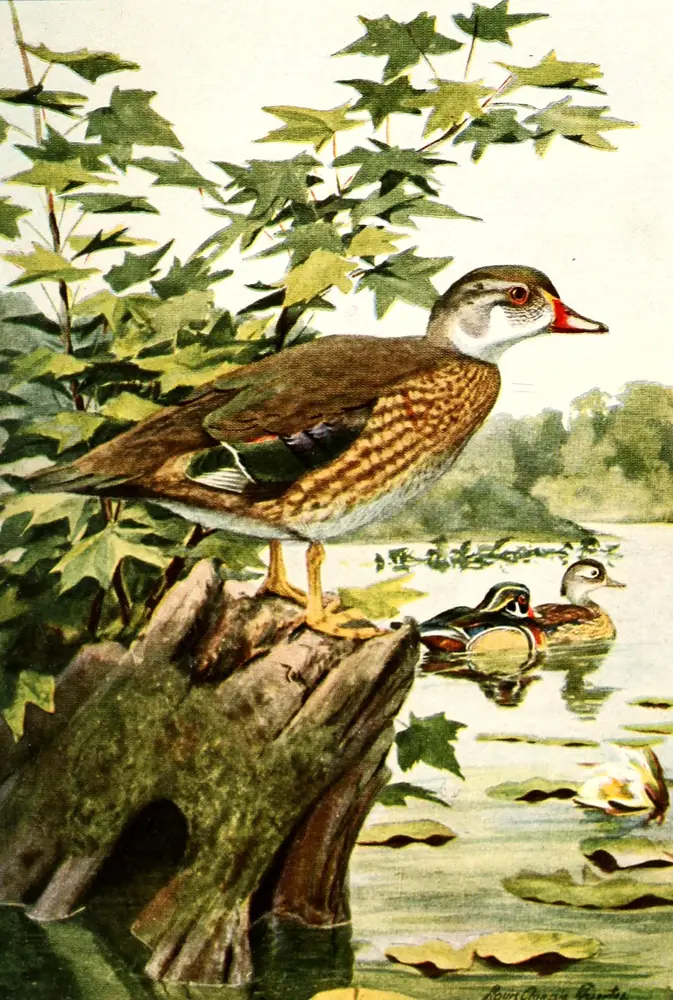
The story of this painting
The duck on the stump looks like a hen, but it is a drake. In the 1912 edition of his Handbook of Birds of Eastern North America, Frank M. Chapman captioned this plate “Adult Male Wood Duck in ‘Eclipse’ Plumage” and told readers to note the missing primaries, the long flight feathers: the bird cannot fly. Louis Agassiz Fuertes painted it from a specimen that E. A. Mearns collected at Fort Snelling, Minnesota, on July 24, 1888.
Ducks lose all their wing quills at once after the breeding season, Chapman explained, and while they cannot fly, the males of many kinds molt into a dull coat like the female's, evidently to be less conspicuous. When the new quills have grown, the eclipse plumage goes and the bright dress returns, like that of the drake swimming behind. That a bird hides itself this way while it is helpless, he added, shows how conspicuous its breeding plumage is.
Fuertes made fifteen full-page plates for this edition, and Chapman's preface called him “America’s foremost painter of birds.” Of Wood Ducks on wooded ponds and streams, Chapman wrote that he knew of “no sight in the bird world which so fully satisfies the eye.” Alarmed, they spring from the water with a frightened whistle, oo-eek, and fly off through the woods.
Story: Chapman, Handbook of Birds of Eastern North America (1912), plate V, facing p. 86; p. xx; p. 186; pp. 197–198.
Audubon’s Wood Duck: plate 206, “Summer or Wood Duck”
“Methinks I am now seated by the trunk of a gigantic sycamore,” Audubon wrote near the start of his Wood Duck chapter, and he went on to picture the bayou: a mosquito he let drink its fill from his hand so he could watch it work, an otter surfacing with a fish, and then a flock of Wood Ducks that swept over the stream three times before settling on it. Scenes like these, he wrote, he had enjoyed a thousand times.
At Henderson, Kentucky, he decided to tame some. His pointer, Juno, ran down ducklings and brought them back unhurt in her mouth. He shut a dozen in empty flour barrels, but whenever he lifted a lid the little ducks were hanging from the rim by claws almost as fine as needles, ready to tumble out and run. Raised on soaked cornmeal and young locusts, they were pinioned and bred in boxes he set over the pond in his garden. Any that escaped headed straight for the Ohio, though they had never been there.
Plate 206 shows males and females with their nest. Near Henderson one pair laid in an old Ivory-billed Woodpecker hole three springs running. Hatched over water, the ducklings simply launch themselves and drop in; from a hole farther off, the mother carries them down one by one in her bill.
Story: Audubon, Ornithological Biography, vol. 3 (1835), pp. 52–59. See plate 206 free at Audubon.org.
More classic portraits, free to see
- John James Audubon, The Birds of America, octavo edition (1840–44), plate 391: “Wood Duck - Summer Duck”. Free scan (New York Public Library Digital Collections)
- Louis Agassiz Fuertes, for Elon H. Eaton’s Birds of New York (1910–14), plate 14: “Wood Duck”, with Northern Shoveler and Blue-winged Teal. Free scan (Internet Archive)
About the Wood Duck
- Wood Ducks pick food from the surface of the water and also look for food on land. (Source: National Audubon Society)
- Hunting and the loss of nesting places cut Wood Duck numbers in the late 1800s. (Source: National Audubon Society)
What does a female Wood Duck look like?
Gray-brown, with a white ring around the eye that trails back in a short stripe, a white throat and a small crest. Frank M. Chapman's 1912 handbook adds grayish-brown breast and sides streaked with buff, a white belly and an olive-brown back glossed with green. Hinterland Who's Who finds her “more colourful than other female ducks”: a few small purplish feathers on top of her wing shine like oil on water, and the drake has none.
In summer, look twice. The bird on the stump in the Fuertes painting above is a drake in eclipse plumage, and the Audubon guide notes that such males resemble the female, with a more distinct white throat. Compare him with the real female swimming behind: he keeps his red eye and red bill, while her bill is dark, blackish-brown in Audubon's description, and her eye sits in that white ring.
Sources: National Audubon Society guide, Wood Duck; Hinterland Who's Who, Wood Duck; Chapman, Handbook of Birds of Eastern North America (1912), p. 197; Audubon, Ornithological Biography, vol. 3 (1835), pp. 61–62.
How many times a year do Wood Ducks have babies?
Once a year in the North and often twice in the South, the National Audubon Society's guide says. A hen breeds at a year old, lines a tree hole with down from her breast and lays 8 to 15 eggs, then sits on them alone for 28 to 30 days, Hinterland Who's Who explains. Hens often lay in each other's nests as well, the guide adds, sometimes in “dump nests” that no one ever sits on. A Mallard, by contrast, raises a single brood a year, however many times she has to start over.
Sources: National Audubon Society guide, Wood Duck; Hinterland Who's Who, Wood Duck; Hinterland Who's Who on the Mallard.
What does Aix sponsa mean?
Roughly, a waterbird dressed as a bride. Aix comes from ancient Greek, the name of a waterbird Aristotle mentioned, and sponsa is Latin for a bride or a betrothed woman, the Livermore Area Recreation and Park District explains. Eastside Audubon Society reads it as a bird “arrayed for bridal,” for its plumage, though on a Wood Duck the finest dress is the drake's.
The second word is the older one. Audubon's text of 1835 still filed the bird under Anas sponsa, Linnaeus's name, with Summer Duck as its other English name.
Sources: Livermore Area Recreation and Park District; Eastside Audubon Society; Audubon, Ornithological Biography, vol. 3 (1835), p. 60.
How long does a Wood Duck live?
Wood Ducks usually live 3 to 4 years, says the Chesapeake Bay Program. Turtles, alligators, snakes and bass take so many ducklings that usually only 3 to 4 from a brood live to fly, UF/IFAS Extension notes. The oldest known wild Wood Duck was at least 22 years and 6 months old (USGS Bird Banding Laboratory): it was banded in Oregon in 1962 and found in California in 1984.
Sources: Chesapeake Bay Program; UF/IFAS Extension; USGS Bird Banding Laboratory. A banding record is the minimum age of one bird when it was found again, not a typical lifespan. How long do wild birds live?
How can you tell if a plate 206 print is an original?
By its size: an original plate 206 is a hand-colored sheet about 26 by 38 inches; the Wood Duck’s octavo version, plate 391, is book-size, from 1840–44. Many prints sold today are reproductions: how to tell an original from a reproduction. Rather have every plate in one book? Here’s which Birds of America book to buy.
In a Birdfolio hardcover, this painting sits beside the date and place you first saw a Wood Duck. See your own list as a book, free.