Reference
How many bird species are in Minnesota?
Minnesota has 454 bird species on its official list (Minnesota Ornithologists' Union Records Committee, no date on the list), tied for the 29th highest count of the 49 states with a verified count. It counts every species documented in Minnesota at least once, not only the birds that nest there.
Minnesota’s state bird is the Common Loon: our Minnesota state bird page tells how it was chosen.
Updated
What are the most common birds in Minnesota?
In summer, the 25 most common birds in Minnesota are led by the Cliff Swallow, at about 275 birds per survey route, then the Canada Goose and the Red-winged Blackbird, by the USGS Breeding Bird Survey’s counts for 2021–2025. Together these 25 made up 62% of all the birds counted on Minnesota’s 71 survey routes.
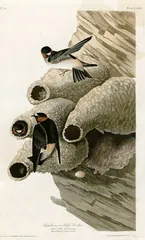
John James Audubon, The Birds of America (1827–38) 1 Cliff Swallowabout 275 per routeon 69% of routesno clear trend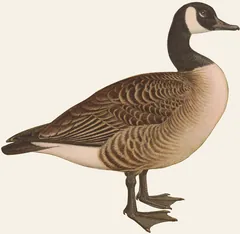
Marinus Adrianus Koekkoek, E. D. van Oort's Ornithologia Neerlandica (1922) about 151 per routeon 82% of routesno clear trend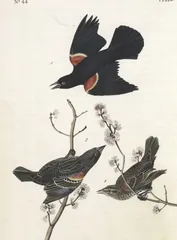
John James Audubon, The Birds of America (1840–44) about 112 per routeon 99% of routesno clear trend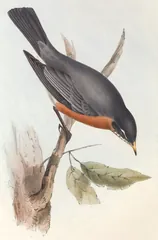
John and Elizabeth Gould, The Birds of Europe (1832–37) about 41 per routeon 100% of routesfalling since 2015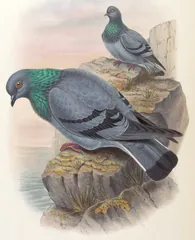
John Gould and William Matthew Hart, The Birds of Asia (1850–83) 5 Rock Pigeonabout 37 per routeon 75% of routesno clear trendintroduced species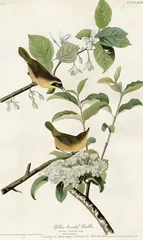
John James Audubon, The Birds of America (1827–38) 6 Common Yellowthroatabout 31 per routeon 100% of routesno clear trend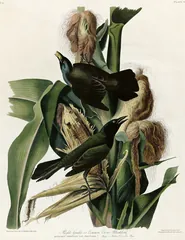
John James Audubon, The Birds of America (1827–38) 7 Common Grackleabout 30 per routeon 89% of routesfalling since 2015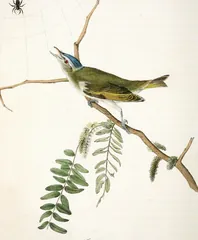
John James Audubon, The Birds of America (1840–44) 8 Red-eyed Vireoabout 28 per routeon 87% of routesno clear trend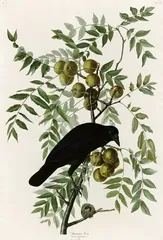
John James Audubon, The Birds of America (1827–38) about 26 per routeon 97% of routesfalling since 2015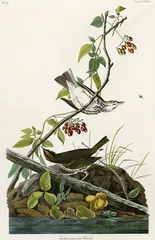
John James Audubon, The Birds of America (1827–38) 10 Ovenbirdabout 25 per routeon 61% of routesno clear trend
Show all 25
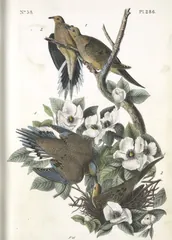
John James Audubon, The Birds of America (1840–44) about 24 per routeon 86% of routesno clear trend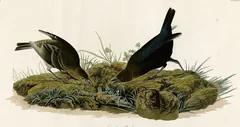
John James Audubon, The Birds of America (1827–38) 12 Brown-headed Cowbirdabout 23 per routeon 87% of routesrising since 2015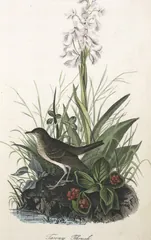
John James Audubon, The Birds of America (1840–44) 13 Veeryabout 23 per routeon 61% of routesrising since 2015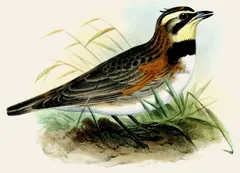
Joseph Wolf, Proceedings of the Zoological Society of London (1855) 14 Horned Larkabout 23 per routeon 58% of routesno clear trend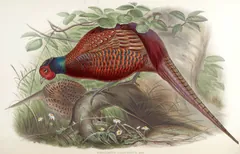
Joseph Wolf and Henry Constantine Richter, in John Gould's The Birds of Asia, part XXI (1869) 15 Ring-necked Pheasantabout 22 per routeon 54% of routesrising since 2015introduced species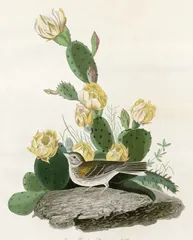
John James Audubon, The Birds of America (1827–38) 16 Vesper Sparrowabout 21 per routeon 63% of routesno clear trend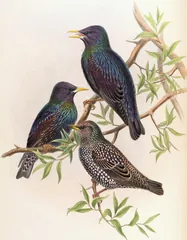
John Gould and Henry Constantine Richter, The Birds of Asia, vol. 5 (1850–83) 17 European Starlingabout 20 per routeon 79% of routesno clear trendintroduced species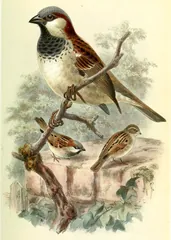
John Gerrard Keulemans, Lord Lilford’s Coloured Figures of the Birds of the British Islands (1885–97) 18 House Sparrowabout 20 per routeon 73% of routesno clear trendintroduced species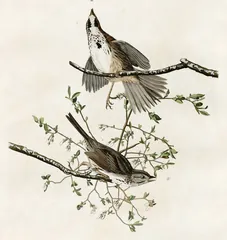
John James Audubon, The Birds of America (1827–38) 19 Song Sparrowabout 20 per routeon 100% of routesfalling since 2015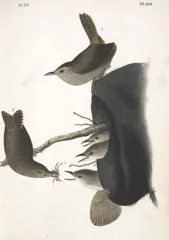
John James Audubon, The Birds of America (1840–44) 20 Northern House Wrenabout 20 per routeon 89% of routesno clear trend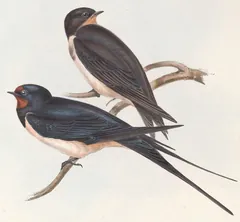
John and Elizabeth Gould, The Birds of Europe (1832–37) 21 Barn Swallowabout 18 per routeon 83% of routesno clear trend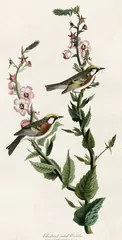
John James Audubon, The Birds of America (1827–38) 22 Chestnut-sided Warblerabout 13 per routeon 56% of routesrising since 2015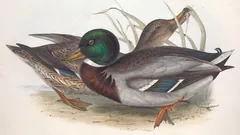
John and Elizabeth Gould, The Birds of Europe (1832–37) 23 Mallardabout 12 per routeon 90% of routesno clear trend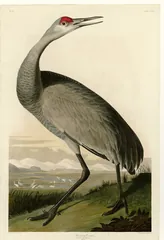
John James Audubon, The Birds of America (1827–38) about 12 per routeon 58% of routesno clear trend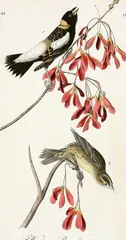
John James Audubon, The Birds of America (1840–44) 25 Bobolinkabout 11 per routeon 72% of routesno clear trend
These 25, led by the Cliff Swallow and the Canada Goose, are a small part of the 454 species on Minnesota’s official list; to name the rest, our comparison of the best bird books of 2026 shows which field guide suits a beginner.
What is the most common bird in Minnesota?
The Cliff Swallow leads Minnesota’s summer survey: about 275 a route on average in 2021–2025, ahead of the Canada Goose at about 151, seen on 69% of the 71 routes. USGS finds no clear rise or fall in its Minnesota numbers since 2015.
In winter it's the Canada Goose: on the Christmas Bird Count of 2023-24, Canada Geese and Mallards were the state's two most abundant species, with 108,500 geese and 37,050 Mallards, and the Rock Pigeon came fourth.
The American Robin was the species reported most often in the Minnesota Breeding Bird Atlas, ahead of the Common Yellowthroat, the Red-winged Blackbird and the Song Sparrow. By the atlas's own estimates, though, the yellowthroat is far more numerous: about 14.7 million breeding adults, against about 3.5 million robins.
Sources: The 124th Christmas Bird Count in Minnesota (National Audubon Society, December 3, 2024); American Robin (Minnesota Breeding Bird Atlas); Song Sparrow (Minnesota Breeding Bird Atlas); Common Yellowthroat (Minnesota Breeding Bird Atlas), read October 10, 2026.
How was this list made?
Each of Minnesota’s 71 routes is a roadside count, 50 stops along about 25 miles, run once a year in early summer by a volunteer. We took USGS’s yearly estimate for each species in Minnesota, the number of birds a typical route records, averaged it over the five latest survey years (there was no survey in 2020) and ranked the birds by it. To keep the list to birds you’re likely to meet across Minnesota, we left out species recorded on fewer than one in five of its routes, and those USGS can only estimate very roughly, which usually means big flocks or colonies on a few routes.
For Minnesota that left out the American White Pelican.
The share of routes is our own count from USGS’s route data for Minnesota, using only counts that met the survey’s standards; “rising” and “falling” are USGS’s trends for the state since 2015, named only where it finds a clear change. Roadside counts on early-summer mornings miss most of Minnesota’s owls and waterbirds, and its winter visitors aren’t here at all.
Minnesota’s counts come from two USGS data releases, the North American Breeding Bird Survey Analysis Results 1966–2025 (Hostetler et al., 2026) and its Dataset 1966–2025 (Ziolkowski et al., 2026), gathered by volunteer observers and free for anyone to use; Birdfolio isn’t connected with the USGS.
How many bird species are in Minnesota?
| Official count | 454 species |
|---|---|
| List’s date | Not given on the Minnesota list (we read it on October 3, 2026) |
| Kept by | Minnesota Ornithologists' Union Records Committee |
| Rare visitors | 48 casual and 88 accidental species (2024 checklist) |
| Nesting species | 269 with at least one confirmed breeding record (2024 checklist) |
| Records committee since | 1974 |
| Among US states | Tied for 29th highest of the 49 states with a verified count, alongside Connecticut |
| Official list | Current List of 454 Minnesota Birds (MOURC) |
What does Minnesota’s count include?
- Every species documented in Minnesota at least once.
- Not a nesting list: visitors and rare strays count as well as the birds that breed in the state.
- The extinct Passenger Pigeon, whose last Minnesota specimen dates from 1895, and two species the committee's 2024 checklist calls extirpated: the Eskimo Curlew and the Northern Bobwhite.
- Birds introduced by people that now live wild, among them the Ring-necked Pheasant, Gray Partridge and European Starling.
Why do other sources give a different number?
Minnesota's committee prints a full annotated checklist about every five years and keeps a plain list of names in between, so which total you meet depends on which one you read:
- 453. The committee's list of names as the Internet Archive saved it on November 22, 2025. By the Archive's copy of March 8, 2026 it had grown to 454 with the Black Phoebe (our comparison of the two copies). Source: Current List of 453 Minnesota Birds (Minnesota Ornithologists' Union Records Committee), the Internet Archive's copy of November 22, 2025.
- 452. The annotated Checklist of the Birds of Minnesota (October 2024), counting records through December 31, 2023: 313 regular species, 48 casual, 88 accidental, 2 extirpated and 1 extinct. Nine species were added after the 2019 edition, and the Hoary Redpoll was dropped in 2024 when it was merged into the Redpoll. Source: Checklist of the Birds of Minnesota, October 2024 (Minnesota Ornithologists' Union Records Committee), the Internet Archive's copy of October 20, 2024.
- 444. The 2019 edition, with records through December 31, 2018. Back then 41 species were casual and 87 accidental. Source: Checklist of the Birds of Minnesota, 2019 (Minnesota Ornithologists' Union Records Committee), the Internet Archive's copy of June 26, 2024.
Minnesota’s list follows its own committee’s rules, and so does every other state’s: see why the counts differ from state to state.
Minnesota firsts, invasions and late arrivals
- On May 4, 2024, a Black Rosy-Finch stopped briefly at a feeder in Silver Bay, Lake County, long enough for the homeowner to take diagnostic photos. The committee accepted it as Minnesota's first by 9 votes to 1 and judged that it probably came on its own: only the second stray of its kind the committee knew of east of the Rocky Mountains, after one in Missouri in 1989. Source: Proceedings of the Minnesota Ornithologists' Union Records Committee, Fall 2024 (The Loon), the Internet Archive's copy of April 25, 2026, read October 5, 2026.
- The Black Phoebe is back. Minnesota's only earlier one, a fall sight record from 1952, was deleted from the list in 2003; the species reappears on the committee's list between the Internet Archive's copies of November 2025 and March 2026 (our comparison). Sources: Checklist of the Birds of Minnesota, October 2024 (Minnesota Ornithologists' Union Records Committee), the Internet Archive's copy of October 20, 2024; Current List of 453 Minnesota Birds (Minnesota Ornithologists' Union Records Committee), the Internet Archive's copy of November 22, 2025; Current List of 454 Minnesota Birds (Minnesota Ornithologists' Union Records Committee), the Internet Archive's copy of March 8, 2026, read October 5, 2026.
- More than 200 Willow Ptarmigan invaded Minnesota in the winter and spring of 1933-34. The 2024 checklist knows only two other records of the species, one in spring 1914 and one in the winter and spring of 1964. Source: Checklist of the Birds of Minnesota, October 2024 (Minnesota Ornithologists' Union Records Committee), the Internet Archive's copy of October 20, 2024, read October 5, 2026.
- Some firsts wait decades for a vote. The Common Black Hawk joined the list after the 2019 checklist, on a record from Beltrami County dated September 18, 1976. Source: Checklist of the Birds of Minnesota, October 2024 (Minnesota Ornithologists' Union Records Committee), the Internet Archive's copy of October 20, 2024, read October 5, 2026.
- 2022 alone brought four new species: an Abert's Towhee in Itasca County on June 18, a Broad-billed Hummingbird in Sherburne County on July 23, a Brown Booby in Winona County on August 15 and a Phainopepla in St. Louis County on October 29. Source: Checklist of the Birds of Minnesota, October 2024 (Minnesota Ornithologists' Union Records Committee), the Internet Archive's copy of October 20, 2024, read October 5, 2026.
Questions people ask about Minnesota’s birds
What is the rarest bird in Minnesota?
No one bird holds the title, but state rules list nine birds as endangered in Minnesota: Baird's Sparrow, Henslow's Sparrow, Sprague's Pipit, the Burrowing Owl, the Chestnut-collared Longspur, the Piping Plover, the Loggerhead Shrike, the Horned Grebe and the King Rail. The Chestnut-collared Longspur, endangered in the state since 1984, now summers only in Clay County, with less than 1 percent of Minnesota's native prairie left.
Sources: Minnesota Rules 6134.0200, Animal species: endangered, threatened and special concern (Office of the Revisor of Statutes, Minnesota Legislature); Chestnut-collared Longspur (Minnesota Breeding Bird Atlas), read October 10, 2026.
What are common birds in Minnesota?
At winter feeders, chickadees and cardinals, which the state's natural resources department calls permanent residents, dependable every year, along with the Blue Jays, finches, nuthatches and grosbeaks that come for sunflower seed and the juncos, Mourning Doves and sparrows that eat millet on the ground. On the 2023-24 Christmas Bird Count, a record 91 counts, Blue Jays and Black-capped Chickadees turned up on every one, the jays in a record number, 10,837, and Northern Cardinals on 80 percent of them.
Sources: Winter bird feeding tips (Minnesota Department of Natural Resources), the Internet Archive's copy of March 13, 2026; The 124th Christmas Bird Count in Minnesota (National Audubon Society, December 3, 2024), read October 10, 2026.
What US state has the most bird species?
California, with 696 species on its official checklist (September 8, 2026), is followed by Texas with 682 (our table), while Minnesota's records committee counts 454, about two-thirds of California's total (our arithmetic).
Sources: Official California Checklist, updated 8 September 2026 (California Bird Records Committee); Current List of 454 Minnesota Birds (Minnesota Ornithologists' Union Records Committee), the Internet Archive's copy of March 8, 2026, read October 10, 2026.
Which birds live in Minnesota?
Water birds of the lakes, northern birds of the bogs and conifer forests, prairie birds in the west and southern songbirds in the river valleys of the southeast. The best known is the Common Loon, the state bird since 1961: Minnesota has the largest breeding population of loons in the US south of Alaska.
Lakes and rivers: Minnesota is the only state where Breeding Bird Survey counters average a little more than one loon per route each year. The American White Pelican, all but gone from the state in the early 1900s, was proven to nest here again only in 1968; statewide counts in 2011 found 22,506 nests, and the colony at Marsh Lake, on the upper Minnesota River, is among the largest in North America.
Northern bogs: Sax-Zim Bog, about 40 miles northwest of Duluth, is famous for its wintering Great Gray Owls, up to 100 in the winter of 2004-05, and its black spruce and tamarack bogs are nesting places for the Great Gray Owl, Black-backed Woodpecker, Boreal Chickadee and Connecticut Warbler. The Agassiz Lowlands hold some of the densest populations in North America of the Connecticut Warbler, one of the rarest warblers of the northern forest.
Prairie: the Greater Prairie-Chicken, whose range once covered nearly 92 percent of the state, now survives mainly in the northwest, and northwestern Minnesota is also a center for the Marbled Godwit, which keeps to the largest and best prairies left.
Southeast river valleys: the Cerulean Warbler nests on wooded slopes along small streams and in the floodplain forests of the Mississippi and Minnesota rivers, and the Louisiana Waterthrush reaches the northwestern edge of its range along the Mississippi, Minnesota and St. Croix valleys.
Sources: Common Loon (Minnesota Breeding Bird Atlas); American White Pelican (Minnesota Breeding Bird Atlas); About Friends of Sax-Zim Bog (Friends of Sax-Zim Bog); Connecticut Warbler (Minnesota Breeding Bird Atlas); Greater Prairie-Chicken (Minnesota Breeding Bird Atlas); Marbled Godwit (Minnesota Breeding Bird Atlas); Cerulean Warbler (Minnesota Breeding Bird Atlas); Louisiana Waterthrush (Minnesota Breeding Bird Atlas), read October 10, 2026.
How many hawks fly past Duluth's Hawk Ridge?
More than 100,000 on the best day on record. Most raptors avoid crossing big water, says Hawk Ridge Bird Observatory, so in fall the birds that meet Lake Superior turn southwest along its shore and stream past the bluffs above East Duluth, often at or below eye level. On September 15, 2003, the counters logged 101,698 Broad-winged Hawks, in a season that brought 160,703 of them. From 1991 to 2013 the fall count averaged 76,000 raptors.
Before 1950 the only people watching that flight were gunners using the hawks for target practice, until the Duluth Bird Club, now Duluth Audubon Society, got the city's shooting ban enforced. Volunteers began a weekend count in 1951; consistent coverage of the peak, early September to early November, started in 1972, the year Duluth Audubon helped the city buy the top of the ridge, and since 1991 the count has run from mid-August to late November. Fall 2025 brought 41,886 raptors, a record season for Merlins, the lowest Broad-winged Hawk season on record after fog hid the peak, and a state high count of 15,280 Blue Jays on September 10.
Sources: About the Migration (Hawk Ridge Bird Observatory); Migration Statistics (Hawk Ridge Bird Observatory); Mission and History (Hawk Ridge Bird Observatory); Bird Monitoring (Hawk Ridge Bird Observatory); Hawk Ridge Bird Observatory 2025 Fall Count Summary (Hawk Ridge Bird Observatory), read October 5, 2026.
How did Trumpeter Swans come back to Minnesota?
As eggs, flown in. Hunted for meat, skins and feathers, trumpeters were gone from Minnesota by the 1880s, and in the 1930s only 69 were left in the lower 48 states, at Red Rock Lakes in Montana. In the 1960s the Hennepin County Park Reserve District, now Three Rivers Park District, started a breeding flock with 40 swans from Red Rock Lakes. In 1982 the state's Nongame Wildlife Program, funded by a checkoff on Minnesotans' tax forms, joined in.
In June 1986 the program's supervisor and a volunteer, flown by a US Fish and Wildlife Service pilot, collected 50 eggs from 16 nests in one long day on the Minto Flats west of Fairbanks, Alaska, then flew home with the egg suitcases in the first-class overhead bins, refilling their hot-water bottles every two hours from the plane's coffeemaker. The eggs went into incubators at Carlos Avery Wildlife Management Area. Since the first releases in 1987 the program has set free more than 350 swans, and a 2022 survey put Minnesota's population at about 51,860. The committee's checklist counts the Trumpeter Swan as a regular Minnesota bird again, reintroduced and breeding throughout the state.
Sources: Trumpeter swan restoration project (Minnesota Department of Natural Resources), the Internet Archive's copy of June 15, 2026; Visions of Swans (Minnesota Conservation Volunteer, March-April 2017; Minnesota Department of Natural Resources), the Internet Archive's copy of May 21, 2026; Checklist of the Birds of Minnesota, October 2024 (Minnesota Ornithologists' Union Records Committee), the Internet Archive's copy of October 20, 2024, read October 5, 2026.
Do Whooping Cranes still pass through Minnesota?
Rarely. The committee's 2024 checklist calls the Whooping Crane a former summer resident of western Minnesota with ten records since 1900, and it counts only strays from the wild flock that nests in northwestern Canada.
The recent ones fit that rule. A crane at Agassiz National Wildlife Refuge on September 12, 2023, was accepted once the committee, consulting the US Fish and Wildlife Service, decided early September suits birds leaving Wood Buffalo National Park. Two stayed northwest of Rothsay in Wilkin County from October 5 to November 11, 2024; one wore a band showing it belonged to the Wood Buffalo flock, which winters in Texas, and had left Wood Buffalo on October 1. In its spring 2025 proceedings the committee also accepted a crane with a GPS transmitter that had stopped at Daubs Lake Wildlife Management Area in Redwood County on November 8, 2013.
Sources: Checklist of the Birds of Minnesota, October 2024 (Minnesota Ornithologists' Union Records Committee), the Internet Archive's copy of October 20, 2024; Proceedings of the Minnesota Ornithologists' Union Records Committee, Fall 2024 (The Loon), the Internet Archive's copy of April 25, 2026; Proceedings of the Minnesota Ornithologists' Union Records Committee, Spring 2025 (The Loon 97), the Internet Archive's copy of April 25, 2026, read October 5, 2026.
Where is the official Minnesota bird list, and how often is it updated?
The current list is a plain page of names on the Minnesota Ornithologists' Union's website, which the union's records committee updates as it accepts new species. About every five years the committee also publishes the annotated Checklist of the Birds of Minnesota. The October 2024 edition sorts each species by how many of the ten years 2014-2023 had accepted records: regular for nine or ten, casual for three to eight, accidental for two or fewer. The next edition is planned around the ten years 2019-2028.
The committee, a standing committee of the union since 1974, has seven regular members and three alternates. Records of regular and casual species pass at 7-0, 6-1 or 5-2, accidental ones at 7-0 or 6-1; a potential first state record waits for discussion at a meeting and needs 10-0 or 9-1, with the alternates voting too. A summary of every vote appears twice a year in The Loon, the union's journal, and the records go to the union's archive at Carpenter Nature Center in Hastings. The union itself dates from 1929.
Sources: Current List of 454 Minnesota Birds (Minnesota Ornithologists' Union Records Committee), the Internet Archive's copy of March 8, 2026; Checklist of the Birds of Minnesota, October 2024 (Minnesota Ornithologists' Union Records Committee), the Internet Archive's copy of October 20, 2024; Minnesota Ornithologists' Union Records Committee, home page, the Internet Archive's copy of April 25, 2026; Minnesota Ornithologists' Union, home page, read October 5, 2026.
How do you count your own Minnesota list?
Your Minnesota list is every species you’ve seen in Minnesota. eBird can filter your life list to Minnesota, and your eBird data download gives the state of every sighting. On paper, count the species you’ve seen in Minnesota; what is a life list? explains how birders keep their lists.
To print your whole list, Minnesota birds and all, see how to print your bird life list, or let Birdfolio make it a hardcover book.
Minnesota’s state bird
Minnesota’s state bird is the Common Loon (officially, the “loon”), the state bird since 1961. Its story, the state flower and animal, and a free picture card for a report are on our Minnesota state bird page.
Birding festivals in Minnesota
Our birding festivals calendar lists 6 in Minnesota, with dates from each festival’s own website:
- International Festival of Owls, Houston: March 5–7, 2027
- Hastings Area Earth Day Birding Festival, Hastings: dates not announced yet; expected in April 2027 (2026 festival: April 25, 2026)
- Detroit Lakes Festival of Birds, Detroit Lakes: May 20–22, 2027
- Northern Landscapes Festival, Grand Marais: May 28–30, 2027
- Loons and Lakes Festival, Crosslake: dates not announced yet; expected in June 2027 (2026 festival: June 26–27, 2026)
- Hawk Weekend Festival, Duluth: dates not announced yet; expected in September 2027 (2026 festival: September 18–20, 2026)
Christmas Bird Count in Minnesota
Minnesota had 87 Christmas Bird Count circles on Audubon’s map last winter, each counted on a single day between December 14 and January 5. Our guide shows where to find Minnesota’s counts and lists 53 Minnesota count dates already announced for this winter; it’s free, and beginners are welcome.
More about bird counts
- How many bird species are in each state: Minnesota beside all 50 states, DC and Canada.
- Bird lists of nearby states: Iowa, Michigan, North Dakota, South Dakota and Wisconsin.
- State birds of all 50 states, Minnesota’s Common Loon among them
- How many bird species are in the US and Canada
- Bird splits and lumps
If you’re shopping for a birder in Minnesota, our gift guide for birders and our pick of coffee table bird books are good places to start.